The British Prime Minister  has, it is reported, described political opponents who do not agree with his proposal to extend our involvement in the Syrian conflict as “terrorist sympathisers”.

I am not alone in being both shocked and angry.

I am not a terrorist sympathiser.  I have read, carefully, the cases that he and others have made, for and against the action he proposes. I am not convinced by his arguments, This makes me, I believe, a citizen with an informed viewpoint – not a terrorist sympathiser.


Posted on by memoirsofahusk | 17 Comments

Jesus weeps. The Pope, Christmas, war – and lemon myrtle soap

The pope gave a sermon last month which was widely reported. It was timely. The western world was turning its thoughts to the annual winter ritual of overspending and over-eating. No surprise, then, that the resulting headlines all seemed to focus on the ‘charade’ of Christmas.

I looked up the sermon but couldn’t see where – or if – Pope Francis used that word. Many other words, though, were worthy of headlines. More worthy. Especially now, as Britain decides whether to support France, our neighbour and ally, in bombing Syria.

What the Pope actually said about Christmas was this:

“Today Jesus weeps … because we have chosen the way of war, the way of hatred, the way of enmities. We are close to Christmas: there will be lights, there will be parties, bright trees, even Nativity scenes – all decked out – while the world continues to wage war. The world has not understood the way of peace.”

He had more to say about war and peace, but before we get to that – a glance at Christmas, in passing.

I saw some research recently that suggested British families expect to spend, on average, around £800 celebrating Christmas in 2015. And to do so, many families will go into debt – in 2014 the UK topped the European Christmas-induced-debt league table.

Fine – if that makes you happy. But I suspect it doesn’t. And that’s just one reason why I’d agree that Christmas is, indeed, a charade.

But there’s more to this charade than hopes raised and dashed, than parents plunged into self-inflicted debt and children dissatisfied with even the wildest largesse.

Especially this year.

Especially here, in Europe.

I’m afraid there’s much to be miserable about at the moment.

The weather is vile. Dank skies and squelching gardens. Pelting rain and roaring winds. Grey flagstones and sodden raincoats.

Friends and acquaintances brim-full with sadness, rooted in reasons more serious than mere weather.

Libraries closing, children’s centres closing, police stations closing.

Cars by the side of the road with handwritten signs buckling in the window: ‘For Sale’.

Our economy supposedly growing, but foodbanks busier than ever.

More homeless people on our streets.

Updates from our local soup kitchen make desperate reading – which young, vulnerable person has died from lack of care lately?

Terrorism stalks the world. In Paris, Nigeria, Egypt, Beirut, Tunisia – too many places to list.

Waves of refugees are washing up – some half dead, some wholly dead – on the beautiful shores of the Mediterranean. More camp in squalor twenty odd miles across the sea, in France.

And our government wants to start bombing Syria.

At this point, then, let’s return to what the Pope said.

“Everywhere there is war today, there is hatred.
What shall remain in the wake of this war …?
Ruins, thousands of children without education, so many innocent victims:
and lots of money in the pockets of arms dealers.”

The situation in the Middle East is far too complicated for a blog post of a few hundred words. But anyone who reads any analysis knows that we’re already playing, as a nation, a complicated cat’s cradle of peace and war.

Our arms industries sell to regimes like Saudi Arabia. Saudi Arabian interests fund extremist supposedly-Islamic groups.

Our government once wanted to take us to war against the Assad regime in Syria. Now it wants us to go to war with those who would keep it in power.

Because ‘we’ want to support our allies in the wake of the Paris atrocities.

Surely even a fool can see this is madness?

Precision bombing?

‘Oops, we accidentally bombed a hospital’, admit our American allies.

Today, in the ‘Independent’, a letter from Dr David Lowry of the Institute for Resource and Security Studies, Cambridge, Mass, cited a report on the US bombing, during the Vietnam War, of Ben Tre city. It was 7 February 1968. Associated Press correspondent, Peter Arnett, reported:

“ ‘It became necessary to destroy the town to save it’, a United States major said today. He was talking about the decision by allied commanders to bomb and shell the town regardless of civilian casualties, to rout the Vietcong.”

Dr Lowry fears the same fate awaits Syrian civilians in Isis strongholds.

I can’t say that emulating anything that happened during the Vietnam War sounds like a good idea to me.

And bombing in Syria and Iraq hasn’t exactly worked so far.

So, why do it?

Here’s Pope Francis again:

“War is the right choice for him who would serve wealth: ‘Let us build weapons so that the economy will right itself somewhat, and let us go forward in pursuit of our interests …’ The men who make war are cursed, they are criminals. A war can be justified – so to speak – with many, many reasons, but when all the world as it is today, is at war – piecemeal though that war may be … God weeps. Jesus weeps.”

Now before you have a go at me about Christianity and war – I know. Christianity has no proud history in warfare. I studied the Crusades as my special subject at university.

But we have, I hope, learned our lessons – at least, some of us have. There are, sadly, supposedly-Christian extremists just as there are supposedly-Islamic extremists.

I do not believe we should commit further to a ‘war’ that we cannot win, cannot fully understand and whose ‘planned’ outcome seems like the equivalent of sticking a tail on a donkey while blindfold.

It’s easy to feel dejected by all the misery stalking the world.

It’s tempting to go back to bed and hide under the covers with a good book till it’s all over.

Yet I’m sitting at my desk, feeling like there’s hope in the world.

I unwrapped a bar of special soap this morning and had a long, hot bath – what a luxury.

The soap came all the way from Australia. From a kind and thoughtful person (I know this, despite the fact we’ve never met) who reads my blog and whose blog I read.

The uplifting scent of that lemon-myrtle-goat’s-milk- soap changed my mood in an instant.

Thank you, Elladee, for brightening my day. Despite everything.

And in that new, brighter spirit, I’d like to give the final words to radical poet and playwright, Adrian Mitchell:

adrian mitchell poem


Posted in Thinking, or ranting, or both | Tagged , , , , , , , , , , | 15 Comments

Of Rats and Men. Of Cabaret, Camus – and Ben

It’s a risk you take when you marry an academic – having worrying conversations over dinner.

I married an anthropologist. But it doesn’t really matter what his discipline is, as far as chit-chat is concerned. Because his daily toil exposes him to such a range of interesting research that you never know what the day’s topic will be.

For example, animal behaviourism.

The other night I cooked a mild, fruity chicken curry. I finished mine well before the anthropologist. He was too busy talking to eat.

A presentation that afternoon, on rat research, had made a deep impression.

The rats, he explained, were being put through various exercises, involving food, to explore their willingness to share and cooperate.

The rodents soon learned that they could obtain more food, not just for themselves, but also for their ratty friends, by pulling a lever. So they did. Cooperative behaviour was displayed.

In the first exercise the rats could all see each other.

The next step was to put up barriers so they couldn’t see each other but could hear and smell each other. And yes, they still helped each other feed their ratty faces.

Next, they circulated the air so they couldn’t smell each other.

Tan-tan-tara!

The rats stopped cooperating.

At this point I was plainly supposed to say, ‘hmmm, that’s interesting’. Which I did. Then I added, ‘did the air being sucked out make a lot of noise?’

But what I should have asked – and what, because of the title, some of you might be asking – is, were the rats representative of both genders?

And the triumphant response would have been: no!

They were all female.

The next step, therefore, was to start testing male rats.

Well. Guess what?

Male rats are selfish.

Male rats don’t seem to want or need allies.

I suppose I wasn’t surprised but the thought began to worry me.

Because rodents – mostly it’s mice and rats – react like humans in many, many ways. Which is why they are so widely used for research.

If you follow the logic, then, this male rat behaviour might suggest that men don’t feel the need for networks of cooperation. For friends even.

Our dinner table discussion moved on to more familiar anthropological ground. With worrying examples of how in societies, as they become larger – too large for hunter-gather style group scrutiny to work – males can become more individualistic, uncooperative and … aggressive.

And yesterday, as I thought further about this analogy between rats and men some unwelcome images came to mind.

As if on cue a sinister cartoon appeared in one of our popular daily newspapers. A nasty portrayal of  refugees (some obviously Muslim) flooding into Europe, with rats scurrying between their feet.

The ‘Twittersphere’ went ballistic (yes, the military-industrial-complex reference is intentional).

Old copies of cartoons from Nazi era Germany were resurrected and pictured side-by-side with the new cartoon. A comment from a 1930s edition of the same paper was circulated, revealing that its xenophobic editorial attitudes had remained horribly consistent.

And I thought about a book I studied for a French exam at school: La Peste, (The Plague), by Albert Camus. A French book, set in France’s former colony, Algeria, written by a Frenchman born in Algeria.

The novel revolves around an epidemic of plague that invades the town of Oran in north Africa, carried by rats. It studies the effects of fear and isolation – quarantine – on the community.

It could hardly be more relevant today.

Rats.

The foreigner, the other.

There seems to have been a perennial equation of rats with evil – with invasions, disease, disgust, fear, loathing.

But the images used in the cartoons depict hordes. And I thought back to the early findings of that research on male rats. They did not cooperate. Male rats did not, so to speak, need friends.

At which point, I’m afraid, a song popped into my head.

Do you remember a song called ‘Ben’ by Michael Jackson?

It’s a slushy, sentimental ballad and very, very odd.

I suspect I’m not the only one who wasn’t aware, on first hearing the song, that it was rat-related. Yes, the Ben to whom Jackson croons is a rat. A rat in a horror film.

Some of the words are quite unsettling.*

One line reminds me of a chilling moment in the film Cabaret, set in Germany in the last days of the Weimar Republic, as the Nazi party flexes its growing muscles. The creepy Emcee, played brilliantly by Joel Grey, stage-whispers about his gorilla girlfriend, ‘she doesn’t look Jewish at all’.

I’m mortified to admit that when I first saw the film I missed that line completely. Though, of course, the film stood without it. But now, as I think about it, it sends a shiver down my spine. Because, while it is always relevant, people forget. And now, we would do well to remember.

Among the anxious Western Europeans worrying about terrorists, some would have us believe ‘Muslims’ are all something other, something not like us.

That cartoon with the rats may have been intended to awaken those historical fears in a good way. To remind us that fear makes us do bad things. Or simply to associate evil terrorists with rats. I hope so.

But some will not see it that way. And it’s frightening to see the extremes to which some people will go.

Refugees are people.

Muslims are people.

We are one race, all of us, all people.

And, yes, there will always be bad people.

But if we isolate ourselves, like those rats in that experiment, it becomes only too easy to ignore others. To believe they are different. Even to envisage – or desire – the extermination of the other. Like rats.

I’m a lousy historian, but there are some lessons I never will forget.


*Read the lyrics here: http://www.metrolyrics.com/ben-lyrics-michael-jackson.html or listen to a poignant Oscars performance by Michael Jackson here: https://www.youtube.com/watch?v=T1dAQN5QcZU

Posted in Thinking, or ranting, or both, Uncategorized | Tagged , , , , , , , , , , | 12 Comments

The Lady in the Van meets a surfeit of anoraks

There’s something disturbing about modern cinemas, y’know.

Have you tried shedding a surreptitious tear in one?

It’s light enough to see, that’s the problem. Yes, you can find your seat without crippling half the audience – or yourself – in the process, but the intimacy of the dark – it is no more.

I sort of imagined that, what with the crowd being predominantly beyond middle aged and more than 50% female, a few other folks might be blubbing, but no. So I held my breath and dabbed as unobtrusively as I could at the tears.

I was terrified I might actually sob.

But I was brave. I coped.

I loved the film. Maggie Smith is superb. But I was also skewered by the twin Alan Bennetts. A writer (Alan) and a person (Alan) living his life – or not, as author Alan jibed. Piercing as only self can pierce the self. (Well we are talking writers, here.)

I came out happier in an odd kind of way. Determined to finish my latest book (76,000 words now) and basking in the glow of a few kind words uttered by a few kind people over the years.

Yes, more than once my writing has been likened – I blush to say it – to that of Alan Bennett. And having seen the film, I shudder to think what would happen if a van turned up outside – I can just imagine …

And then, what would the neighbours think?

(Dear friend who’s contemplating buying a van and living in it – you know who you are. Please, don’t paint it yellow, with a dish mop, if ever you plan to visit.)

But, seriously, I think what those people meant, when they said it, was that I notice what ordinary people do in ordinary situations. I notice ordinary things happening.

And I suspect those people are also the kind of people who smile a small smile at the mention of Alan Bennett’s name – and categorise him as gentle. The kind of author one sets alongside tea and a toasted teacake, in a genteel tea room in Harrogate, at half past three in the afternoon.

Well, if they do, the might try reading The Laying on of Hands. I found it at the bottom of a box when we moved and realised I hadn’t read it. Cosy? Forget the tea and teacake. A little vial of vinegar, perhaps?

And as for me. Well, my book is giving me nightmares. I mean that – the sleep-related kind.

Causing me to reassess a lot of things I’ve quashed in mental self-defence for many years.

Warfare, nuclear weapons, protest. The people we trust and the assumptions underpinning the world of the everyday.

And that’s why this post is short. And why there haven’t been so many just lately. I think I should get on with it.

If ever it makes it to film (I, who should know better, the optimistic pessimist, still live in hope), then I doubt if the audience will be composed, as Sunday’s was, almost entirely of elderly men and women wearing anoraks.

I mean, yes, it was raining. But anoraks? Some, even, matching?

And yet – I noticed something odd amid the rustle of showerproof zip-ups.

Red – solid red – has gone.

Where once every ramble was punctuated by visions of mature heads nodding a greeting above matching red anoraks, now they are navy blue, fawn, or black.

Me?

What was I wearing?

I, dear readers, was wearing my expensive, resorted-to-in-desperation, navy blue raincoat with distinctive white buttons.

Fortunately, the pockets were full of tissues. I could have passed spares around if needed.

But they weren’t.

I wonder why no-one else cried?

Alan Bennett, no doubt, would know.

Posted in Art, jaunts & going out | Tagged , , , , , , , , , | 4 Comments

Romantic ruins and inner visions

I’m elitist and snobby. Unadventurous. Uncultured.

And worse.

They’re just a few of the things I’ve been accused of being. No, not by trolls, nor disgruntled readers. This is some of my friends I’m talking about.

Why?

Because I’ve not seen ‘The Lord of the Rings’ films. Or ‘The Hobbit’ films.

And you know what? I never, ever will unless someone handcuffs me to a chair, tapes my eyes open and forces me. And then, trust me, I will sing ‘la la la’ throughout and forever hate him or her, whoever it is.

When I was very young I read – and loved – ‘The Hobbit’. A little older and I read ‘The Lord of the Rings’ for the first time. The first of many times. So many times my original copy (all the books in one volume) fell apart and I had to buy a new one.

But it is a bit of a Marmite thing, ‘The Lord of the Rings’. Someone I know (you know who you are) calls Marmite the Devil’s earwax. There are probably people who think ‘The Lord of the Rings’ is … well, best not go there, perhaps.

But, it seems either you either love it – or think it’s sad, silly and childish.

When I was eight ‘The Hobbit’ was deemed appropriate. A children’s book, read by a child.

By the time I reached my teens and became one of many fans of ‘The Lord of the Rings’, a bit of a backlash was beginning, notably in the USA where ‘Bored of the Rings’ took off in 1969.

Even way back then, some merchandise was circulating – though I only recall posters. I had one, of Shadowfax. Still have it. But a poster of a white horse and generic wizardy bloke wasn’t enough to spoil my inner vision.

You see, that’s why I won’t see the films.

The book – its characters and its settings, its rugged mountains, dwarves and elves and Ents – has taken root in my imagination. I have my own vision of Tolkien’s Middle Earth – I don’t want anyone else’s.

So when, on Sunday, in Cheshire, I hear:

‘Tom Bom, Jolly Tom, Tom Bombadillo!’

the jolly, lusty voice in my head is the voice I imagine. The bounding chap in yellow boots – who isn’t there, but could be – he’s the figure I imagine.

The biggest of the many trees around me are not just oaks but Ents – my image of Ents.

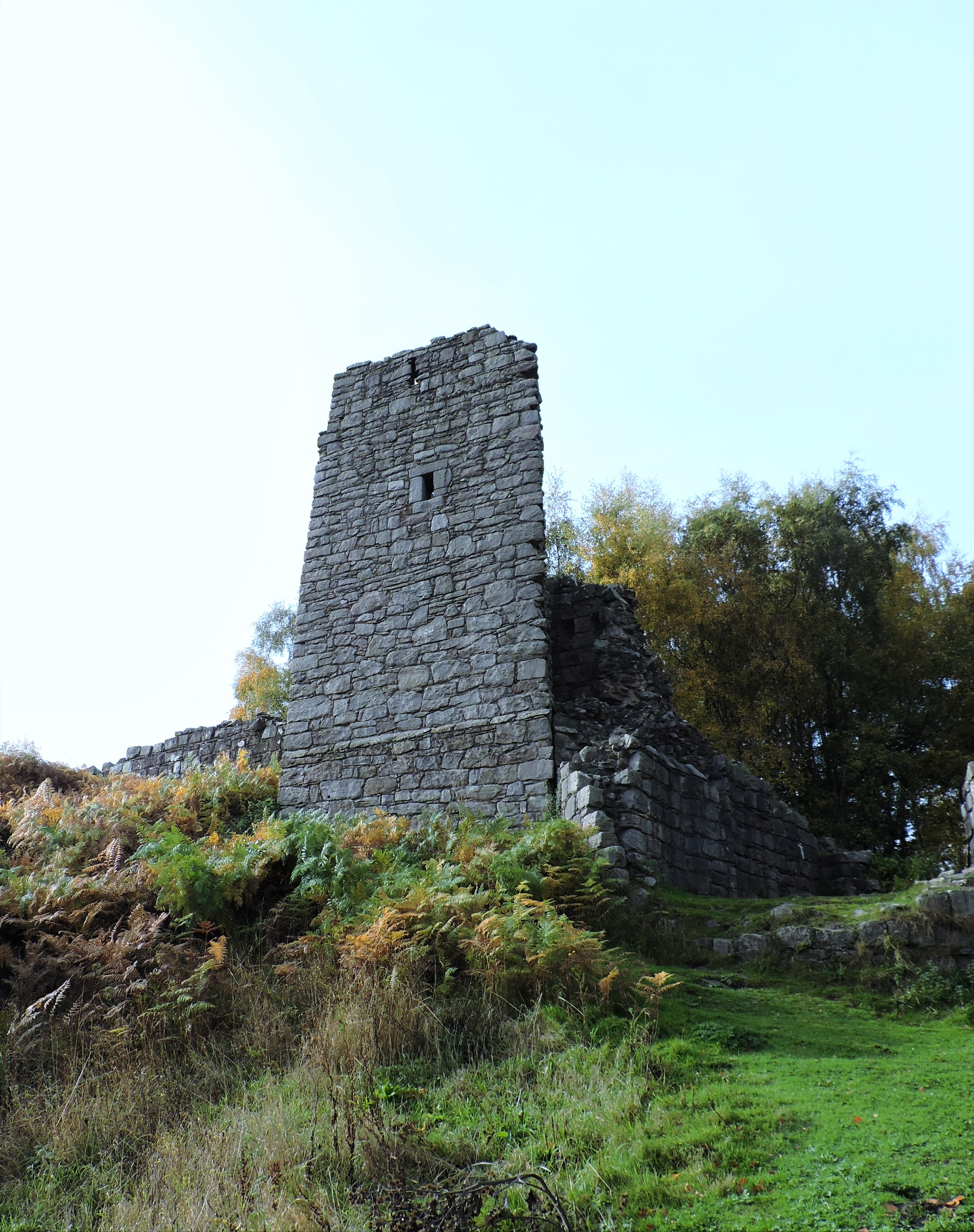
We’re walking in woods. They’re wrapped like a scarf around the base of a castle mound.

I’m captivated by the ancient oaks. I don’t even try to take a picture. It would be an intrusion. The real image could never be captured.

It’s as if the Ents are making ready to speak.

Hrrum.

Telling me their image is too slow, too old, too living to imprison in pixels and bytes.

I suppose it’s the castle making me feel all fairy tale and romantic. Ruins do that, don’t you find, when the weather is right? Misty, thundery, moonlit – or gorgeously autumnal, like today.

DSCN1112

Climbing up to Beeston Castle

Beneath the jagged castle’s beaten battlements lie remnants of Bronze and Iron Age settlements.

Humans have long lived here – you can sense it. The site feels deep, dense with once-lived moments – and still alive.

Teeming with natural life, if not – any longer – with humans. Except for tourists.

Part of a gatehouse

Part of a gatehouse


The castle was destroyed in our civil war. Parliamentarians versus Royalists, the interpretation boards call them – I knew them as Cavaliers and Roundheads.

Whatever their names, they fought each other, there was a siege, the building was ravaged – and who knows who really won in the long, long run. Except nature.

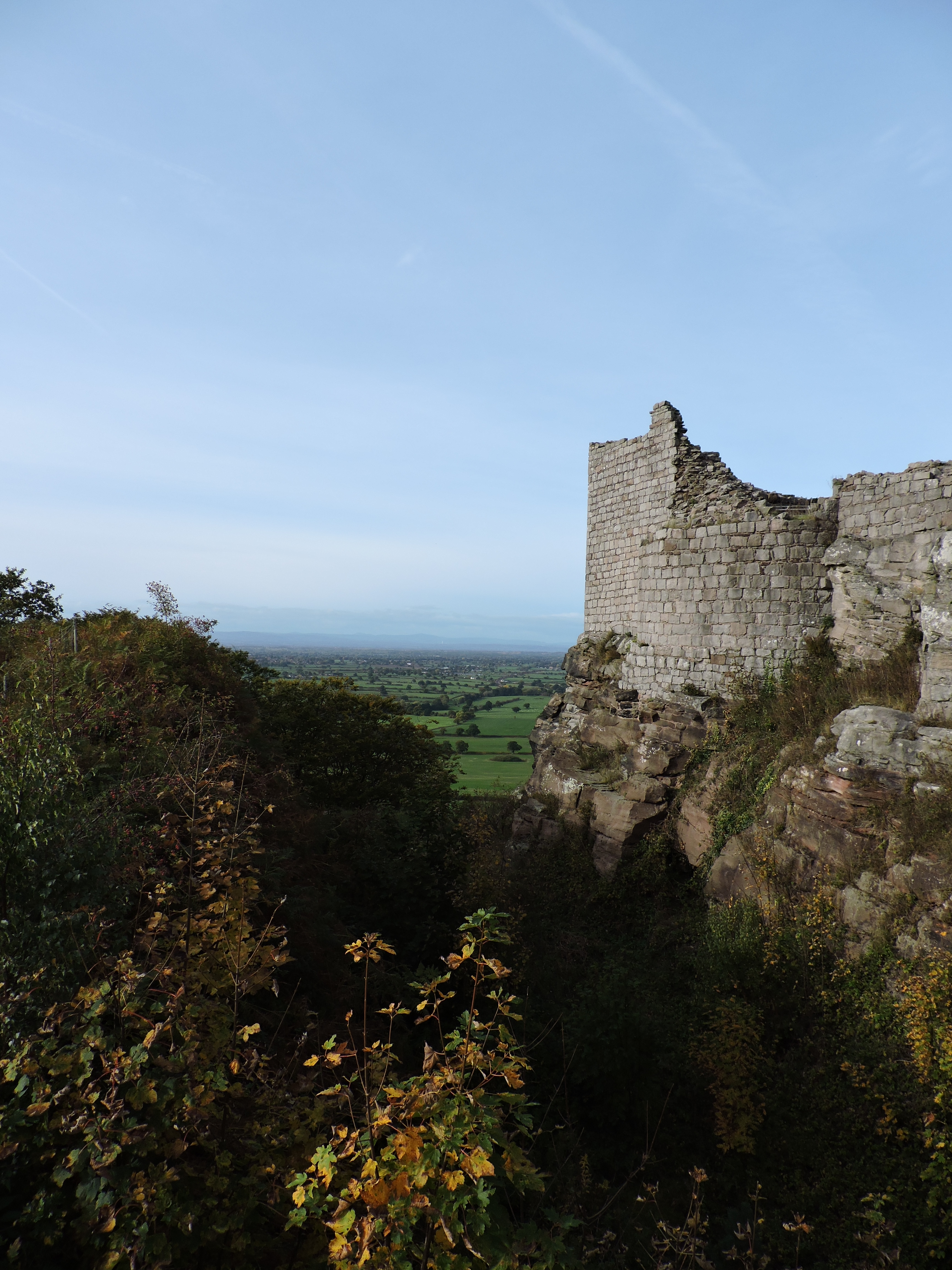
As befits a fortress, the climb up is fairly steep – but nothing compared with drop beneath the bridge that spans the gaping defensive ditch to the castle itself.

That ditch goes a long way down!

That ditch goes a long way down!

‘Sheer drop’ says the notice. No kidding. It’s terrifying.

Eyes straight ahead, hand clasping the cold metal rail, I try hard to think of something nice. Like lunch.

DSCN1124 (2)


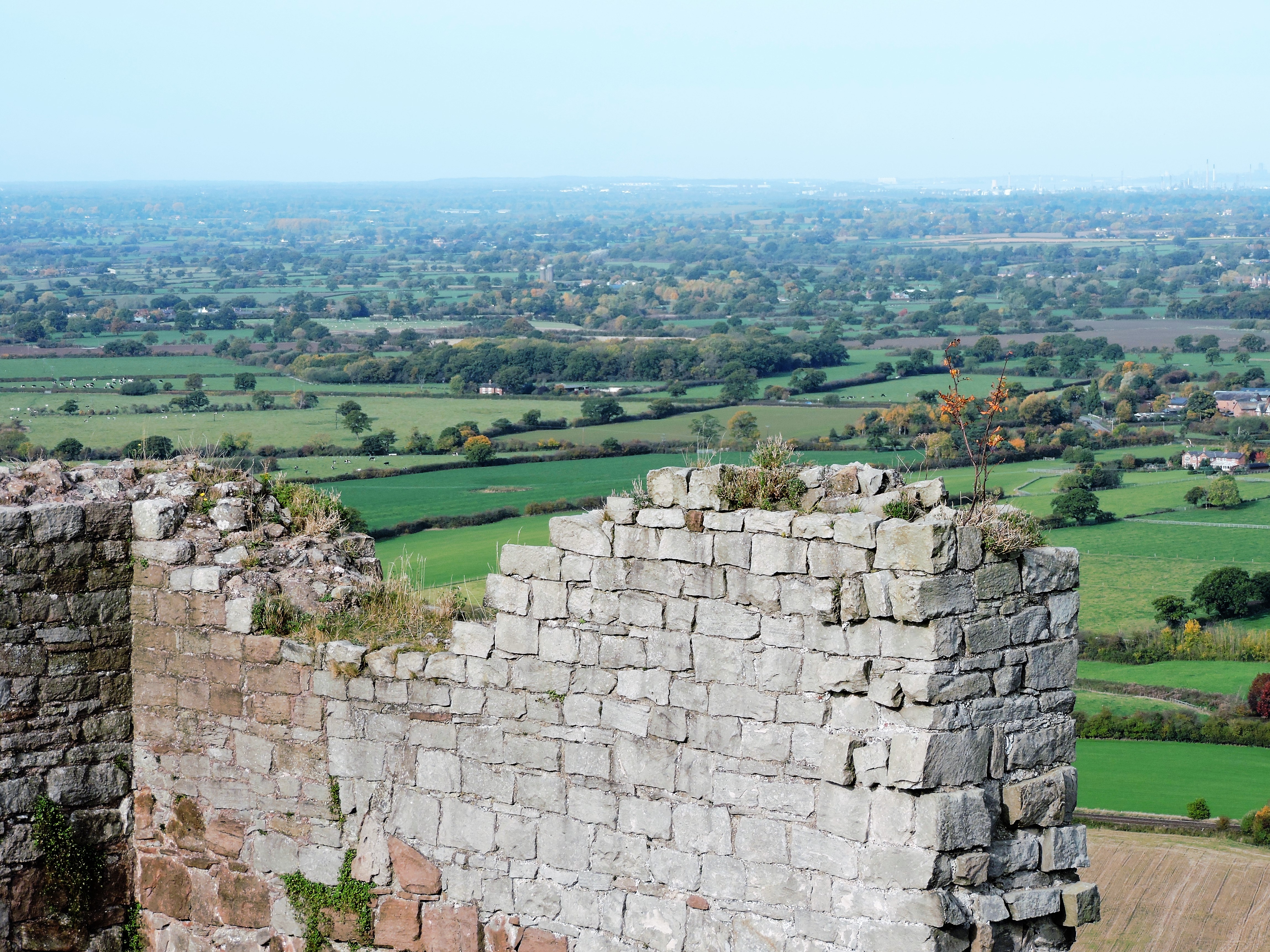
It’s worth the fear for the views.

A hazy day, but even so, there’s Liverpool, twenty two miles away and both cathedrals visible – just – to the naked eye.

There’s Jodrell Bank’s huge radio-telescope.

And there – the Welsh Mountains.DSCN1135

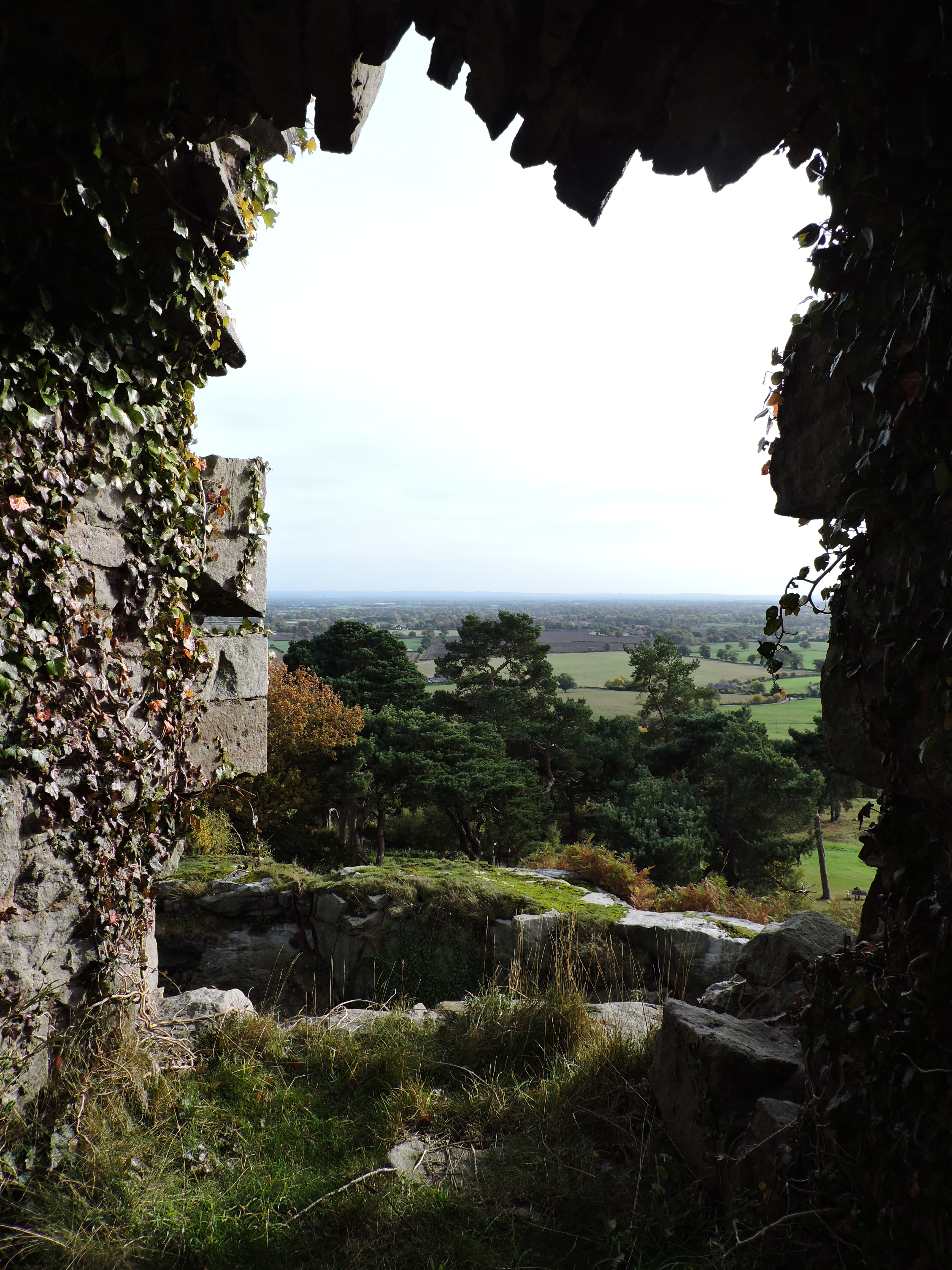
Vistas stretching in all directions.

A strategic location, close to a border – one of those invisible man-made lines on a map that tend to encourage conflict.

Dropping down, towards the base of the mound, the woods begin.

A strange, large black bird makes an odd call, impossible to describe. Then it clicks its beak, quickly, a sound like an expert knitter, plying metal needles.

Perhaps it isn’t a real bird. Perhaps it’s a witch’s familiar – or an emanation, a ghostly rara avis?

It’s this place. These woods. They’re enchanting, if not enchanted.

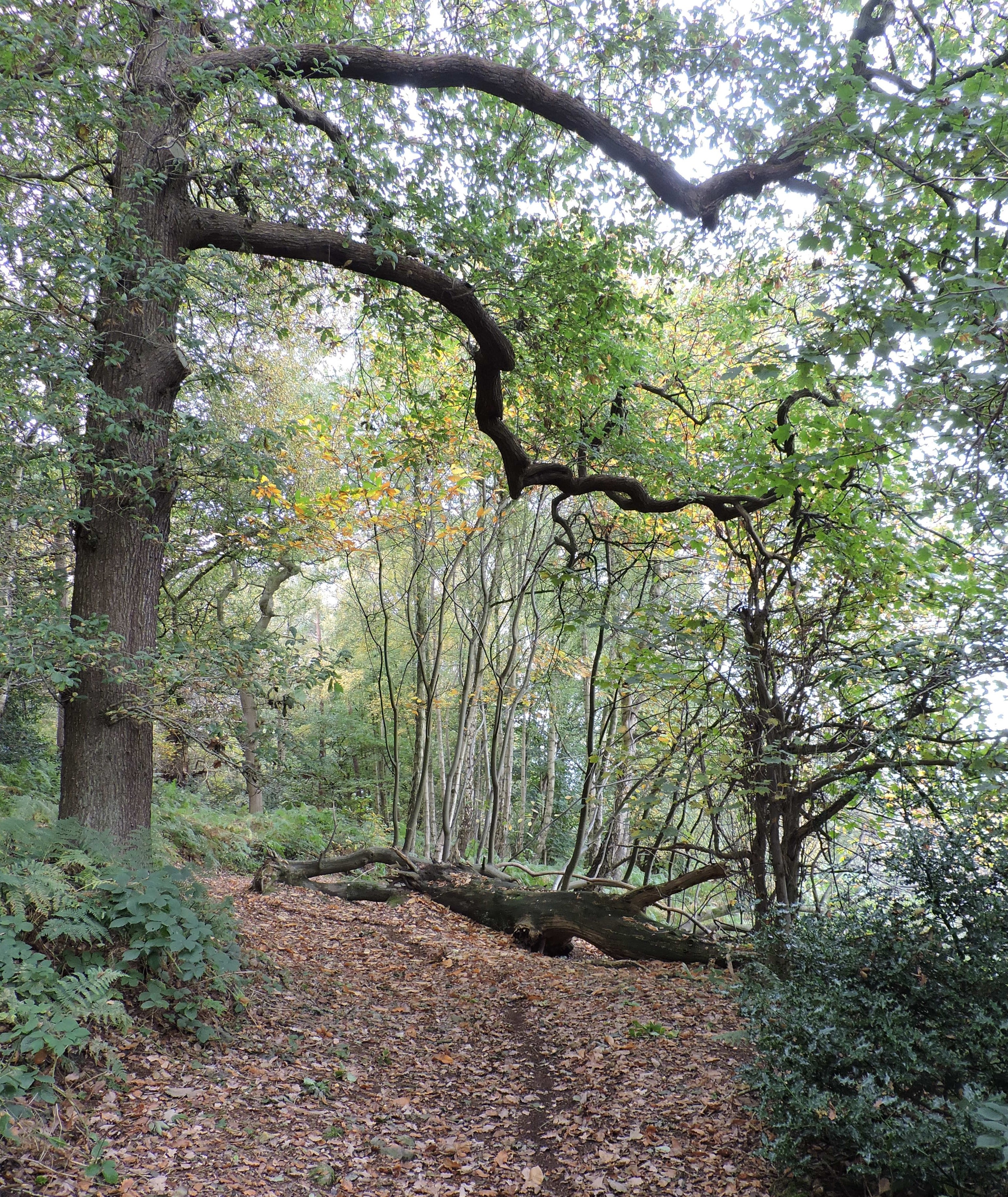
I stand, dumbstruck, before a vast oak. Huge, barrel of a trunk bristling with former branches. Dark, gnarled limbs bared by the dying foliage as it descends.

DSCN1154

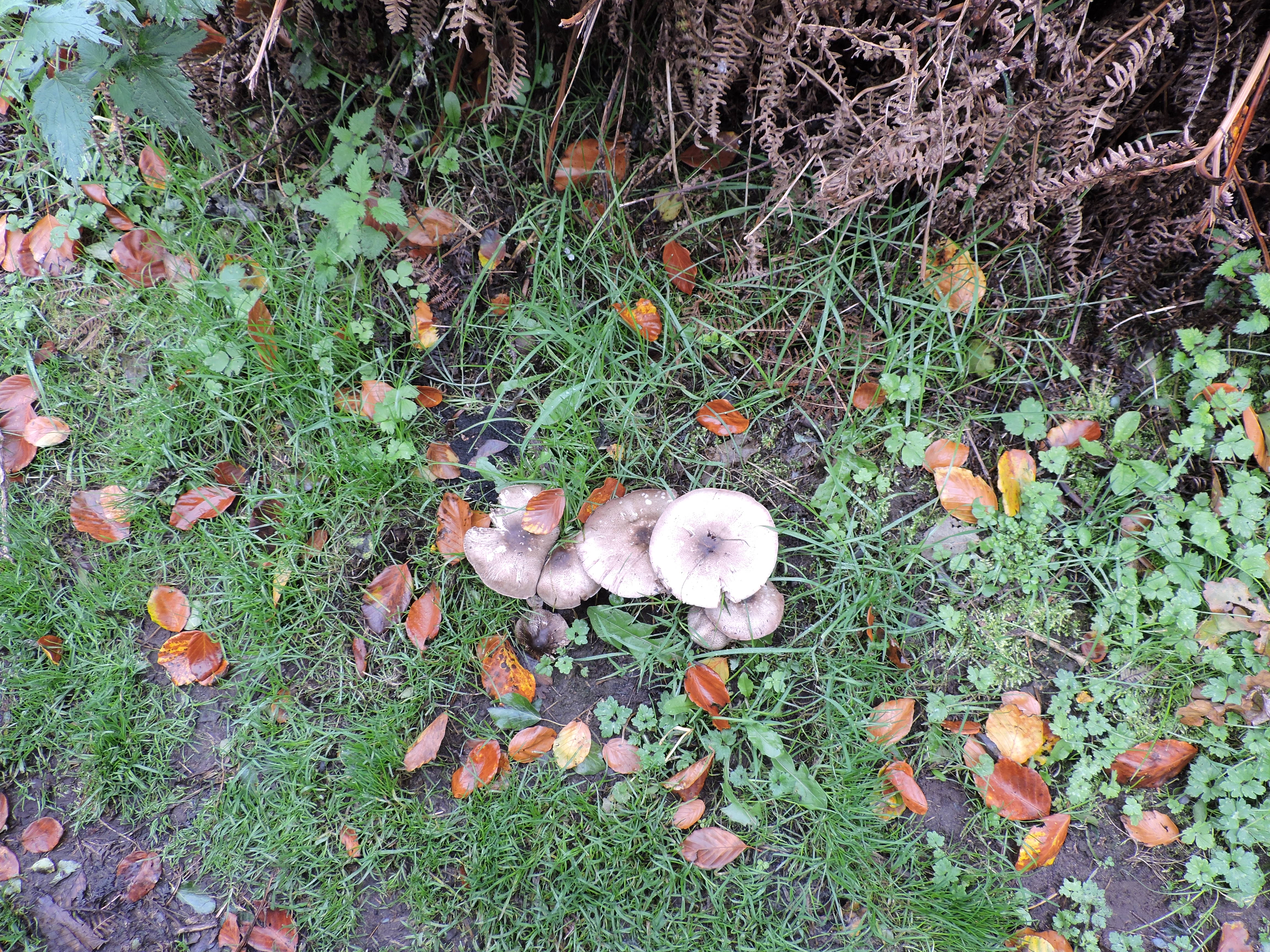
Off the path, a clutch of fungus

The path beneath our feet glows yellow and orange, leaves outlined in blackness – the dark soil. Created by centuries of leaves dying. Being eaten by worms. Excreted as a life-giving food for the greenery that will burst forth next spring.

Acorns crunch underfoot.

And so branches become trees …

Some trees have fallen – but are still rooted. Just. Enough so that what should be branches now shoot upright like small young trees. Seeking the sun above the birches and beeches, hollies and hawthorns.

English Heritage runs the site.

They’re losing Government funding and we decide to join. We’ll drop the National Trust. Seen plenty of stately homes.

We’ll make do (happily) with ruins and earthworks. Places imagination can roam free.

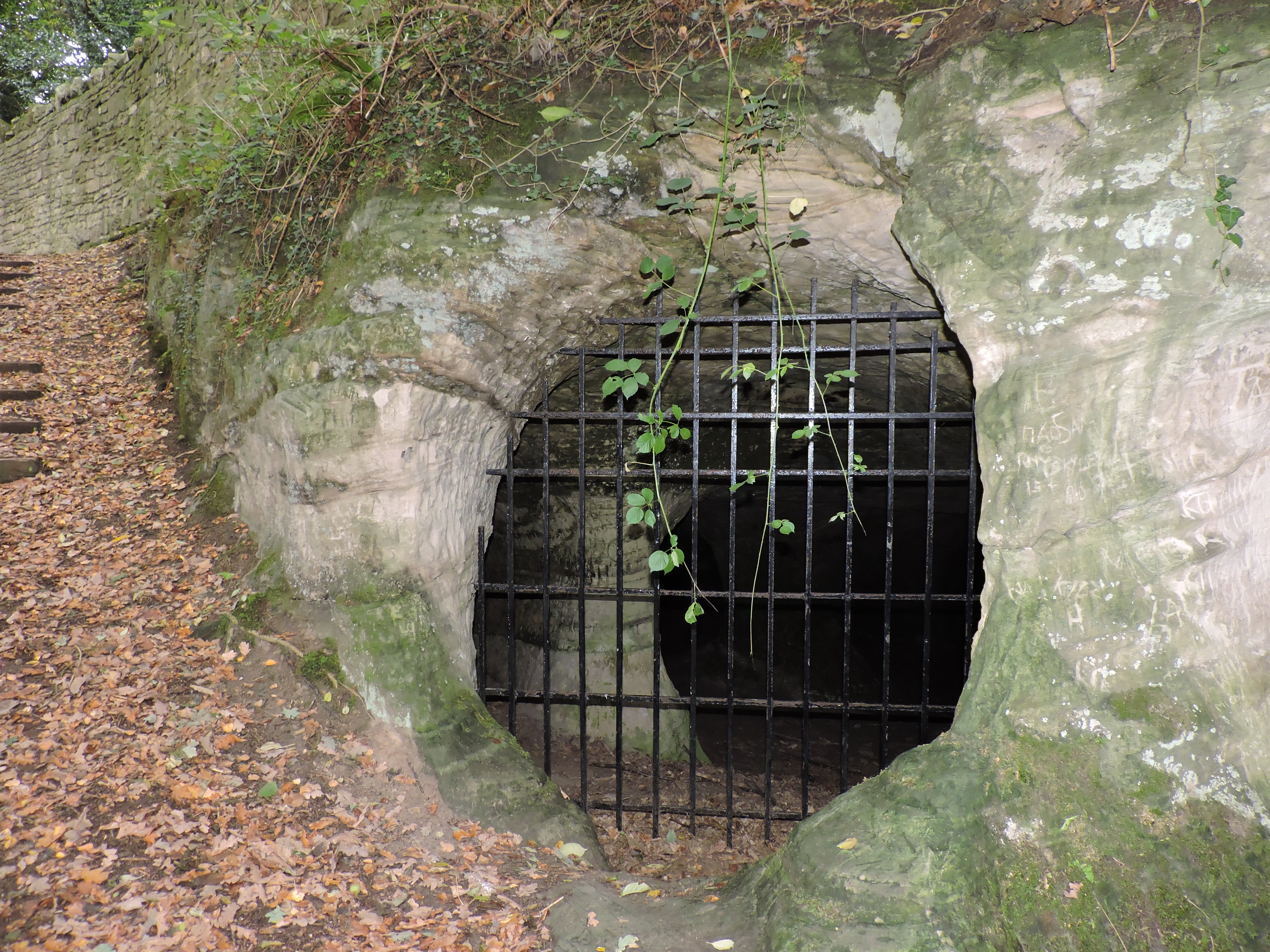
And who knows what lurks within

And who knows what lurks within

With isolated chapels and ghostly barrows.

Barrow wights? Yes, I’ve imagined them, too.

All of a sudden the world turns cold.

Imagination – a powerful, personal thing.

[And I haven’t seen Titanic, either, btw.]
Posted in Art, jaunts & going out, Britain now & then | Tagged , , , , , , , , , , | 10 Comments

The customer is always – irrelevant?

Here in Britain one of our oldest shops is Marks and Spencer. It started life in Leeds, Yorkshire, as a market stall. By the time I was a child it had become a well-loved and respected chain selling knitwear and knickers – in which a label proclaiming its ‘St Michael’ sub-brand was sewn.

It was a proud boast that almost everything was made in Britain. Women (mostly) wanted to work there because of the employee perks – hairdressing, physiotherapy, chiropody and free uniforms.

Treating its staff like valuable assets paid them back in spades. Its reputation radiated out from its employees and their families, not just its products.

A little while ago I stood in our local Marks and Sparks (one nickname) in a queue for the checkout – because M&S does food nowadays. I was behind several people with large loads in their trolleys.

Just two checkouts were open, both with long queues.

To one side was a large area in which several slow-moving, confused people attempted to use the self-service tills.

In front of the self-service tills was a line of fast checkouts. They were all closed. I guessed they’d be opened at lunchtime to serve the snack-and-hurry-back brigade.

A slim young man in a dark suit stood watching, behind a desk with a computer monitor.

There were very few members of staff in evidence and their task was to help the off-peak shoppers, mostly elderly people, who weren’t able to cope with the new-fangled self-service payment system.

Perhaps like me, they had gone seeking the fast checkouts only to find they were closed and couldn’t – unlike me – face going back to join the long queues behind stuffed trolleys at the two open checkouts.

Being a bit bolshy when occasion demands, I approached slim-young-man-behind-desk.your-ms-logo-black

‘Why don’t you open some tills, it would save time and be much easier?’

He turned a gaze on me that could’ve turned a butterfly to stone.

‘We want them to get used to these.’

And turned back to his monitor.

End of.

In our local Co-op it’s much the same story. One till open. Four self-service tills. And two members of staff being called in every two minutes to help the people who almost always do something wrong and need help making their purchases.

But it’s not just food shopping – and before I leave it, yes, I know, some people like the anonymous self-serving option.

Anyway – onto other stuff.

I do my share of online shopping. I like being able to order four pairs of shoes for delivery to our local branch.

I don’t have to hope they’ll have my size, I know they will.

I don’t have to pay up front.

I can try them on in the shop, send them back if they don’t fit – and probably buy something else in the process.

But there are times when it just doesn’t work that way …

Autumn is here – and I need a new raincoat.

I want to see what styles are around, to try a few on, see what suits me best. Choose a colour.

I go to John Lewis – that much lauded middle-class establishment that shares its profits with its employees. But that doesn’t make it cuddly. Oh, no. It isn’t a cooperative, nor a charity, it’s a profit making business.

I drive seventeen miles. Park in an expensive car park.

And arrive to find they’re renovating.

I walk around the limited space allocated to ‘fashion’, assuming that the stock is limited because of the work.

‘Where are the macs* – please?’ I ask a nice person in uniform. (A member of staff, btw, not a police officer.)

She takes me to one furry parka. Um – not what I had in mind, no thanks.

One padded effort that reminds me of the caterpillar in Alice in Wonderland. Um (again) – no thanks.

And one really smart raincoat that I like but won’t try on – it’s way too expensive.

‘Have they put the raincoats away for the time being,’ I ask, ‘are they coming back when the work’s complete?’

‘We won’t have a section of raincoats,’ she smiles condescendingly, ‘but you can see them all online. We’re just not going to keep them in-store [aargh hate that expression] any more.’

Reader, after trudging the shops for a further hour, gaining a blister (new shoes) and discovering no-one sells raincoats any more, I ended up buying the expensive mac.

It’s very nice.

It should be.

I was harrumphing about this yesterday as I stood, wearing aforesaid new raincoat,  outside a local bank that’s due to close its doors on 19 November.

People were readily signing the protest petition that three of us were proffering. Hopeless – but hey, it eases the frustration.

Almost everyone agreed it was a shame and that this – the fourth bank to close in our urban village – was likely to be very bad news not just for local customers but for the commercial life of the village.

One man said, ‘How much profit do they actually want? Why not spend some of it on giving their customers what they want?’

You know, I couldn’t have put it better myself.


*mac=mackintosh=raincoat

Posted in Britain now & then, Thinking, or ranting, or both | Tagged , , , , , , , , , , | 16 Comments

There’s a hole in my heart where Mary used to be

Saturday night. The last train home.

The station’s bright and light. The sound of squiffy silliness peppers the air.

There’s no menace, no riotous shouting. No spitting, or pissing, or – you know – any of those ‘I wish I’d gone home earlier’ kind of things.

The train pulls in. My friend from Leeds (I’ve known her 42 years – eek) and Anthro-man and I pile into a four-seater space and relax. Well, mostly.

The evening began at six in the bar at the Hard Day’s Night Hotel. A reunion of college friends. Since then much wine has been taken. And paella eaten.

Conversation between the fifteen of us has roamed around the world, bounced off politics, given religion a wide berth. Struggled back to earth again. And of course we’ve resorted to gossip – but shhh, don’t tell.

The three of us have left the rest digesting – making ready for city hotel rooms or adventures in late night bars.

And so here we are, three old friends, sitting in a metal tube with random, diverse strangers. Alert to intimations of imminent excess – of mood, of danger, or just familiarity.

This being Liverpool, we don’t have long to wait.

The train is blessed by the presence of some very merry people.

A young-ish man with a not-very-hipster beard parades up and down. He’s in a section of the carriage close enough for us to be amused – but also a little worried. Too close for comfort.

He sits on the knee of a woman with pale grey hair. She seems tolerant – and semi-amused – and keeps her hands well away. He tries other knees, as if it’s a game of squeak-piggy-squeak at a little boy’s birthday party.

Soon enough he’s bored and back to wandering round.

But at least he’s quiet, I’ll say that for him.

Unlike the two women – one of them plainly called Mary.

I can’t quite work out their age. Late thirties? Maybe forty or more?

They’re well beyond tipsy and into seriously inebriated – but mobile, laughing and somehow quite charming with it.

Not-Mary runs towards us.

You know how it is with a drunk – she starts off walking as if she can’t quite move her legs, as if they don’t belong, then suddenly they’re sprinting, with a mind of their own.

She staggers past us and slumps, face down, across the knees of two women sitting across the aisle, behind us. Stays there, her bottom sticking out into the aisle.

Immobile.

We’re laughing like drains now. And hoping we’ll carry on being the audience, not the cast.

Then Mary comes steaming down the carriage, chasing her friend.

Two men (with two more not-quite-hipster beards) sit side by side. Opposite – and presumably with – the two young women who make up friend-of-Mary’s human sofa.

Mary flings herself on the knee of the one by the aisle.

And a cry rings out:

‘Mary! Mary! Stop it – I feel defiled!’

It’s hard not to laugh, let’s be honest – and no one can help themselves. We’re all in stitches, the whole carriage.

Mary is sitting on his knee tugging up his top. We can all see his chest – and now she’s rubbing his chest hair.

The two young women who’ve ceased to be soft furnishings are now, amid gales of hysterical laughter, filming the whole thing on their mobile phones.

Is this a flash mob, we wonder? But not for long.

The train pulls into a station.

Friend-of-Mary raises herself.

Sways her way to the door.

‘Mary! Mary!’ she yells. ‘It’s our stop, Mary. Come on it’s our stop.’

Mary looks as if someone’s told her she’s been banned from walking and her legs have been removed below the knees.

She stands still – well, except for the rocking back and forth.

At last, she moves her feet. Stands facing the open doors.

Friend-of-Mary is out on the platform now.

Defiled-man is yelling at Mary.

‘Get out of the train, Mary, it’s your stop!’

But Mary can’t make her brain connect with her legs. (Yes, she does have legs again.)

As the doors shut she rushes up to them and stands, maybe seeing, maybe not seeing her friend laughing helplessly outside on the platform as the train pulls away.

Mary stays put. Topples out at the next stop as soon as the doors split open.

And the man with the beard, the chest hair, the defiled existence, yells.

‘Mary, Mary, Mary. Oh, Mary.’

‘There’s a hole in my heart where Mary used to be.’

Just another night out. In Liverpool.

Posted in Art, jaunts & going out, Britain now & then, Liverpool | Tagged , , , , , , , | 6 Comments