Lights, sights and lingonberries

Nearing ten o’clock at night. Speeding through customs with a small, carry-on backpack to a waiting taxi. Luxury!

Well before eleven we round a corner warmed by the glowing windows of the William Pub to arrive at Akademi Hotellet.

Opening the door of our third floor room we step straight into a vision. Two steeples of the cathedral alight against the inky blackness of night. Stars of many colours ascending to heaven.  Lasers lancing dark clouds.

Camera phone not good at this... You get the idea.

Camera phone not good at this… You get the idea.

Bags dumped, we gleefully retrace our steps and head for the William. An English pub Swede-ified.

Mellow lights. A rumble of conversation. No music.

A hipster pours us a Guinness and a glass of red wine. We sit in the window, taking in the sights.

A pile of dirty snow – and de facto bike rack. The cathedral’s mesmerising lights. Pavement grit, sparkling.

We sleep well. Don’t hear the bells marking the passing hours. Or the long peal greeting six in the morning, when the world’s still immersed in night.

View from our hotel room window, early morning

Cathedral seen from hotel room window, early morning


Downstairs, the dining room’s warm and welcoming.

Tea lights glimmer on tables, pendant lights in windows.

Very hygge (yes, I know, that's Danish not Swedish)

Very hygge (yes, I know, Danish not Swedish)


A buffet of many delights awaits: boiled eggs, meats, pickles. Jams, cheeses, breads.

Tiny smoothies, violet speckled with blackberry-blue. Each a mouthful of jewel-like richness.

White yogurt, ladled with scarlet lingonberries. Like fresh snow dotted with bright holly berries – but edible.

Well-breakfasted, the prof heads off to Uppsala’s university, to meet a group of geneticists. A joint project, many moons in the planning.

For me, a day of lone discovery.

Preparing for this trip was odd. I had no worries, no anxieties. Most unlike me.

Somehow I knew. All would be well.

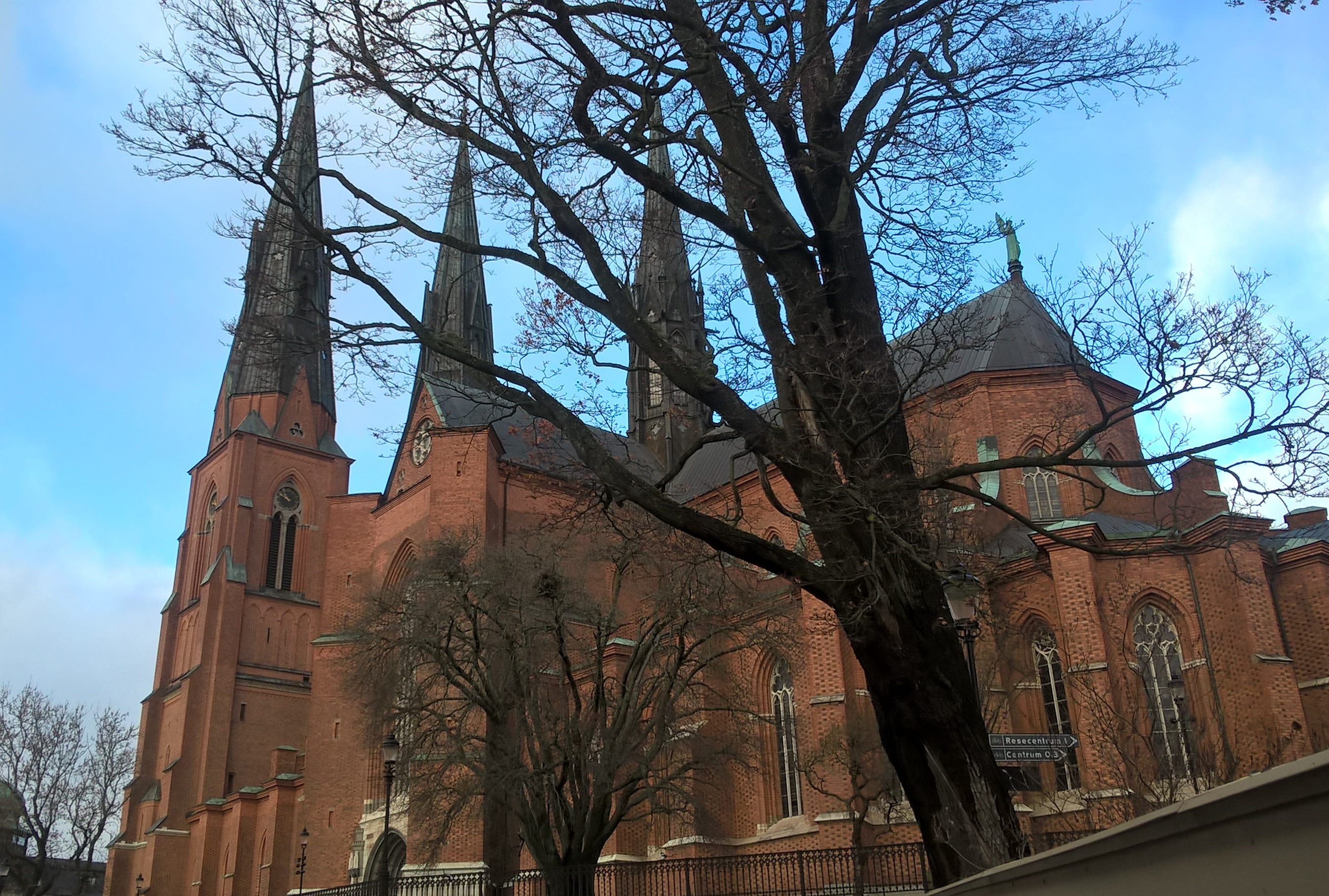
The cathedral, my first stop, detains me several hours.
wp_20161117_10_50_18_pro

Building began in c 1270, it was consecrated in 1435 but in the great fire of Uppsala in 1702 extensive damage was done. At the end of the 19th c major restoration works resulted in the spires, paintings and stained glass of today. It’s the largest church in the Nordic countries, 118 m high and long.

I see the memorial to 12th century king and saint, Erik the Holy. It was believed he was murdered by the Danish on the site where the cathedral now stands.

Sumptuous repository in the shrine for the relics of King Erik, Sweden's patron saint

Sumptuous repository from 1580 for the relics of King Erik, Sweden’s patron saint who was killed in c 1160 on the site where the cathedral now stands

Another monument, somewhat obscured by chairs (preparations for a professorial inauguration are underway), celebrates Carl Linnaeus.

There’s even a side chapel named after a chancellor of the university, Johan Skytte (1577-1645).
wp_20161117_11_54_02_pro-2

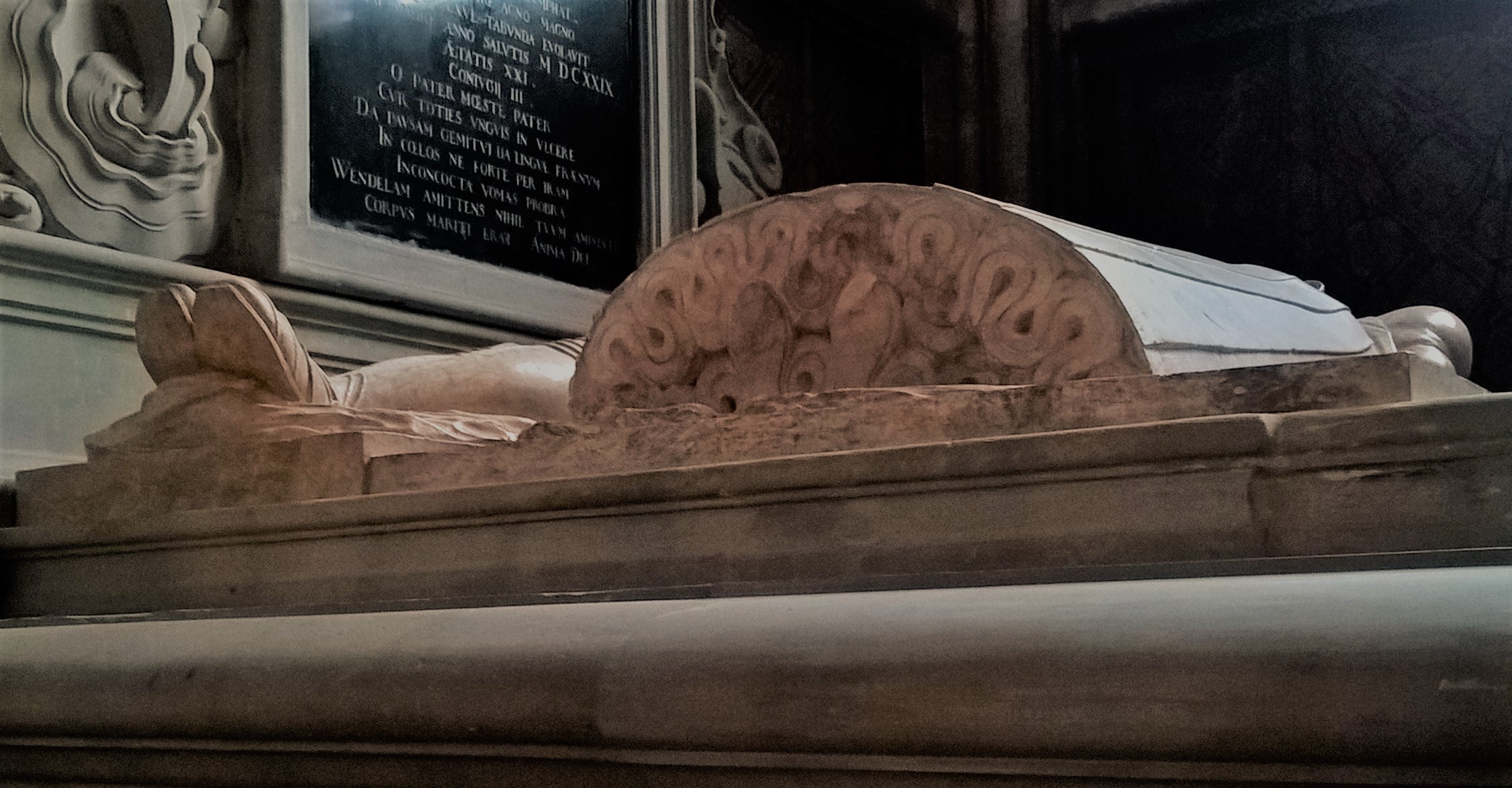
Look at her skirt all ruffles! And her shoes hidden in there. Never seen one like this. She is Vendela Skytte (maiden name, daughter of the chancellor) renowned for her learning. She died of the plague with her newborn daughter in 1629 aged 21.

Particularly touching for me, with his links to Zambia and Barbara Hepworth, is Dag Hammarskjöld’s memorial.

Tragically killed in Zambia in 1961 when his plane crashed - rumours persist that it was shot down - when he was on his way to negotiate a cease fire in a conflict in the Congo. He was awarded a rare posthumous Nobel Peace prize.

“Not I, but God in me” He was killed in Zambia in 1961 when his plane crashed – rumours persist that it was shot down. He was on his way, as UN Secretary General, to negotiate a cease fire in a conflict in the Congo. He was awarded a rare posthumous Nobel Peace prize.

In the chapel for silent prayer I sit, thinking.

Two young men enter. One tousled blonde, the other neatly dark.

The tousled one confounds my expectations, kneeling, praying, writing in the guest book.

He leaves.

His friend kneels in turn, head bowed, concentrating. Writes at length in the book. Prays some more before leaving.

I kneel. Send my hopes and fears up through the roof, into the winter sky.

Curiosity impels me to read what the young man wrote, in English – plainly not his native tongue.

It’s a plea for peace in the world.

Humbled, I pen a short echo and leave, warmed by the spirit of youth.
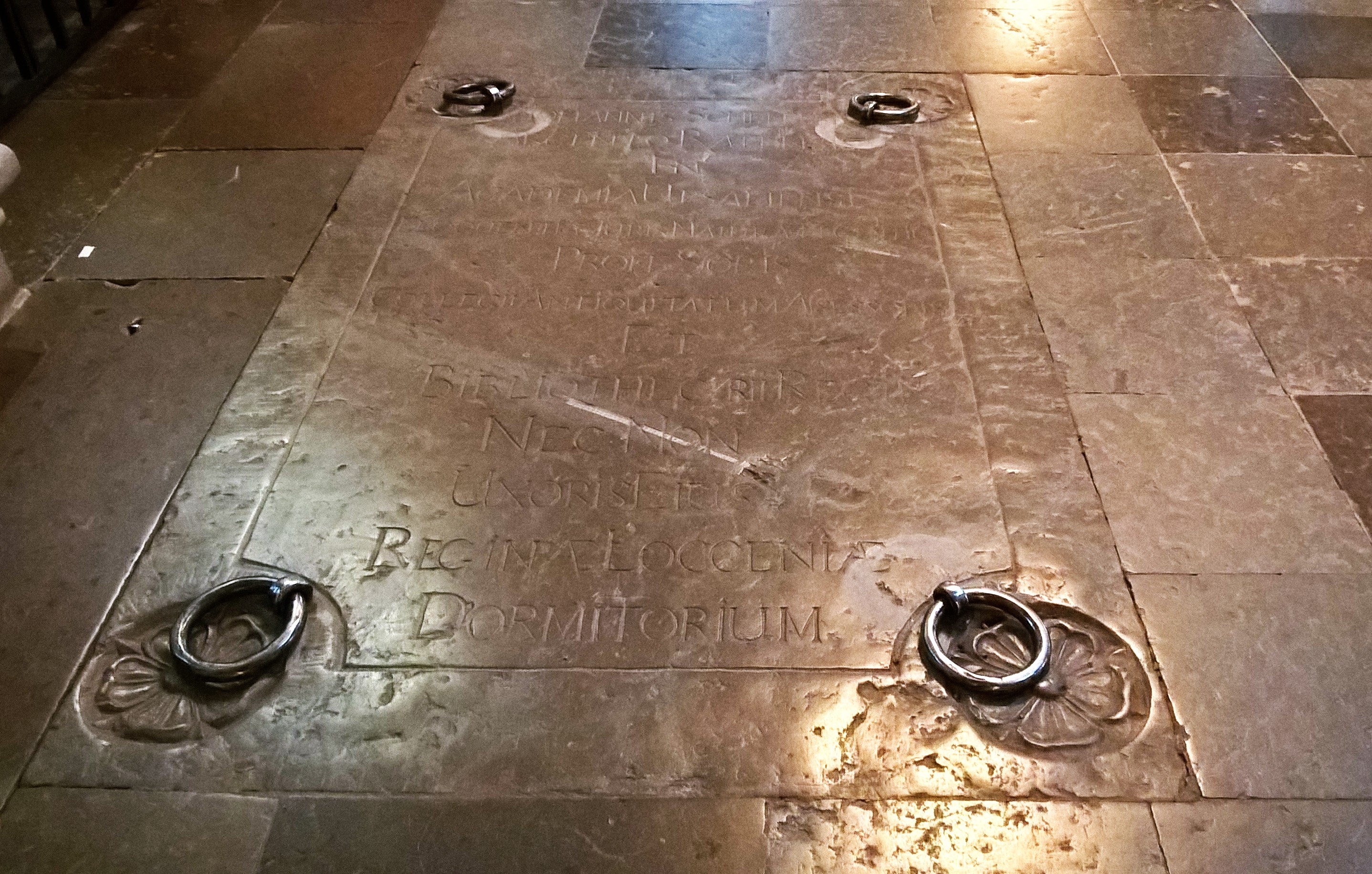
These heavy rings (for lifting?) are a common sight in the cathedral - and practical I suppose!

These heavy rings (for lifting?) are a common sight in the cathedral – and practical I suppose!
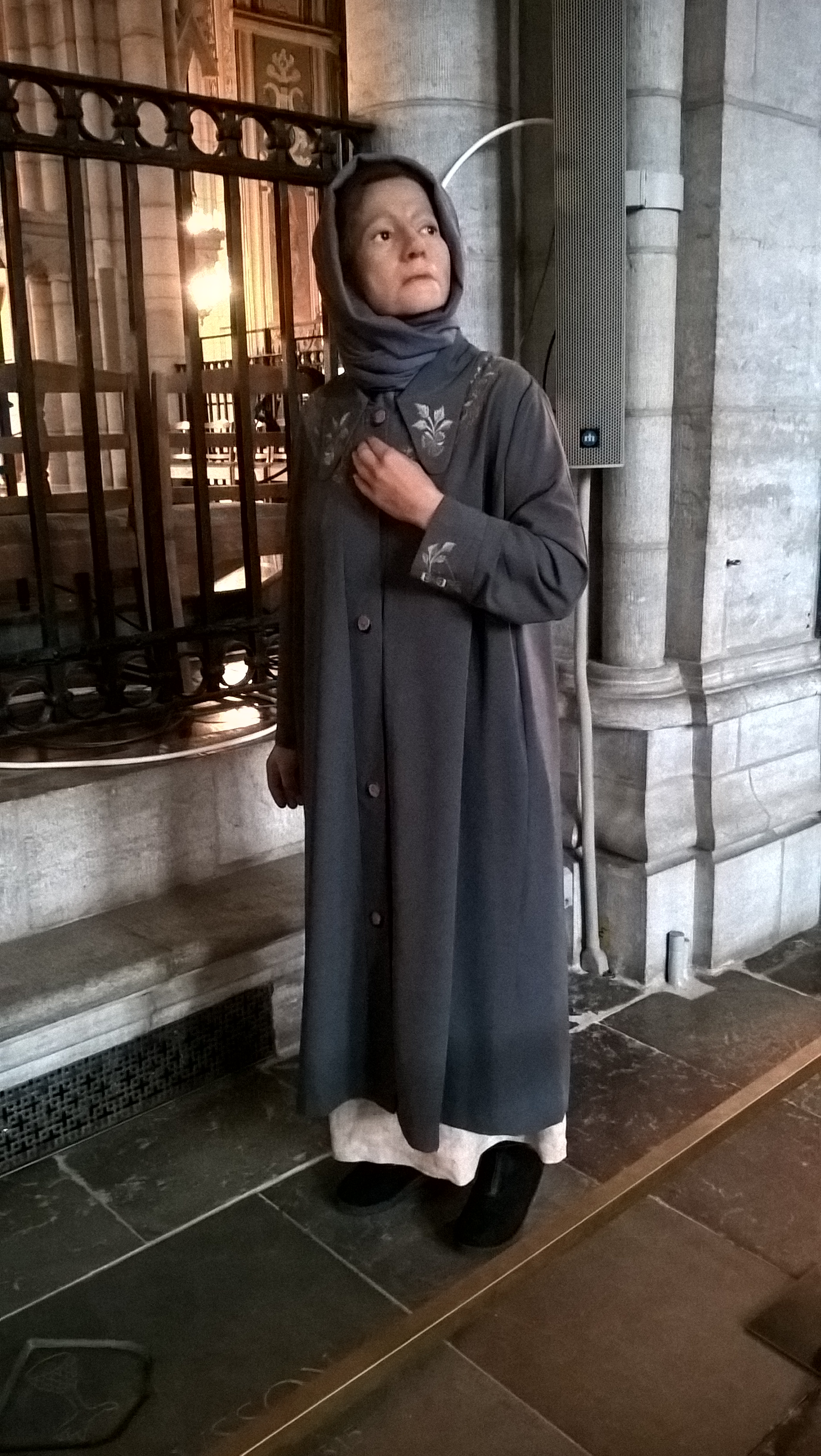
wp_20161117_11_29_45_pro

I stood a while, hesitating to walk past this woman, eventually realising it was a statue – it is incredibly realistic. The piece is called ‘Mary (the return)’ by Anders Widroff. His aim was apparently to portray the mother of Jesus as herself, independently of Jesus and someone we would recognise as a person like ourselves

Taking the lift up the tower to the seventh floor I gawp at a medieval dress and other ancient textiles.

Back down on earth I realise I’m hungry and make my way downhill to the shops.

I enter one selling special teas – in packets, not to drink. The young man behind the counter chats in perfect English. Swedish by birth, son of Eritrean parents, he recommends a falafel van round the corner.

I’m too cold for that and brave a tiny café down a side street. Order an avocado ciabatta. Tea – black leaves, dotted with blue – is served in an infuser dunked in a mug of hot water.

I wander the shopping streets, amble along the riverbank.

A window display of Moomins lures me into a toyshop. I buy a plastic Moomin plate. The woman, roughly my age, remarks, in halting English, that though we learned to love Moomins as children, age doesn’t lessen their appeal. She’s right.

Light fading, I tromp back uphill, hesitate, then try the door of a church which looks as if it’s closed.
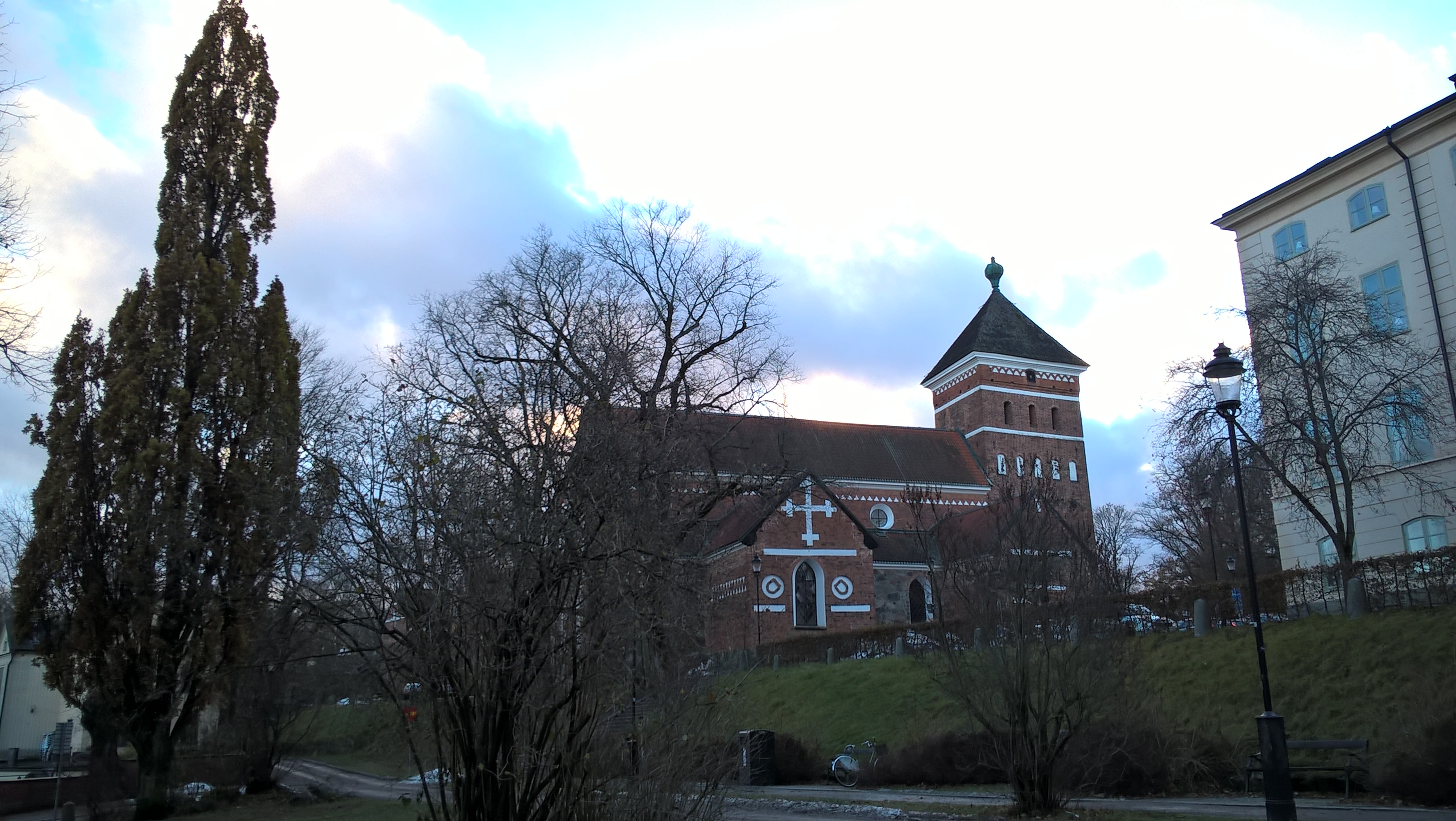
wp_20161117_14_08_19_pro

Holy Trinity church built during the 14th c and consecrated in 1343. The cupola and weathervane were put up after the great fire of Uppsala in 1702.
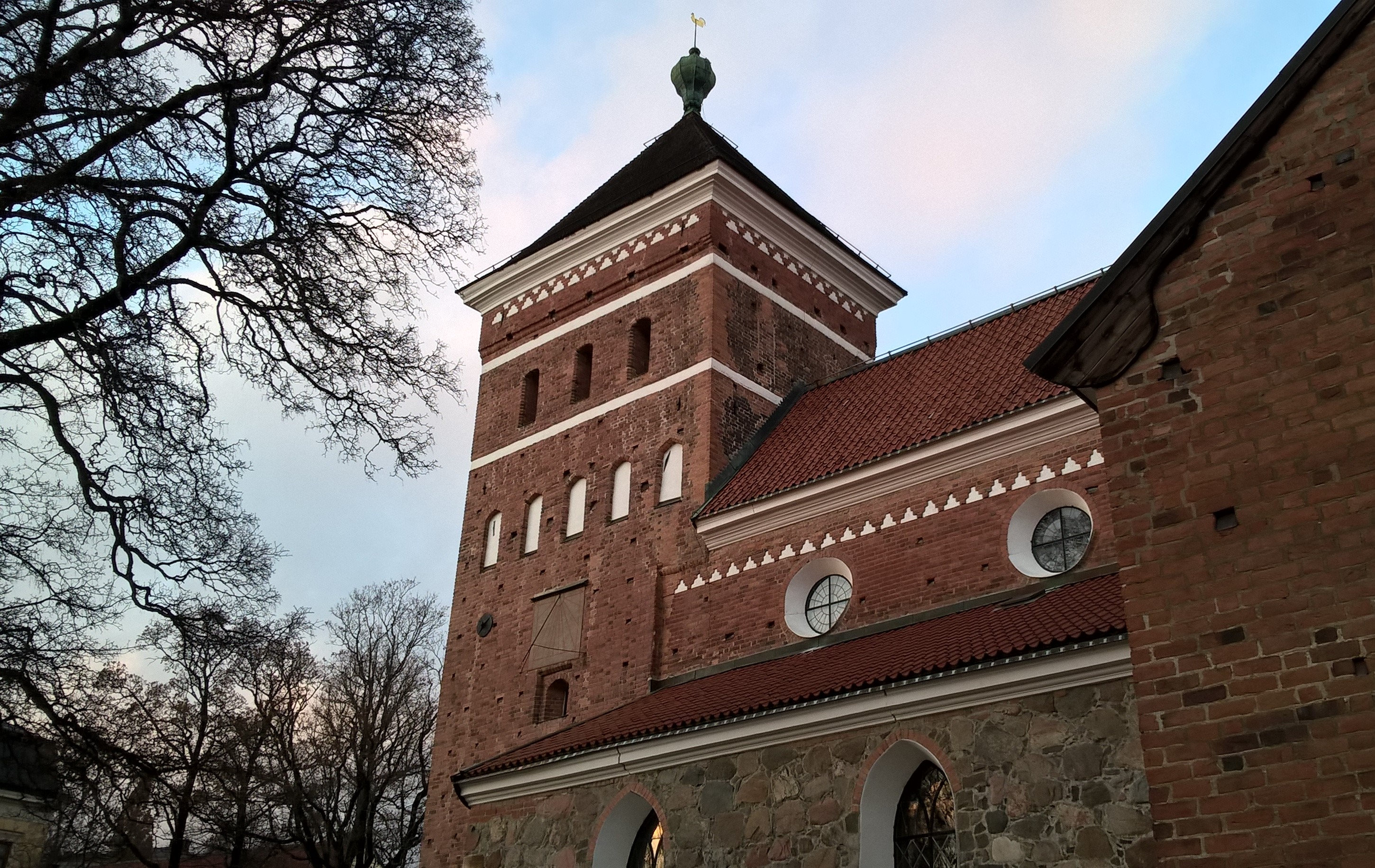
The (partly) granite church was first mentioned in 1302 and to distinguish it frrm its near neighbour, the cathedral, it was called Bondkyrko - the peasants' church.

The partly (see base) granite church was first mentioned in 1302 and to distinguish it from its near neighbour, the cathedral, it was called Bondkyrko – the peasants’ church.


In the porch, I stand, stunned by faded scraps of paintings adorning walls and ceiling.
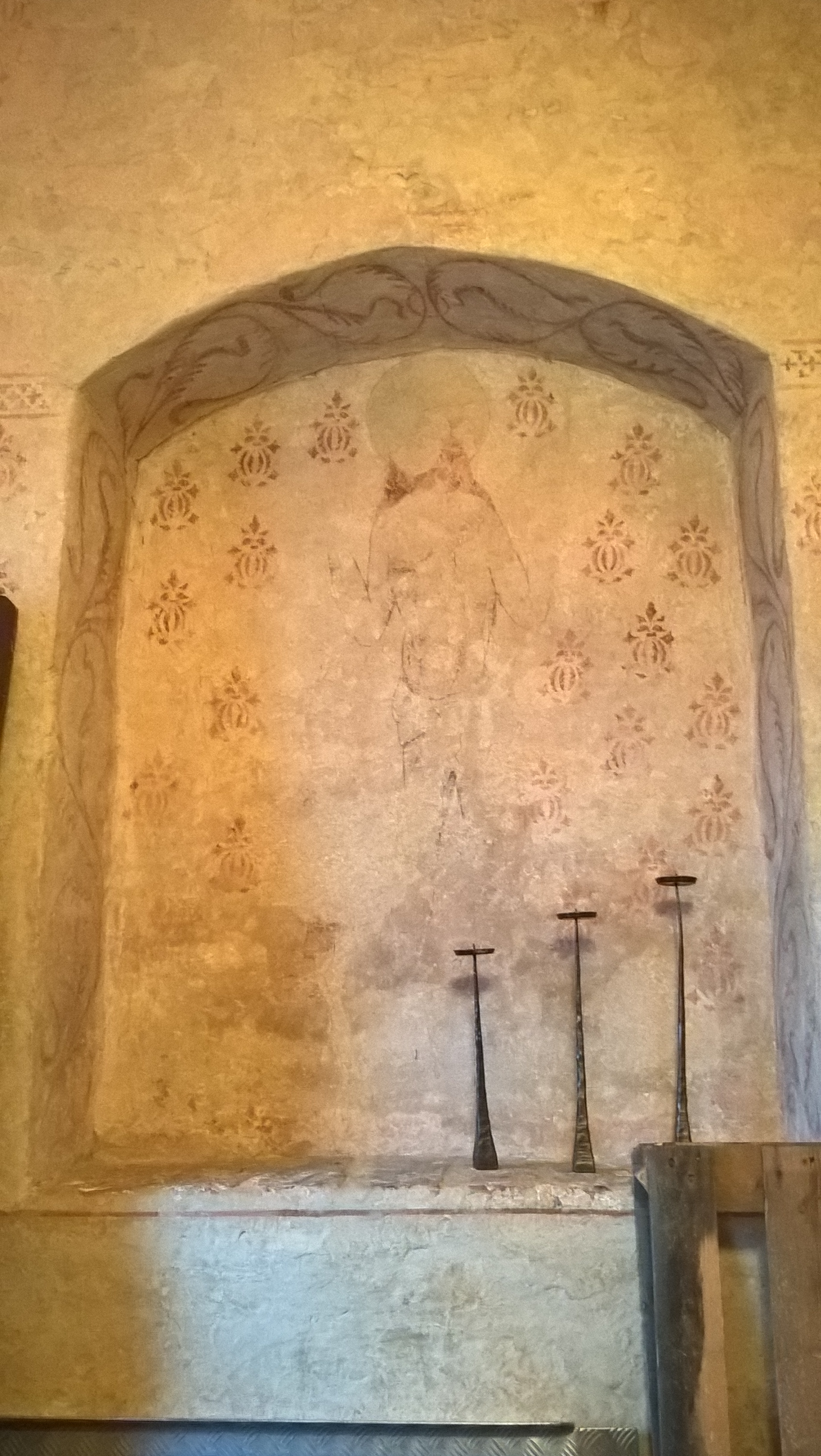
I thought this was amazing, before I went inside the church...

I thought this 15th c painting was amazing, before I went inside the church…

Still in the porch...

Still in the porch…

It’s the famine before the feast.

For the next hour I look, walk around, sit. Spellbound. And alone.

Like everywhere I’ve been it’s warm.

Brass chandeliers emit a mellow light. Candles burn.

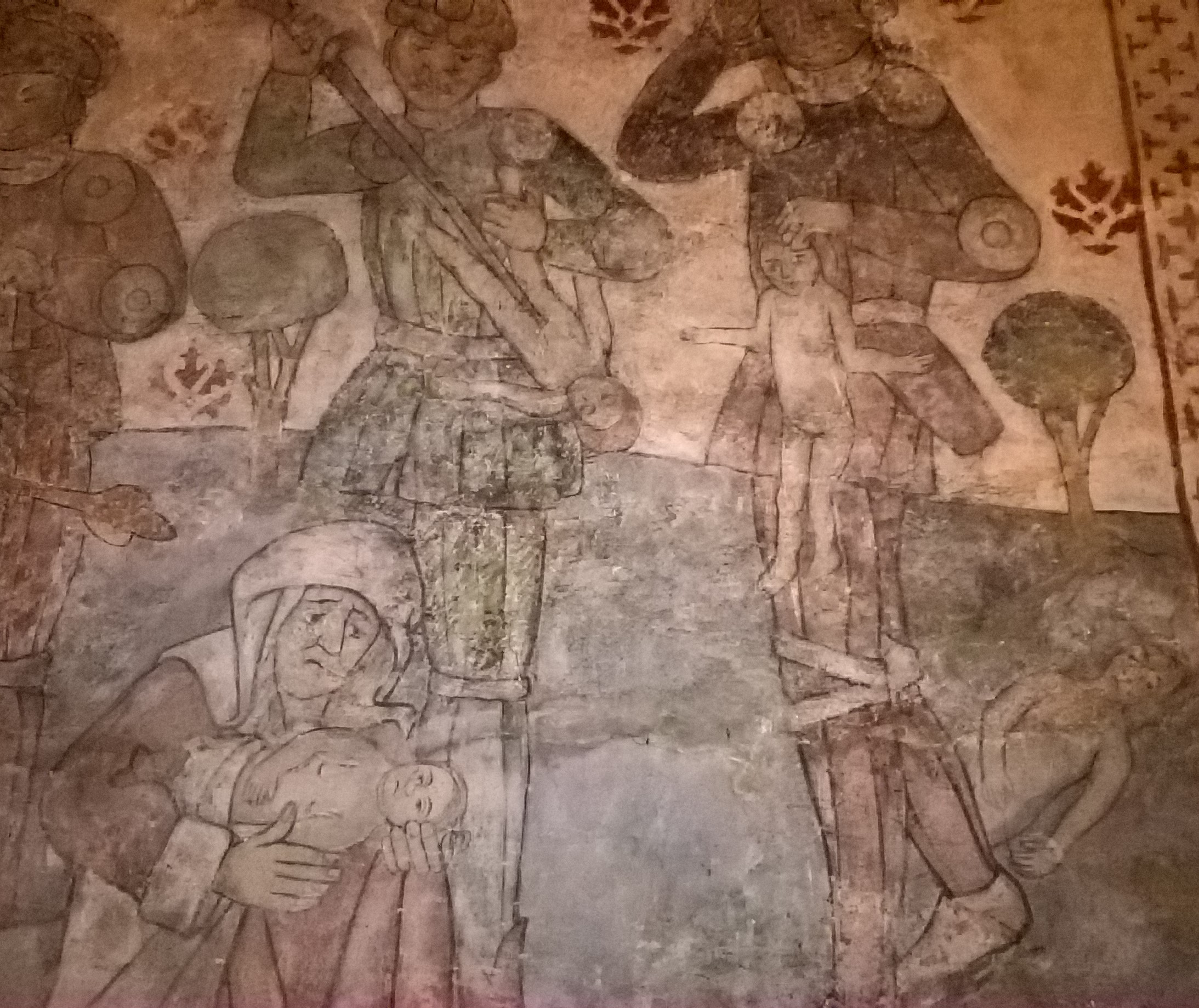
It’s easy, here, to see how important paintings would have been to illiterate church goers. One has a special resonance for me, a child born on Holy Innocents’ Day. But I’ll let the images speak for themselves.
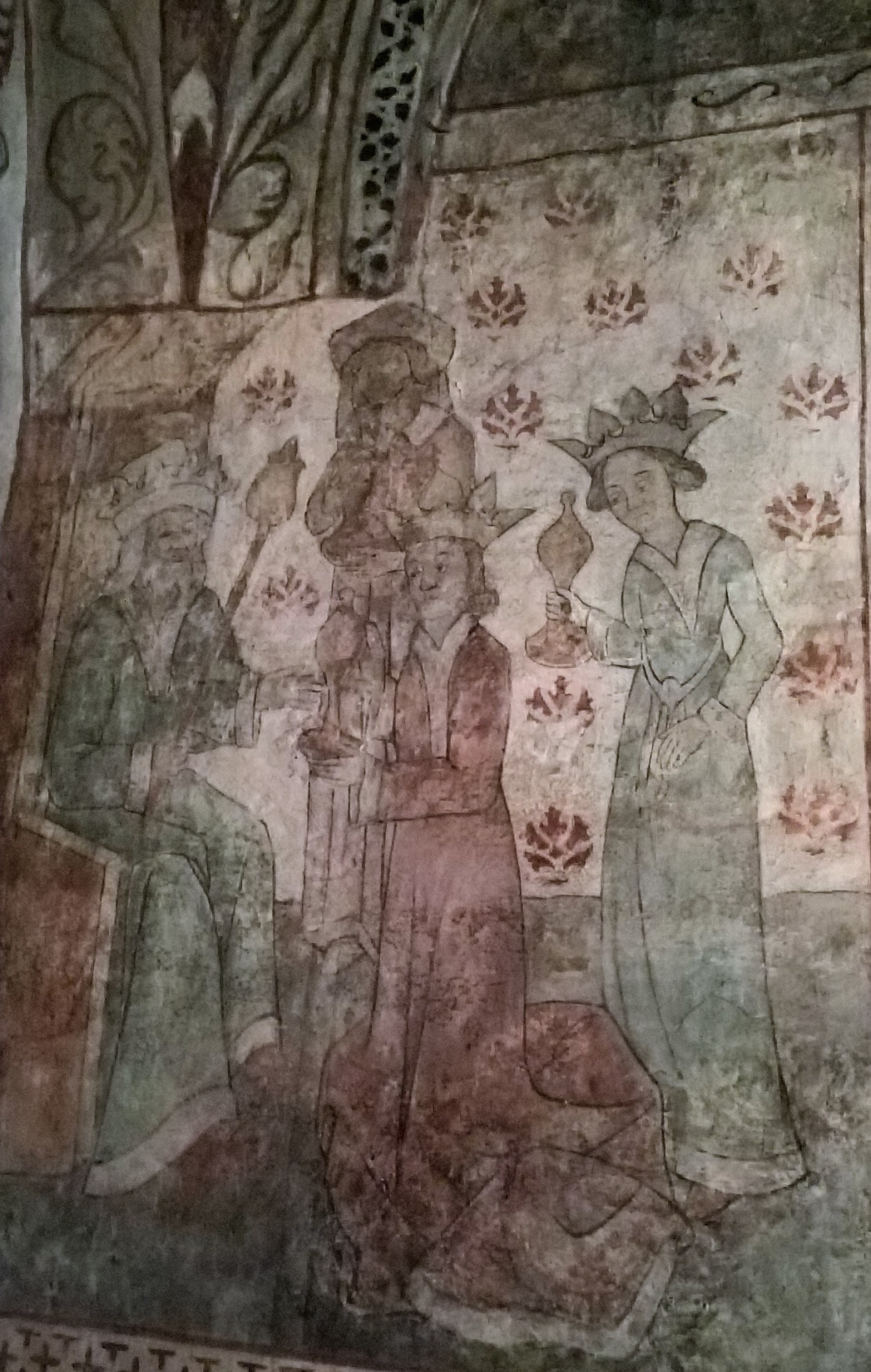
The magi meet King Herod
The magi meet King Herod

Herod orders the slaughter of all male children under three years of age - an event remembered by the Catholic Church n 28 December

Herod orders the slaughter of all male children under three years of age – an event remembered by the Catholic Church on 28 December

Mary, Joseph and the infant Jesus flee to Egypt

Mary, Joseph and the infant Jesus flee to Egypt

wp_20161117_14_36_43_pro-2wp_20161117_14_26_31_prowp_20161117_14_35_11_pro-2wp_20161117_14_33_52_proIn the evening, we’re treated to an Italian meal by the prof’s academic colleagues. Around the table are seven of us, of seven nationalities.

By the time we leave my brain’s abuzz. As if it’s been reconditioned. For one who works alone, it’s a rare treat.

Next day the prof and I are free to be tourists together and visit ‘my’ church.
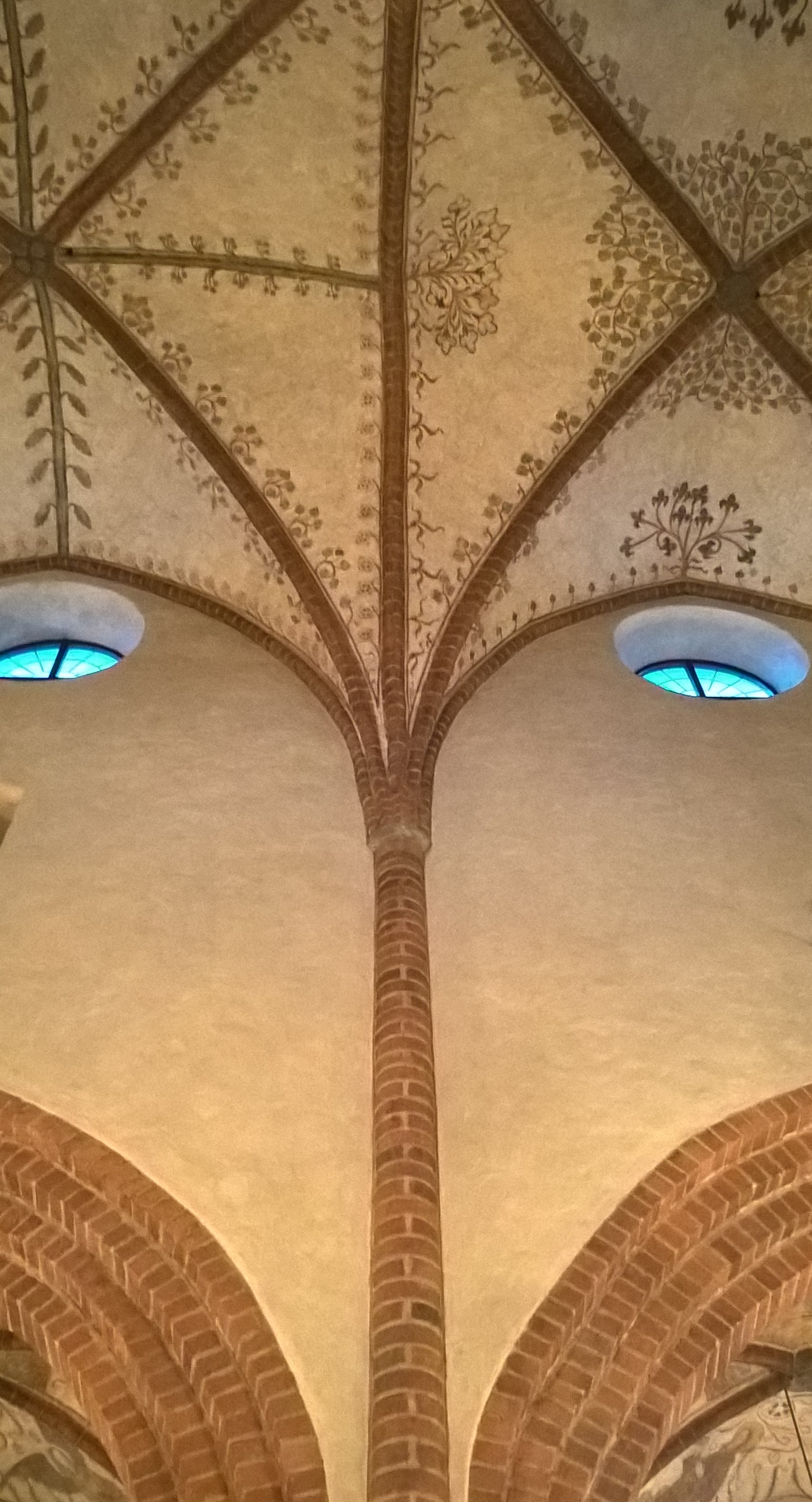
The prof took this - so like a tree don't you think? The tree of life?

The prof took this – so like a tree don’t you think? The tree of life?

The cathedral’s closed for the professorial inauguration. A disappointment soon eclipsed  by the castle.

wp_20161117_15_08_38_pro-2

The peachy shape in the trees is the castle. Originally built in the 16th c it was the site of the Sture murders by another King Erik (not a saint). Dag Hammarskjöld lived some of his early life here as his father, Uppland Governor, resided there – it now also houses an art museum and fab cafe! The castle was severely damaged in the great fire of 1702 and much of what is seen now is renovation.

We marvel at the University’s precious  silver bible. Written in the Gothic language, in the sixth century, on purple tinted parchment in silver and gold ink, it’s now on Unesco’s Memory of the World register. We see some awesome paper treasures – 700 year old books, maps and pictures. (Imagine 700 year old data sticks in a display case?)
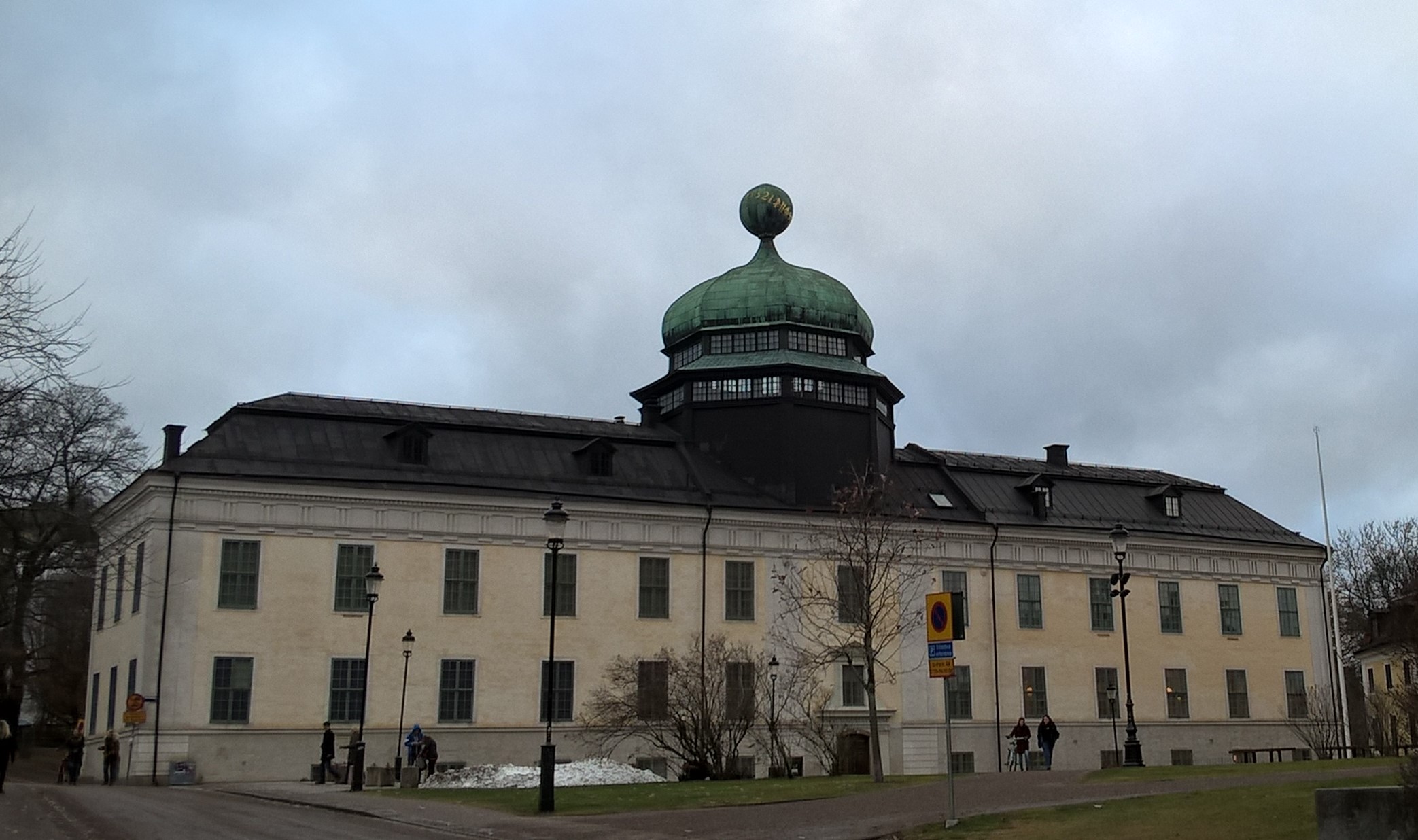
The University Museum. At the top is the original dissecting theatre - designed for light to flood down onto the action and also designed so that anyone who fell asleep or fainted would be wedged int heir narrow slot int he seating and not fall! I was told about this and aim to see it next time... Two days was not enough.

The University Museum. At the top is the original dissecting theatre – designed for light to flood down onto the action and also designed so that anyone who fell asleep or fainted would be wedged in their narrow slot in the seating and not fall! I was told about this and aim to see it next time… Two days was not enough.

It strikes me that education – learning – is valued here.

Yes, Uppsala’s an ancient university city. But the hoardings round building sites don’t boast of financial investment, or facilities, they celebrate Nobel prize-winners.

Admittedly, in this land of Abba, ‘money, money, money’ is a bit of an issue for us Brexit-burdened-Brits. Things are expensive, especially now the pound is weak.

But think on this, all ye who hate paying tax.

Signs outside the library and the castle tell us (in English) all the people of Sweden pay for the upkeep of these national assets – because it’s their national heritage.

There’s an additional charge on the fare for public transport into the airport – to help repay the costs incurred in upgrading the infrastructure.

That’s what taxes do. They pay for the things we all need, or care about, or treasure.

Or arguably should.

So I suppose the question is, what do we treasure?

Well, I treasure the memories of this visit. Well worth the airfare and my half of the hotel bill.

Thank you, Uppsala. It was wonderful.

See you again, soon. I hope.

This may seem rather an odd picture to include, but in my wanderings I cam across this huge cemetery right there between the shopping/tourist side and the university - it's obviously well used as a thoroughfare - another path dissects it too - but this one and the woman in the distance reminded me for some reason of my favourite (probably) film, The Third Man. The woman walking away at the end. Cue the music...

This may seem rather an odd picture to include, but in my wanderings I cam across this huge cemetery right there between the shopping/tourist side and the university – it’s obviously well used as a thoroughfare – another path dissects it too – but this one and the woman in the distance reminded me for some reason of my favourite (probably) film, The Third Man. The woman walking away at the end. Cue the music…
That's it. The end :-)

That’s it. The end 🙂
Posted in Art, jaunts & going out, Sweden, Thinking, or ranting, or both, Travelling | Tagged , , , , , , , , , , | 11 Comments

‘Michigan seems like a dream to me now …’

I started off yesterday writing a thoughtful, elegiac piece referencing music. But the longer the day wore on, the more it wore me out, the effort of trying to be calm.

You see, we’ve had a tough couple of days here, me and my man (see how sloppy I’ve become?). (Blame the hangover and the sleepless night.) (Yes, they’re connected.)

It may amaze my American rellies, friends and followers (you can be two, or even all three) to know this, but we here in Blighty have been paying close attention to your hellish, drawn-out and frankly rather rude election campaign.

We’ve snooped on your TV programmes and dipped into your newspapers. We’ve read the commentary in serious UK papers and watched Channel 4 news (the best).

We’ve fumed at lies on Twitter, tried hard not to lose friends on Facebook. Well I have, the Prof is far too sensible to let the devilish antics on social media grind him down.

The end result is that we are depressed, despondent, disillusioned and many other words not beginning with D.

When I awoke on Wednesday, it felt like a re-run of Brexit day. As I feared it would be, in my heart of hearts.

I knew, if I went upstairs to the kitchen, I would find a grim-faced husband making tea. So I waited, kept off the lights, pulled the eiderdown up to my chin – and wished I’d not had that last glass of wine.

Then we sat, tea taking the chill off the truth he’d brought down with him: Trump had won.

There was no time to do more than commiserate with my American-citizen, Hillary-voting husband.

He dashed off to catch a train to London. I made ready to drive to a monthly freelancers’ co-working day.

There I let off steam. We all did. In turns and together.

No-one to tell us that democracy had worked and we should just accept it.

Or that Trump would be all right, you’ll see.

Or that most of that stuff about racism and sexism was just media bias and anyway what does it matter if he’s sexist or misogynist, that’s just personal after all?

A sad text pinged in mid-morning as I comforted myself with hot chocolate. ‘I feel numb,’ he wrote.

Arriving home as the day died, the oddest cloud had formed on the horizon, over the sea in the west. Like a scary ghost, the kind that’s really a blob in a sheet, its spiky sheet-arms reaching out to grab you. But the sheet was black.

The rest of the sky was a pale, watery blue.

Trump has won, I thought. Even nature knows it.

A few minutes later the Prof returned home and saw exactly what I saw. Spook-y.

‘I wouldn’t be surprised,’ I think I said, ‘if nature threw a tantrum tonight.’ Though I may have made that up.

Nature did. She howled for hours while the sky was crying (I hear Stevie Ray Vaughan, calling from his grave in Texas) .

But that was long after the Prof had returned and ditched his usual tidy, putting-things-away-of-an-evening routine.

Instead he went straight upstairs to our old stereo in the sitting room. Pulled out a 1973 album. Selected a track and cranked up the volume.

The song’s called ‘Sold American’ and sung by self-styled Texas Jewish cowboy (and detective writer and dog saviour and would be politician) Kinky Friedman, backed by the Texas Jewboys.

I replied with Leonard Cohen.* Democracy. Because by then I was angry.

The Prof (I won’t call him Tex any more, we agreed) was just sad.

When he finally spoke this is what he said:

‘I don’t know who I am.’

Out came the wine. Out poured the sadness, the anger, the disbelief, the hurt, the bemusement, befuddlement, bewilderment.

‘What is America? Who are Americans? Am I an American? Do I want to be an American?’

Now, I am sure at this point some people – possibly relatives – might be getting annoyed.

But, bear with me – our situation is not straightforward – and there’s another country to take into account here.

When we married, his parental units weren’t exactly wild about me, but when they realised we were going to stay in the UK it became serious.

It shook me a bit when the family began urging him to return to live in America because – believe it or not – we didn’t discuss it before we married. I’d just assumed …

Pretty big assumption, right?

Fast forward. We’re still here.

Getting older.

Worrying about money – and bam! Someone tells us Prof should have been doing tax returns all this time. For more than two decades. Even though he was a UK taxpayer.

Yes, two countries in the world require their citizens to account for their tax back home even if they’re living abroad and paying tax there. The USA and Eritrea (or so I have been told).

We sorted it out at the cost of sending a few hundred dollars a year to a New Jersey wide-boy – sorry, accountant. No, seriously, funny and efficient. It was a real relief the-British-variety-of-Prof wasn’t earning enough to have to pay back tax.

But long before this threat to his income emerged (and mine – we had to split our bank accounts) he had decided to become a British citizen in order to vote. Keep his American citizenship, but take his full part in British society.

It was an interesting process and a heart-warming ceremony (wrote about it here).

But that was before Brexit.

If I felt bereaved after Brexit (I did), he felt cheated (he was).

‘This isn’t the country I joined,’ he said. He has a brief but effective way with words when he’s upset.

Well, Brexit is forever. Perhaps that’s the one, not-as-bad-as-everything-else thing about Trump – it should be a short-lived thing…

But to return to the USA and money and citizenship.

I’ll sum it up rather baldly: if I die first, we keep debating, will he want to return to the USA?

Well, the money is certainly an issue. His pension fund would be subject to US tax.

But the bigger issue is, how would he feel about moving there, alone?

Which is where the ‘who am I?’ ‘am I an American?’ dilemma came in.

Watching what has been happening in the USA has not been an edifying experience.

I’d hope there are at least as many good, as not-so-good people in any given country – the USA included. But as a nation – how did it come to this?

How could so many affluent white men with education – and women, for pity’s sake – vote for a man who said the things Trump did, who did the things Trump has done, who promised the things Trump promised?

Don’t tell me! I’ve read a heap of explanations. Yet still I wonder.

Brexit has made this country feel like a grubby place, one I really can’t say I’m proud of any more. But living here we can at least help to make it better, stop it getting worse.

We haven’t a hope in hell of making a contribution to America taking back control of its manners, its decency, its culture, its tolerance…

One of the other pieces of music I hear in my head as we ‘look for America’, now, in 2016, is America by Simon and Garfunkel, from 1968.

While checking the date of that song I found, to my amazement, what America readers will probably already know.

Saginaw (as in, ‘it took me 4 days to hitch hike from’) is in Michigan, a state won by Trump.

Saginaw’s population decreased dramatically when automobile, and other manufacturing, moved out. Unemployment skyrocketed, though it’s settled down a bit now.

The ghosts of its industrial heritage are derelict buildings and many bear graffiti – specifically words from… America by Simon and Garfunkel.

I love that song, its questing, yearning poignancy. And perhaps if we were younger, if he were younger, it would be different.

But there isn’t the time left for us to sit on a Greyhound bus and look at the scenery and watch the cars on the New Jersey Turnpike and look for the real America.To help re-find the real America – wherever, whatever that is.

So, it looks, at the moment, as if the US passport might not be renewed when it expires next year.

And we will have to turn our efforts to making Britain great again. No.  Let me rephrase that, making Britain kind, caring and pleasant again.

Thank you for your tolerance. Have a nice day.


PS. It became plain to me after some comments recently that though I know what I write, sometimes people will read what I don’t. Take their own meaning from my words. If you take offence from any of this please put it away swiftly, none is meant. I am deeply saddened by the world and want nothing more than to help make it a better place. And, by the way, I’m an optimistic pessimist. Despite:

leonard-3

*Yes, RIP one of my all time musical heroes, the master, Leonard Cohen. We bought this piece of his work several years ago and now I am comforted to have it on the wall, next to our old stereo, where last night I listened to ‘Democracy’. Tonight we will listen to some of his more romantic and spiritual songs, today I may re-read some of his poetry, out of ‘Death of a Lady’s man’. It’s been a very dispiriting week.

Posted in Britain now & then, Texas, Thinking, or ranting, or both | Tagged , , , , , , , , , , | 13 Comments

Autumn. A little too close for comfort, this time

It’s been the most beautiful autumn I can remember.

The stillness of each reluctant dawn.

The drama of the sunrise, turning the world from grey to lemon, gold to rose.

The vast, v-shaped skeins of pink-footed geese heading for the salt marsh, rowdily honking, like teenagers en route to a party.

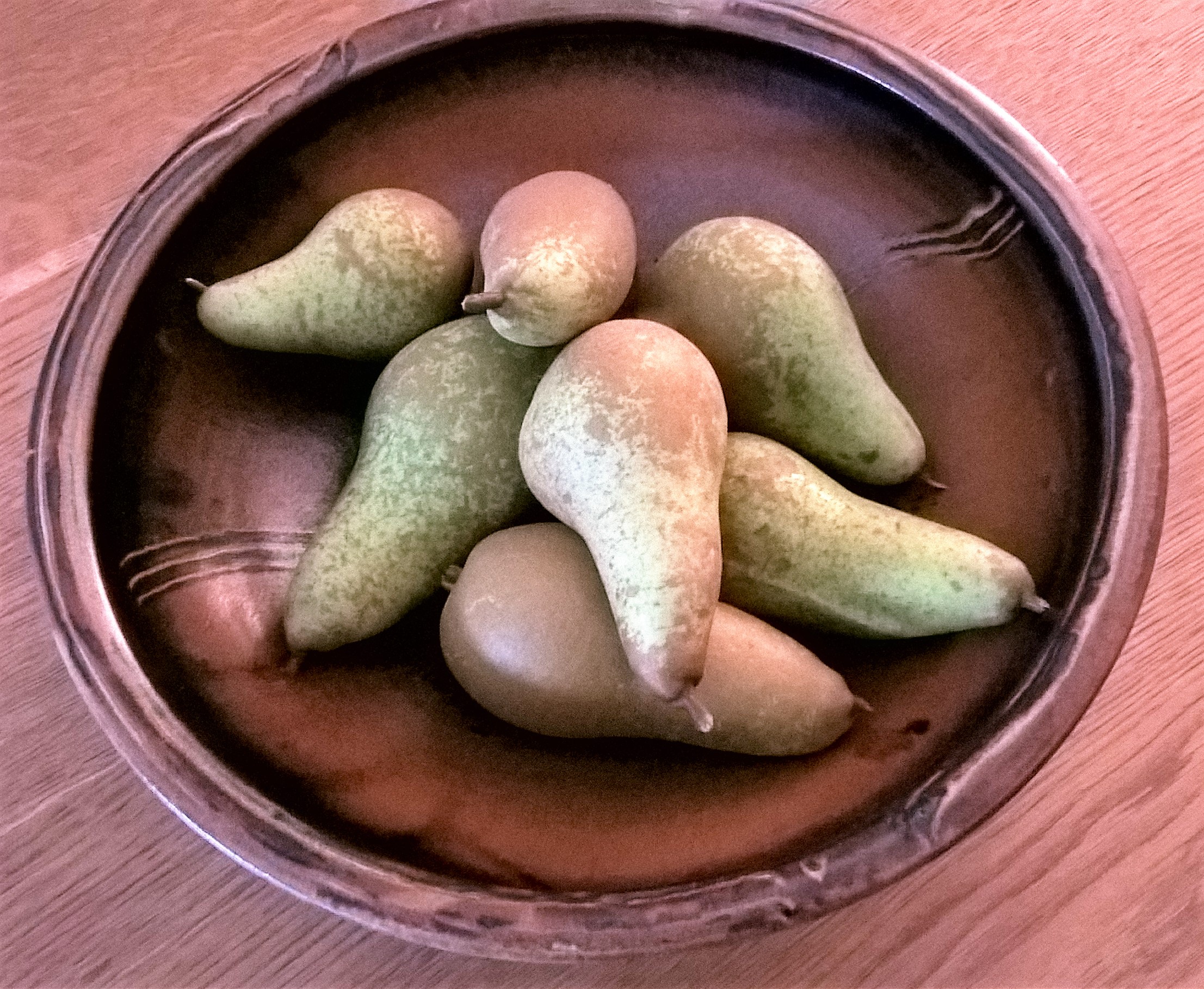
wp_20161012_17_09_08_proThe luminous yellow leaves of the pear trees, espaliered against the drab fences of our small back garden, their mottled fruit juicy and ripe after time in the bowl indoors.

The rowan trees lining the cul de sac, branches weighed down by luscious clusters of crimson and orange fruit.

And now, sheltered against our back fence, beneath the path of the red squirrel, skittering its way to a peanut feeder meant for the birds, the very last roses of summer.

‘Dusky Maiden’ is boasting two brave blooms. Crimson petals, yellow stamens.  Small, delicate, simple. Defying the season.

In a perfect line of sight for me when I lift my eyes from my desktop.

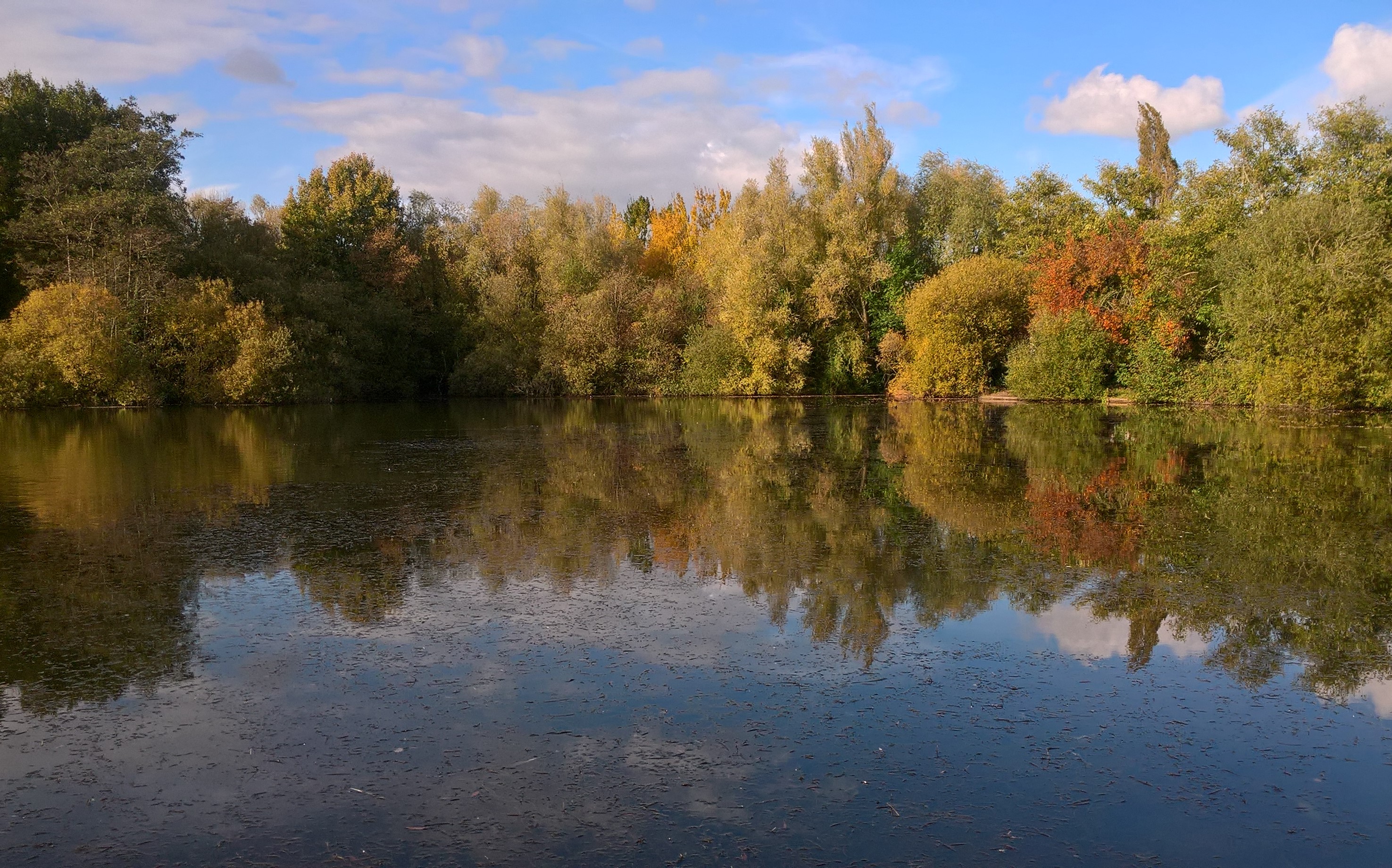
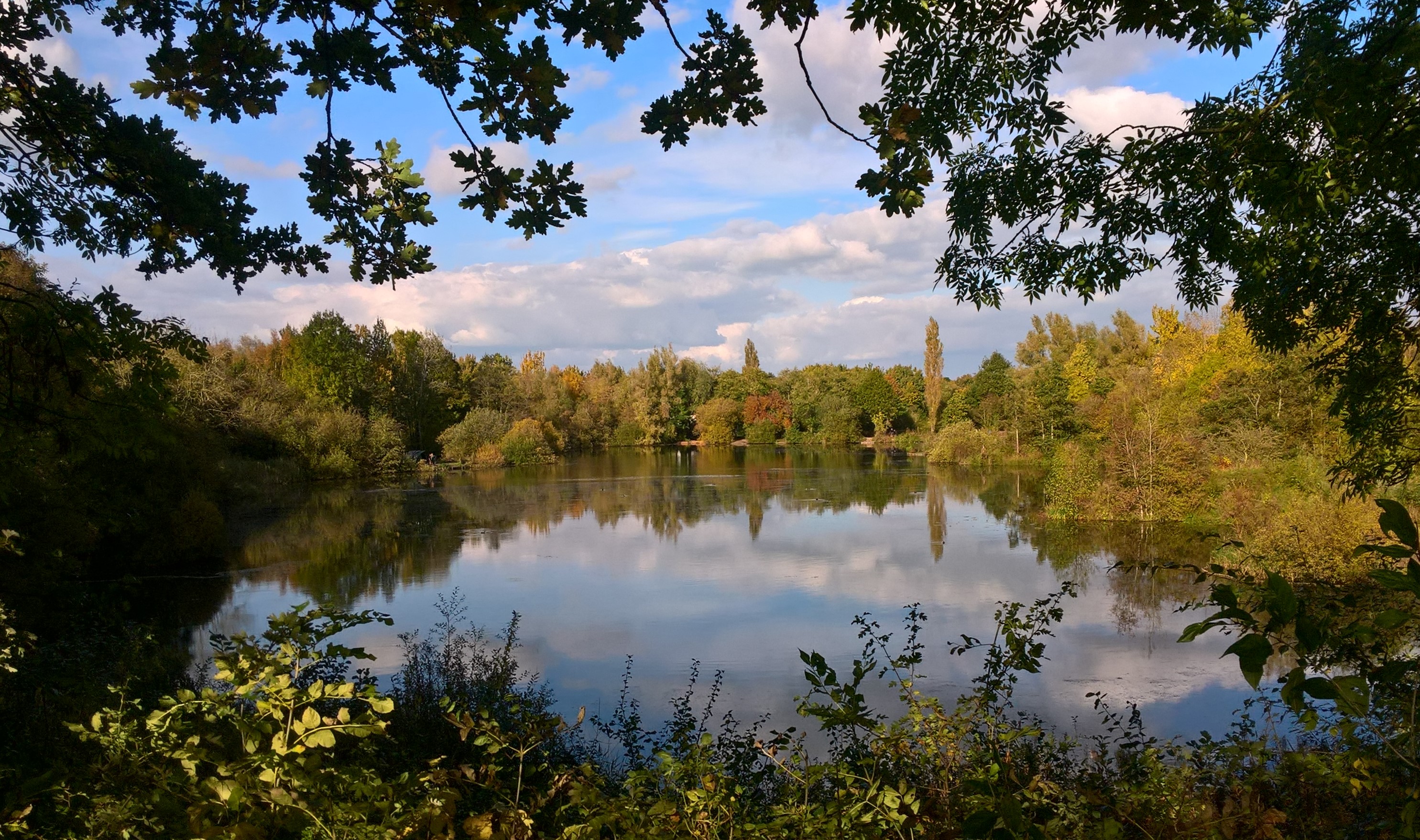
There have been walks. In a nature reserve, cached in a former brickworks. Trees decked out in their finest finery, gaudy cascades of gold and bronze, reflected in ponds swimming with resident waterfowl. People and dogs, birds and insects, fungi and flowers – all manner of life is here.wp_20161022_14_26_31_pro-2

wp_20161022_14_33_52_pro-2

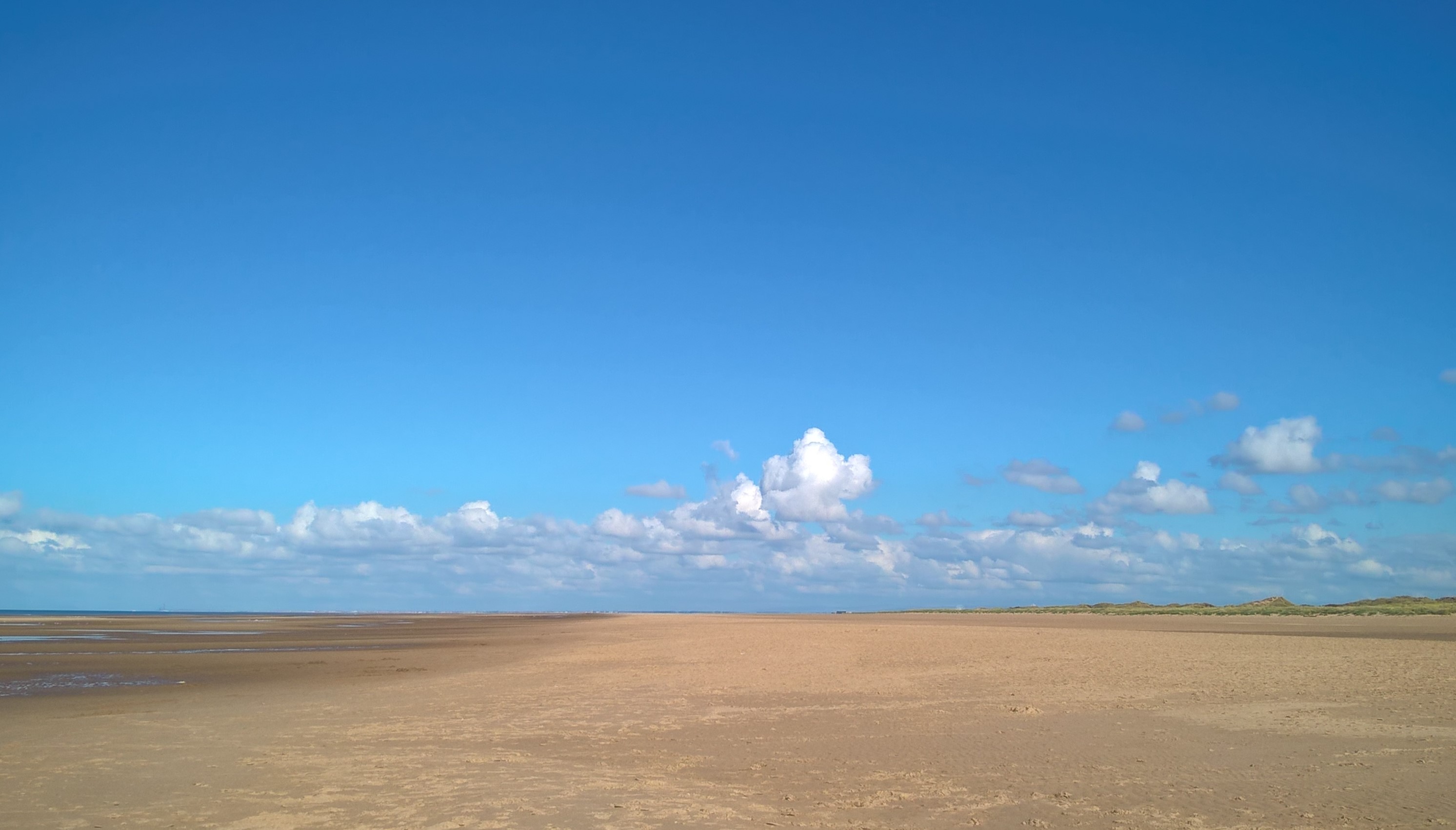
There have been strolls on the vast sandy stretch of our local beach, tears rolling from my eyes as the cool wind catches the corners.

wp_20161012_12_52_33_pro

There was a trek, at dusk, to a special Wildlife reserve. An hour spent waiting and watching, legs chilled, eyes peeled. Then sighing and ahhing as starlings wove their magical murmurations against the backdrop of a dusty twilight sky. (Be patient with the video, watch the horizon, stay to the end)

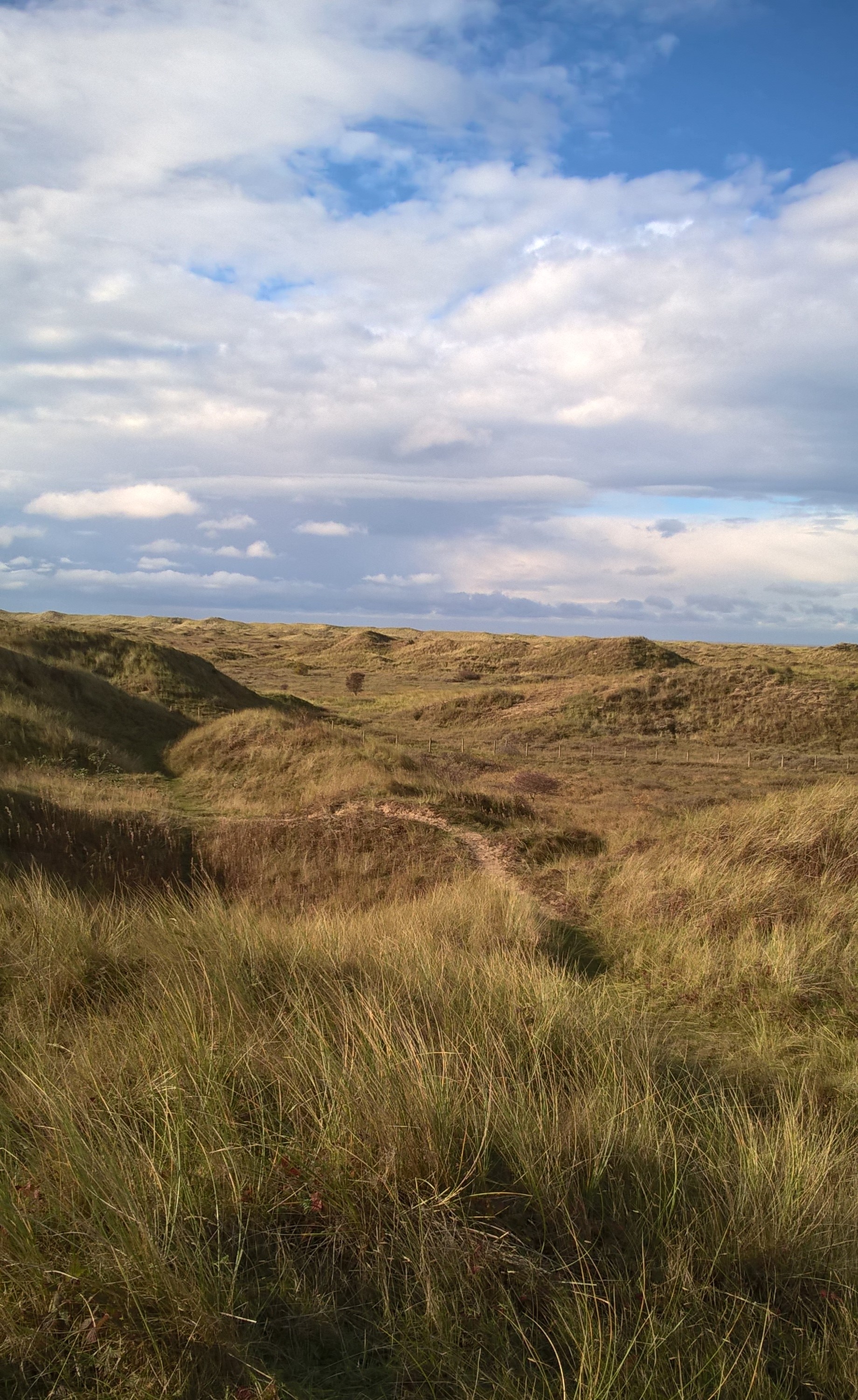
Yesterday was a tromp in our local nature reserve, pine trees soaring above us, roots of evergreens, birches and beeches ribbing the bare sand beneath our feet. Marram grass holding the dunes together. Stabilising the human world. For now.wp_20161106_12_08_55_pro-3

And there have been such sunsets.  Nature’s been wielding a swashbuckling paintbrush these last few weeks.

But the moon is not to be outdone.

A moonset last night had me gasping with delight. A juicy orange segment slipping down to the smooth curve of the golf course, dipping behind it – and suddenly –  expired. Gone. The only clue left, a sliver of amber light, silhouetting the slope of the manicured, marram-grassed sandhills.

Later, we sat out on our little balcony swaddled in wool, begloved and behatted.

We watched the stars turn from vague speckles on a not-quite-dark-yet sky to glittering pinpricks in a cloth of inky indigo.

And amid all this beauty – what?

Joy?

Peace?

Bursts of creative passion and words tripping off my fingers and onto the screen?

No.

Once indoors the dimmer switch has been turned. My mind wanting out. But there’s nowhere to go.

It’s proving dispiriting for me, this autumn.

Don’t get me wrong, I’m aware how lucky I am, to be born in this affluent world, a child of loving parents, educated by good schools and cared for by a free health service. Married to a wonderful man.

I’m aware how well my life has gone so far, how much I have to look back on that’s good and fun and even – some of it – worthy.

But.

The other day someone who knows me well was chatting about some younger folk of our acquaintance. A five year old, I heard, was itching to meet my husband.

A man who knows about dinosaurs and bones and things? I’d be excited too!

But it came at an unfortunate time. A time when I was realising that, not only have I graduated into the ranks of ‘invisible women’ (this is how I wrote it before) as far as strangers are concerned, I’ve also become a nothing as far as, well, non-strangers are concerned.

I murmured something to that effect. And when she said, ‘yes, they just see us as appendages of our husbands,’ I was there before her, in my own head.

She meant no malice. And I didn’t challenge it. She was right. And she’s a kind, loving person.

She’s also a mother and a grandmother. Neither of which I am.

She, I suspect, thinks I have retired from life. Though I’m not of retirement age.

She thinks this, I suspect, because I ‘work’ from home.

I tell her what I’m ‘working’ on, but it feels like an exaggeration. Because my ‘work’ is writing – and I’m not a success. Not by the world’s standards. Not by my standards.

I have no book deal. No agent.

Finished novels languish on my desktop for want of confidence in their saleability. I published one myself – only to discover how bad I am at self-promotion.

Unfinished odds and ends languish in optimistically named folders on data sticks and laptops. Unfinished because I know I have no agent, no deals, no chance – in my own head – of being published.

My last paid freelance work was a drop of rain in a desert. I’m not actively seeking freelance work –but that’s beside the point.

Kind friends resort to saying, ‘but look at what you’ve done.’

Yes. I once was. I once did.

I always feel sorry for folk who say ‘I used to be’ when asked about themselves.

But now, I’m there. An ‘I was’, not an ‘I am’.

Unless I admit to, resort to, being an appendage.

Hey ho.

Late middle age is our autumn, isn’t it? And next, of course, comes winter.

I will regroup, don’t worry.

Pull myself together.

Spring, after all, is just a few months away.

And with the spring comes Wendy  😉 or even … well, let’s just wait and see.

Hope, as they say, springs eternal.

wendy


Posted in Art, jaunts & going out, Lancashire & the golf coast, Thinking, or ranting, or both | Tagged , , , , , , , , , , | 16 Comments

Prepare yourselves. I’m wondering if Donald – yes that one – has a point

If a little knowledge is a dangerous thing, a minute amount of knowledge plus an article in the Times is arguably a foolish way to start a blog post about politics. But then, politics is riddled with foolishness, as I write.

Or is it?

Isn’t it all rather predictable, especially when you consider things such as the state of world trade, in particular, the west’s deal with China?

Yes, that’s where this is going. But first, let me explain…

Laid low by a lurgy last week, I found myself hooked by a couple of blogs*. Both pondering the questions raised by the Trump/Clinton drama being acted out over the pond.

Even at a distance the general shock is palpable. A feeling familiar to those of us who suffered the bereavement-like fallout of Brexit.

There’s a, ‘w-w-w-what the heck’s happening?’ burble issuing from the mouths of politicians, pundits, commentators and journalists.

How did it come to this?

Donald Trump? Why?

How can anyone think that he would make a better president – any kind of president – than Hillary Clinton?

I’m deeply puzzled by the women who don his slogan t-shirts, who’d have Hillary behind bars, if they could.  But I think I can recognise what some of them might be feeling – and why.

My life isn’t theirs – we could be two different tribes. But I suspect all of us, in different shoes, might find echoes of our own worlds in the oddest places, making lambs lie down willingly with serpents.

But I’m even more puzzled by the behaviour of Republican grandees. How come they went along with it this far?

I’ve no time for conspiracy theorists. Seriously, Donald Trump is not running and behaving as he does to ensure Hillary is elected. Yes, some people are saying that, not a word of a lie. (I never tell lies.)

But what is it that’s brought so many people into the raucous crowd that billows behind this blustering behemoth of a man?

Answers came there many.

Answers only too recognisable to bewildered Remainers in Britain, still coming to terms with the Brexit vote.

But yesterday, in the newspaper that plopped through our letterbox, came an article with an answer that rang other bells.

Closure of the coal mines bells. Textile industry moving to India bells. Shipyards abandoned bells. Steel mills threatened with closure bells.

All things that happened, or are happening to the industrial organs of the British commercial body, leaving a lasting legacy of damaged communities.

And a damaged community is made up of damaged souls.

But that’s not where I am going with this – or at least, not directly –  it’s to China. To the free movement of trade.

The article in the Times, written by Rhys Blakely, is behind a paywall so you can only read it for yourselves if you have a subscription. I’ll summarise some of it and hope the author won’t mind.

The headline reads:

Town that furnished America’s dream sold out by globalisation

The town is Hickory, North Carolina.

In 2001, after 200 years of being ‘the furniture capital of the world’ (self-professed, I assume) a shock wave hit the town.

China joined the World Trade Organisation.

In the nine years, between 1999 and 2008, unemployment rose from two to 15 percent.

Cheap imports flooded in, jobs flooded out.

The benefits of freer trade – cheaper prices – went unsung amid the visible decline of once prosperous towns and cities like Hickory across the USA.

There, as in the UK, certain industries clustered in certain areas – making the problem as clear as acne on the skin of the nation.

Then, to add injury to insult, came 2007.

In 2016 it looks as if around half of Hickory’s population will vote Trump. Not because they like the man or find him presidential (according to quoted vox pops), but because he understands what free trade has done to them, to their family’s aspirations and expectations, to their community.

Most of the areas worst affected by this trend have certain things in common and it’s not surprising, when you consider the Trump support base and when we over here think of Brexit, that they tend to be areas where people are whiter, older, less educated – and poorer.

According to the Washington Post (quoted in the Times) Trump, in the presidential primaries, won 89 of the 100 counties that have been most affected by competition from China.

All of which (thanks, Times, you’ve done your bit) made my in-house academic (he’s the one who voted) wonder about the World Trade Organisation.

And he wondered aloud. Then went online. A sensible chap, he stopped at that – but when he started talking about Dan Brown my writing whiskers sensed a blog post, if not a full blown thriller.

I have neither the time, the expertise nor enough of your patience to go much further with this today. But I want to give you a little taster of what I found in just a couple of minutes.

  • The World Trade Organization came into being in 1995. One of the youngest of the international organizations, the WTO is the successor to the General Agreement on Tariffs and Trade (GATT) established in the wake of the Second World War.
  • The WTO has about 160 members, accounting for about 95% of world trade. Around 25 others are negotiating membership.

The press release from the WTO welcoming the agreement with China said:

“During a 12-year period starting from the date of accession there will be a special Transitional Safeguard Mechanism in cases where imports of products of Chinese origin cause or threaten to cause market disruption to the domestic producers of other WTO members.”

And I wonder (because I have so little knowledge) did the people whose jobs have gone, thanks to Chinese imports, here in Britain and over there in America, know about that safeguard mechanism?

Was it applied to Hickory?

There’s a list on the website of the many cases made to the WTO  relating to this issue, mostly (it seemed to me) emanating from the EU and the USA. I haven’t the time or inclination to delve further. Yet. (Though that mention of Dan Brown does have my writerly neurons firing.)

But, in the meantime, I wonder, who, exactly, negotiated China’s deal? (We don’t know.)

And who policed it?

We hear of these world organisations, everyday news-bulletin acronyms – and nod them by, assuming they’re doing good on our behalf.

But what if?

When it comes to politics and trade, too little knowledge, I fear, is the really dangerous thing.


*Those two blogs:

Prepare to be depressed by the ‘Idiot of the Week’ series:   https://jilldennison.com/

And yet more potentially depressing thoughts on US politics in the run up to the election: https://hughcurtler.com/

Posted in Thinking, or ranting, or both | Tagged , , , , , , , , , , | 15 Comments

Precious

It’s one of those Zambian names, along with Gift, that always makes me feel good about my fellow humans. Naming a baby girl Precious is just such a joyful thing to do.

Lately I’ve been wondering about the things we rich-nation folks call precious. It was the mention of emeralds in my last post about Rio that set me off.

I need to confess something right at the start: I have a massive collection of jewellery.

The only gold I have, though, is a cheap, white-gold ring, bought from Ratners* the week before our wedding when we realised we’d forgotten about such trivia.

*(if you haven’t heard of Ratners, Google it with ‘prawn sandwich’ )

I’ve had gold jewellery, but never very much of it. A gold and amethyst ring given me by my godmother vanished along the way. A gold cross, also her gift, was stolen.

A gold and garnet signet ring which had belonged to my grandfather I foolishly lent to a long-term boyfriend to wear. He took it off to shower – it was gone when he dried off.

A second-hand gold and ruby ring came from another former boyfriend, along with some seed pearls threaded on a gold chain. Both, like he, are long gone. He wasn’t very observant. Gold has never been my thing.

Silver, though, I adore. And turquoise.

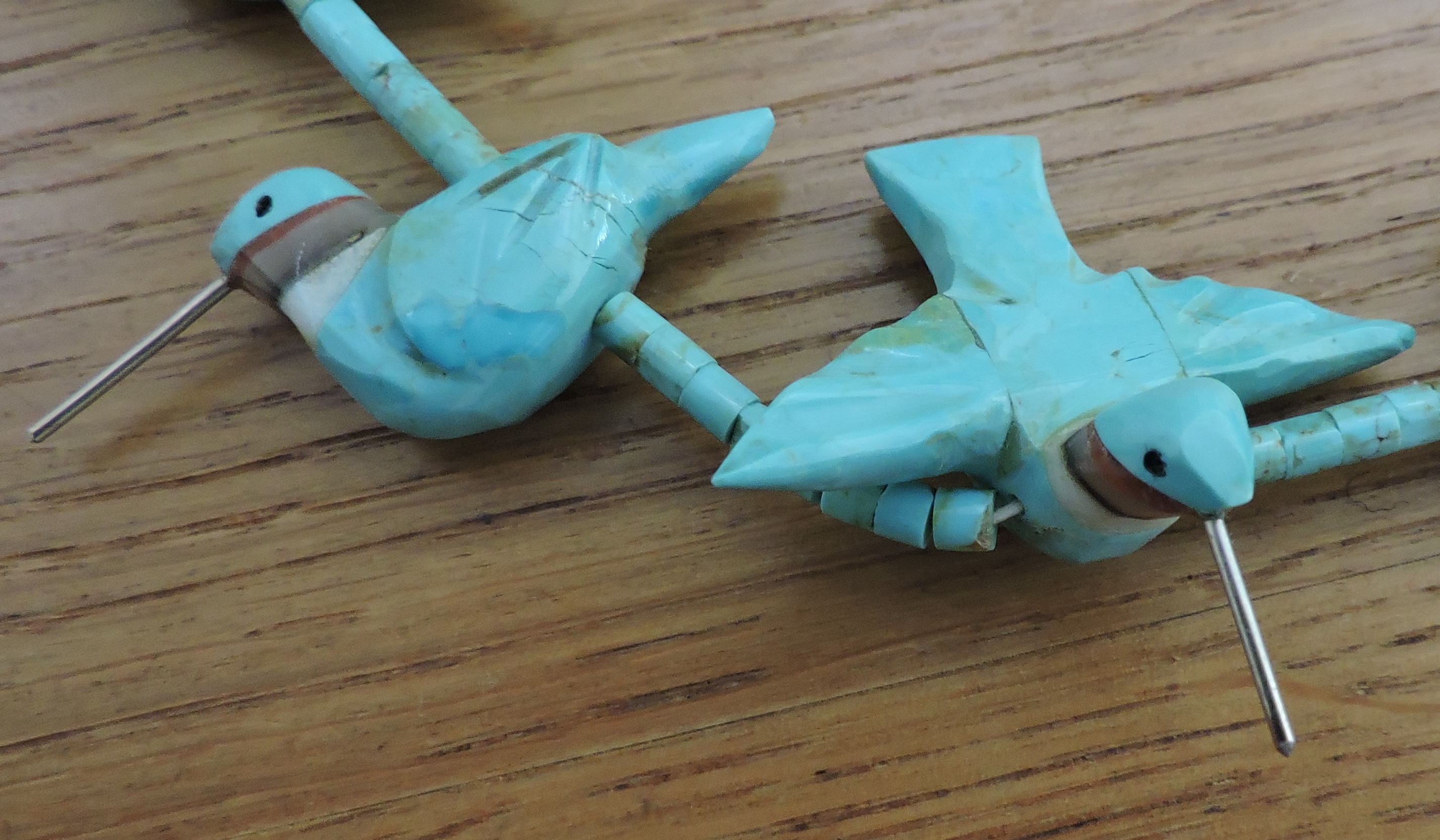
I have a lot of silver. And turquoise. I have a necklace that’s 17 humming birds made of turquoise.

The neckalce has 17 humming birds, the central one, here, is different, all the others like this, finsihed with silver and agate.

The central bird, with the open wings, is different. They’re all detailed with silver & agate.

But I also have a lot of things that have little or no monetary value.

Bracelets made of grass.

Necklaces made of seeds.

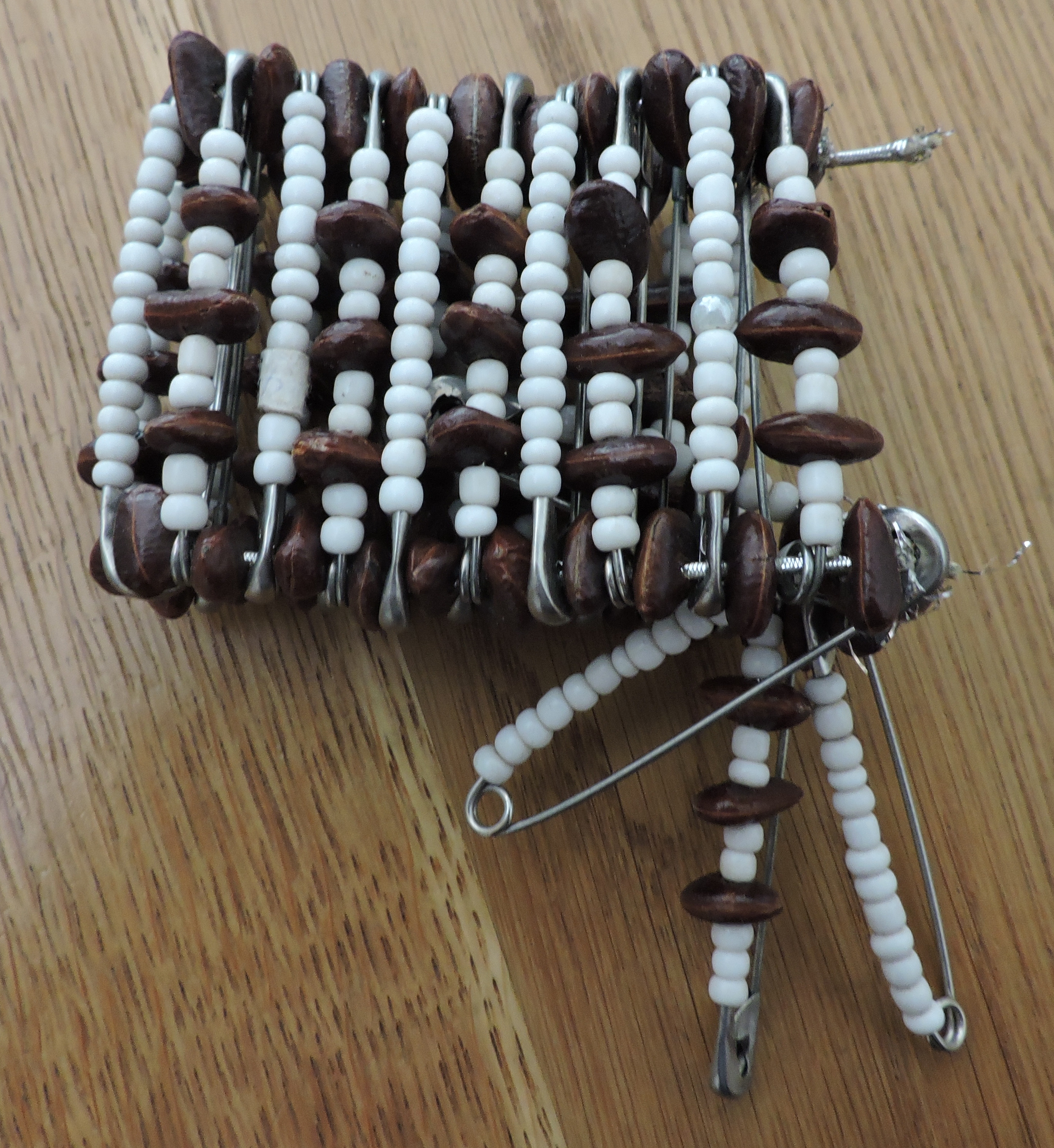
Brooches made of safety pins.

Rings made of cow-horn.

Earrings made of snakeskin.

Yes, snakeskin. Dyed red.  It was a phase. I’m over it.

I also have things made from bits and pieces that some would regard as precious and others would not.

Trade beads, for example, some westerners regard as precious. Nowadays similar beads are made in Ghana, I’ve seen them – and very pretty they are too. Though possibly not as robust.

Copper comes and goes as a ‘precious’ commodity and I have plenty of that, from various African sources.

I have bangles made of Malachite, that gorgeous, deep-green ore that copper can be derived from, which is regarded as semi-precious.

I hope no-one’s ever named their child Semi-Precious. I’ve encountered some odd names – Transistor Radio, for example – but that would never do. Imagine growing up semi-wanted? But I suppose it might spur the young woman on, to prove she’s way better than semi.

Anyway. Back to the great discrepancy between what some regard as precious and what others regard as waste.

I’ve written before about a session my in-house-Prof holds with students in which he asks them to clear their minds of preconceptions. To imagine they’re humans who have never come across the objects before them and rank them in order of value. Silvery bottle tops, transparent plastic bags, safety pins and so on. It’s a revealing exercise.

What has value and why?

Safety pin bracelet - sadly the elastic has broken

Safety pin, seed & bead bracelet – sadly the elastic has broken

Last year I was given a dozen bracelets made of ‘waste’ glass, threaded on elastic.

Handmade, from materials the maker must surely regard as precious, since people like the beads enough to swap them for paper  money (now there’s an interesting concept in value).

The beads are rolled by hand on stone slabs until they’re sufficiently spherical.

Some are made from beer bottles.

Some are made from Coca Cola bottles.

Some are made from trade beads.

(Which we, being westerners and valuing old beads more highly for whatever reason, hope are new.)

Some are painted, some are left plain.

Here’s a rather lovely video showing how the beads are made.

I have a particular fondness for those made out of Coke bottles. Frosted pale green glass, like a terrestrial version of sea glass.

And I rather like the fact that all the marketing hype, all the slogans, colours, logos and other expensive promotional techniques in which the great Coke brainwashers invest is wasted. The beads say nothing about their origins.

They’re just beautiful. In my opinion, that is. I certainly value them more than a sugary, caffeine-laced drink.

I’d planned to include many pictures, of my favourite precious things.  But without their stories they aren’t complete – and to explain would test your patience. And be superfluous.

Because what I’m trying, in this roundabout way to say, is that no one can know what precious means to another.

Yes, scarcity makes gold precious – or do I just mean valuable? But unless it makes you feel that special feeling that precious does – as turquoise does to me, a kind of awe – then it’s not, whatever its value, precious to you.

Enough. You’ve understood by now.

One final point.

I’d like to say a heartfelt thank you to those of you who responded to my last post.

Those words aren’t even drops in the ocean that is the daily outpouring into online world, but it’s not their scarcity that makes them precious.

It’s you and the fact you wrote them for me – thank you.


Postscript: while putting this together I tried several times to photograph the Coke bottle bracelets. It’s impossible (well, for me) – they always look terribly out of focus. Perhaps that’s why I like them so much – they’re elusive!

I’m also giving more thought to ‘precious’ as I wait for the return of my Desktop, not yet 2 years old, yet ready to expire.  The thought has a certain allure. Freedom from all that has digitally gone before…

Posted in Ghana, Thinking, or ranting, or both, Zambia | Tagged , , , , , , , , , , | 7 Comments

Did you miss me?

I expect not. Though now you’ve had this reminder perhaps it’s occurred to you that it’s been a while since I posted.

Don’t fetch your cuppa, though. This is merely a stopgap. Not a fully fledged rant, nor a eulogy, nor reminiscence.

I just wanted to confirm that I’m still around. (I worry about bloggers who vanish – sometimes the reason’s not welcome.)

So, here I am. Still writing, just not writing blog posts. Because I’ve started a new writing project. And it’s diverted me from everything else.

It’s a sort of voyage of discovery.

Revealing a bizarre, interconnected world. One that’s been there all along, I just haven’t noticed.

Like one of those colouring books we had as children – you dip your brush in your jam jar of water, paint the empty page and – ooh!

One minute there’s nothing, next there’s a picture. Magic.

Although I’ve been out and about (a post with pictures soon, perhaps) I’m restricting myself, this time, to my own small patch of territory.

Looking in. And up. And around. And liking it.

Because so much of what’s going on out there, in our crazy, war-torn, unpredictable world, is way beyond my comprehension.  And I won’t let it drive me to despair.

No doubt it will impinge, though, the messy human world – and the rants and the eulogies will resume.

Of course, if the other project fizzles out too soon, then you might just find that here.

In instalments.

It’s not just the world that can be unpredictable.

😉


Posted in Thinking, or ranting, or both | Tagged | 24 Comments

And Charlotte sighs

Reality is fickle.

The day is warm, the breeze light to non-existent. Technology tells us we’ve arrived at our destination. But technology is wrong, bamboozled by forces beyond its ken.

A woman with bright red lipstick, walking a dog, stops and bends to my open widow.

‘Are you lost, love?’

Turn around in the cul de sac. Back the way we came. Turn right past the Cenotaph. Then follow the signs. To Wycoller.

Behind us, a view I don’t see as very ‘Brontë’. Pendle Hill, made infamous by the 17th century Lancashire witch trials

Now this, the other side, is more of a Bronte view, don't you think?

Now this, the other side, is more of a Bronte view, don’t you think?

Odd, that. The signs not looking our way. Showing their faces only to those who’ve reached the end – and not found it. Weeding out the faint-hearted.

The large car park is mostly empty. Clumps of tough grass have breached the pale grey crust of ageing tarmac. Reclamation by nature is well underway.

A path descends to the village, separated from the road by a dry stone wall. Separated from the fields by – a dry stone wall.

Nettles, dull breeding grounds for gorgeous butterflies, reach out for careless fingers to sting.

Hawthorn berries are still bitter green, with a tinge of ripening russet.

And there, a wild rose grows, fragile and pink. ‘Charlotte’s rose’, for me, evermore.

I can’t resist. Out with the camera.  A picture, just because.

The wind picks up. Blossom, leaves, stem all dance to its tune.

I wait. But it’s no good.

I put the camera away. And the wind abates.

Oh, well. I shrug and we walk on down the hill. But there’s another Charlotte’s rose.

Out with the camera, again.

In the stillness of middle day, a mischievous wind arises. I give up, with another shrug. Put the camera back in hiding.

WP_20160716_15_09_27_ProAn ancient bridge, a ford, a stream. That tea brown, shallow water. Has it flowed down here from Brontë Falls?

A cloud of midges, riding a sunbeam, dithers over the opposite bank.

And there, beyond the trees, across the ford, over the bridge and tea brown water, it is: the ruin.

‘Last night I dreamt I went to …’?

No, not that one.

Perhaps it’s the empty shell, the fire-blackened ruin that signified doom – and liberation – for Mr Rochester?


WP_20160716_14_22_12_Pro (3)

It isn’t.

But the house that now lies desolate, in ruins, was, they say, the model for ‘Ferndean’. The house in which they lived, dear reader, after she married him. Jane Eyre and Mr Rochester.

The path across the bridge is worn deep into ruts by the passing of many feet.

WP_20160716_15_07_00_Pro (2)

Trees encroach upon the old hall. A heroic fireplace stands proud in the empty, roofless chamber. Children scramble on the ‘do not climb’ masonry.

WP_20160716_14_26_40_Pro (2)

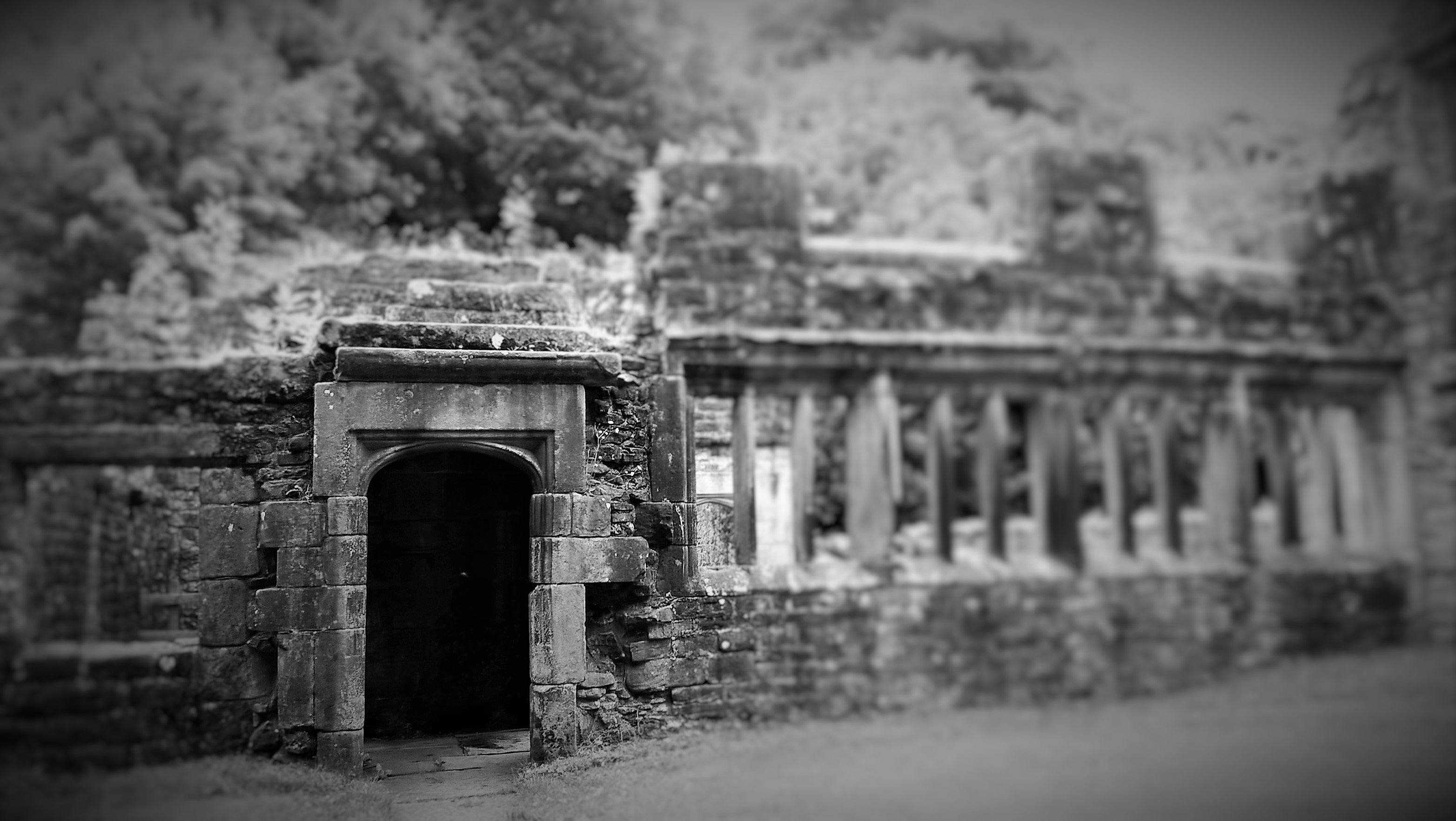
An air of tranquillity – and, perhaps, resignation – permeates the one-time home.

Recklessly lost by a gambler, part ruined, used as a hunting lodge. But never, it would seem, a truly happy place.

A barn contains displays, the history of the hall’s building and decay. The local village’s rise to prosperity thanks to weavers of wool, its decline thanks to the steam-powered looms.

A lone volunteer wipes the bat dung from benches.

‘They eat the midges,’ she says.

Those tiny insects with their insidious bites, not felt till after – and then long after.

‘A midge of a woman…’ says a gossip, of Jane Eyre. Words put into his mouth by Charlotte as the stranger describes Jane, incognito, to herself.

The one-time governess is now an heiress, of independent means. Returning, seeking news of Mr Rochester. Not knowing what she might find.

But what a miserable description. In so many ways.

A midge of a woman.

Was this Charlotte, using the voice of a fictional stranger, to describe how she thought others saw her? I wonder. I’m sure some scholar knows.

Midges aside, the tiny village around the hall is charming, but offers few amenities. A tea room, though, is one.

Inside, a small gift shop sells spells, potions and incantations. We are after all on the trail of those poor maligned creatures, the Lancashire witches.

Despite the dark interior, the place feels good. Homely. Welcoming.WP_20160716_15_14_32_Pro

We order giant crumpets with Lancashire cheese. And tea.

Outside again, we stroll over the bridge, gaze up the path to Haworth. Nine miles too far away.

We head back up the hill.

WP_20160716_15_49_45_Pro

The green of a damp valley


WP_20160716_15_59_58_Pro

Summer in Lancashire….


The camera’s in my hand when another pale pink Charlotte’s rose entices me to stop.

As I point the lens, the wind rustles through the undergrowth and the roses shudder.

Charlotte doesn’t want her roses captured. It’s her sigh from beyond the grave, this gentle wind.

No, I don’t really think she’s here and haunting. But there may be some lingering magic.

After all, it is a hidden valley.

And, possibly, bewitched.

Witch way?

Witch way?


The whole Wycoller area, its landscape and the village’s treasures, are one more thing under threat thanks to ‘austerity’ measures, in this case cuts to local council funding, in Britain. Lancashire County Council has to find a new guardian for the house, barn, car parks and landscape by 2018. The cuts are already biting :

Notice in one of the car parks

Notice in one of the car parks

Note: to my shame, I had Wycoller spelt Wykoller. Tsk. Corrected now, this 14th day of May 2017.

Posted in Art, jaunts & going out, Britain now & then, Lancashire & the golf coast | Tagged , , , , , , , , , , | 7 Comments