The little matchgirl. A tale re-told. Part 2 of 2

nightA spiteful wind howls around the streets. Blows away the fog, the smoke – the warmth.

Jack Frost mocks the locked gates of the arcade. Dances through their iron bars, into the doorway where the little girl huddles. Touches her toes and nose and fingers. Nips at the elbows poking through holes in her threadbare cardigan.

Molly is fast asleep – and dreaming. Of hot stew and fur boots. Of feather cushions and roaring fires.

But Jack Frost’s teeth bite harder – and she opens her eyes. Looks at the matches in her lap. Thinks of that leaping fire.

Beside her a low brick wall rises up to meet the curved glass window. She takes a match and strikes it on the brick.

The light flares.

Molly smiles at the brightness and the sudden spurt of warmth. Holds the match to the window and sees its reflection. Leans closer.

Inside the window, a mannequin models a long fur coat.

The match goes out. The fur coat disappears.

There’s no going home, now, she knows. Without pennies her father will beat her. Without matches or pennies he may well kill her.

Tomorrow she’ll have to think of something. But tomorrow’s so far away.

And she’s so cold.

Molly ties the red flannel around her head. Takes a bundle of matches and tiptoes from doorway to doorway. In each she strikes a match and waits till it goes out, nose pressed close against the glass.

In one short evening Molly sees a world she will never know. Gold and wine. Books and chocolates. Fur-lined boots and cut glass decanters.

As the clock chimes midnight Molly finds the warmest doorway and lights the remaining matches, one by one. Imagines that each is a falling star, the kind you wish upon, as they die their beautiful deaths.

And then, she sleeps, still wishing.

At five o’clock the clock strikes. Long before the invisible dawn.

One of the iron gates groans as it opens. Groans again as it’s shut.

A woman, Elspeth, enters the arcade. Her job – to brush away any dirt that blew in overnight.

Her jaw hurts badly, today. But at least she’s alive. Thank God.

She puts the small lantern she’s carrying down. Bends to pick up a heap of old newspaper, blown into the corner of a dark shop doorway.

But it’s not newspaper. It’s a little girl.

Molly is barely alive. The woman picks her up. Cradles her in strong arms. Breathes warm breath on her face.

Molly dreams of a smoking fire, putting out a strange smell and wonders what’s burning. Her little eyes open and she sees a miracle. A face, shining in the dark.

The woman with the ugly face – for ugly it is – smiles as best she can. Molly gasps, startled, as the vision becomes real – and awful.

She wails.

The woman shushes her.

Elspeth, old at thirty, puts her shawl over Molly and bids her stay still while she cleans.

Her tasks over, she bears Molly, piggyback, all the way home. In the dark.

Elspeth’s jaw gleams when she speaks. When she smiles. When she’s silent.

She works, by night, at any job she can find, when it’s dark and no-one can see her. Stays at home by day, safe from the stares, the shouts and the spitting.

She’s had the worst of it removed, now. She should not die.

Not yet.

Molly is frightened, at first, by this ugly woman and her shining jaw.

But as she sips at a bowl of hot soup, wrapped up in Elspeth’s blanket, in the flickering light of Elspeth’s small fire, she thinks she understands.

The lady’s a saint. It’s just the halo slipped.

Perhaps her saintliness came from her words, not her thoughts.

Yes, Molly likes that idea. And she smiles the first smile that her ugly saviour has seen in months.

And so Molly sleeps. And dreams.

Feels safe.

Tonight she’ll eat bread with beef dripping.

Tomorrow, she’ll have a new job. Making matches, for the Salvation Army.

And for Christmas, this year, she’ll eat ham hock with cabbage.

Luck, at last, has visited our poor little match girl. But Luck, as we know, can be a fickle friend.

Fear not, though, for Molly.

For thanks to a stranger’s Charity, now, she will always know Hope.

And, this year, her first happy Christmas.


Merry Christmas (or whatever you’d like to celebrate), to one and all!

If you’d like to know a little of the background to this little match girl’s story read on:
For years in the late 19th century the match firm Bryant and May used white phosphorus for making its matches, even when it became clear that it could cause terrible sickness and death. It was very poorly paid work. The young women and girls who did it were not allowed to take time out for eating so ate while they worked which transferred the phosphorus to their mouths. ‘Phossy jaw’ began with pain, progressed to glowing bones, necrosis of the tissue and – if the jaw bone was not removed (and often even if it was) – to death.
The plight of the ‘match girls’ became famous (or infamous) when campaigner Clementina Black, an influential and early women’s trade unionist, gave a speech at a Fabian society meeting which was heard by journalist Annie Besant. Besant helped organise the Match girls’ Strike of 1888. Better working conditions were eventually agreed, but it took years before B&M stopped using white phosphorus and in the meantime the Salvation Army set up a matchmaking business using the safer red phosphorus – which B&M eventually took over.

Posted in Fiction, probably | Tagged , , , , , , , , , , | 24 Comments

The little matchgirl. A tale re-told. Part 1 of 2


once upon a time

                                                        … when respectable heads were hatted and industrial smoke filled every lung, when automobiles were rare and horses and carts were common, then, lived a poor little match girl. Molly.

We join her one cold December day, as the clock strikes noon.

Grates heaped high with coal blaze brightly in many-roomed merchants’ mansions.

Glimmers of red peep out from meagre fires, damped down with vegetable peelings, in the terraces of the poor.

Factory chimneys, tall and soot-blackened, jab at a place where the sky might be – but instead is choking fog.

Molly is used to the smoke. So used to the smoke she doesn’t see it. Sulphurous yellow, grey or black – the guises of smoke are nature’s work, as far as Molly is concerned.

Molly has no coat to keep her warm. Her father sold it – came home drunk, again.

Her shoes are cast-offs – and too small. So small, they make her icy feet feel icier still.

Filthy water, churned from the grey-yellow slush by the wheels of horse-drawn carriages, seeps through the holes in their soles.

Christmas is coming – but that means nothing to Molly. There will be no tree, no presents.

She won’t be eating goose or beef. Just boiled potatoes, or turnips, or perhaps a bowl of watery soup – with bread, if she’s lucky.

But Luck is someone her family doesn’t know.

That’s why Molly is out on this miserable, chest-congesting day. Hoping to sell matches to gentlefolk. Trying to earn pennies, to buy some luck.

Molly makes her way to the smartest part of this grimy town. To a brightly-lit arcade of shops.

It’s warm in the arcade. But the man with the black top-hat and coat with shiny brass buttons will hit her legs with his stick if she tries to sit inside.

So Molly stands at the edge of the shop on the corner of the glowing tunnel. One side in the dark world, the other in the bright.

Marvellous riches are there, her brother says. Rings for ladies’ fingers, coats for gentlemen’s backs. Gloves and hats – and bowls full of flowers. Wonderful things, in that golden, forbidden realm.

But Molly’s not angry, nor envious – don’t presume to know how she feels. This is the way things are – how could she know anything other?

Molly holds her store of matches in what looks like a large red handkerchief. But it’s not a handkerchief, it’s cut from a red flannel petticoat that a kind old lady gave to her mother.

Striking a pose, with a false, bright smile, Molly keeps watch. Endeavours to catch the eye of each likely buyer that passes her by.

A man with a fat cigar. A man with a thin cigar.

A man tamping down his pipe tobacco.

It’s an ugly old ogre of a thing, his pipe. Molly squints to work it out.

It’s shaped like a head, has a face.

She won’t make a sale. The man has a matchbox, in silver, attached to his waistcoat watch-chain.

He scrapes a match on the serrated edge. The flame flares.

He puffs – and puffs – and smoke curls out of the ogre’s head. Molly shudders.

Smart ladies chatter as they approach – until they see the little girl. Edging towards the other side of the pavement they turn their heads and tut.

Little slattern, how dare she.

One lady – perhaps not such a lady – stops as she leaves the arcade. Takes something from a paper bag, hung by striped-string handles. Opens a little grey tin. She tilts the tin to the light, revealing a row of brightly coloured – what?

Molly doesn’t know what they are.

The woman removes a blue stick, inserts it in a tube, puts the tube to her mouth. Fumbles around in her bag – then sees our little match girl.

How much?’ she asks.

‘Tuppence a bundle, ma’am,’ says Molly. Her dad says they’ll pay it, at Christmas.

The woman rummages in her deep, beaded bag, but cannot find two pennies. She shrugs, puts the cigarette – a Cocktail Sobranie – back in the tin.

The sale vanishes into the fog. Soon she’ll be sipping cocktails, in a smart hotel. The staff will light her cigarette, for nothing.

A clock, somewhere, strikes four.

The winter’s day grows murkier. Darkness, unseen, saturates the world.

The arcade’s golden lights are almost painful, now, for Molly to behold.

The smoke – she doesn’t know it’s the smoke – makes her eyes prickle. She rubs with one hand and clutches the matches safely with the other.

The clock strikes five.

The man with the coat – and buttons – and hat – begins to close the arcade.

Soon all the light is gone, except for the dull, hissing, gas lights lining the street.

The fog becomes denser – or perhaps it just seems that way, now the light has stolen from the world.

Molly is frightened. She’s made no money and her father will be angry. She wonders if she can slip into the arcade before the big man notices.

A shopkeeper stops to chat. As the two men laugh, barefoot Molly– she’s left her worthless shoes behind – runs into the arcade.

Like a piece of newspaper tossed by a sudden gust, she flies into the corner of the nearest doorway – and nestles.

The red flannel settles on her lap like the breast of a wintry robin.

But tonight the world will grow bitter.


Please forgive any anachronisms. 


Posted in Fiction, probably | Tagged , , , , , , , , , | 8 Comments

Beheaded for flirting? LOL!

One of the things foreigners living in England always struggle with is identifying the social trip wires.

How do you hold your fork?

Is it a napkin or a serviette?

Do you need to go to the toilet, lavatory or loo?

And – perhaps more 2015 – when is it socially acceptable to use emojis or textspeak? (Tell me if you know the answer.)

IMHO  🙂   the fact that even the garden isn’t safe has always seemed just a tad ridiculous.
I mean, take the ordinary pink (or blue) mophead hydrangea. Is it an acceptable shrub for a middle-class, wannabe-upper-class, garden?

Say what?

You’d think the answer would be, ‘if you like it and if it’ll grow where you live, plant it. Who cares?’

Well, people do.

And when it comes to music, Gilbert & Sullivan – did I hear several sharp intakes of breath? – is a very, very pink (or blue) musical version of the hydrangea. Not a lace-cap one (they’re OK, especially if white). Just an ordinary, big-bloomed, blowzy one.

The production of the Mikado we saw last week was first performed 29 years ago. And it created a dilemma for the cultured classes then, in its own, small, artistic way.

Not only was it staged by the English National Opera (acceptable), it was – and still is – directed by a man who’s undeniably classy, clever and cultured. A human colossus of taste and style (don’t quibble with my construction, I’m tired, it’s December and I have a cold).

So what did those who needed to read all the class runes correctly do about this radical Mikado (for radical it was)?

I don’t know – and I don’t care. Because I enjoy Gilbert & Sullivan.

There – I’ve said it.

I can see the curl of sneering lip, the wrinkle of snooty nose. The not-quite-concealed smug smiles.

‘Aha,’ the point-scorers cry, ‘she’s failed!’

My own enjoyment of G&S – the Mikado in particular – goes back to my teenage years, revising for exams, with a very bad cold, at home. My parents had a two record set. I played them, again and again. Loved the tunes, could understand most of the words.

The first G&S production I saw in real life, though, was not the Mikado. It was an amateur production at my father’s school, combining the talents of his boys’ school and my girls’ school in Trial by Jury.

All I can remember about it is the boy I fancied. Gerard. Ges. Good looking, great singer. And a heartbreaker (not mine).

Later in life a boyfriend (well, actually it was a less-than-satisfactory relationship that never quite took off – though we had three attempts at it. He was very sporty – cricket and rugger – maybe that was the problem?)

– sorry, where was I? Got a bit distracted there.

Oh yes. Wicket-keeping, rugger-playing chap took me to see Ruddigore, one of the lesser known G&S works, in Oxford.

Ruddigore stands out for me because of one line. There’s a character called Margaret who tends to get a bit wild. The only way to calm her down is to say, in emphatic tones, ‘Basingstoke, my dear.’

Having worked a couple of years in Basingstoke I’m not convinced of its likely effectiveness.

But moving on.

Last week we went to one of those ‘live’ screenings at the cinema. It was a revival of the same Mikado we were fortunate enough to see all those years ago.

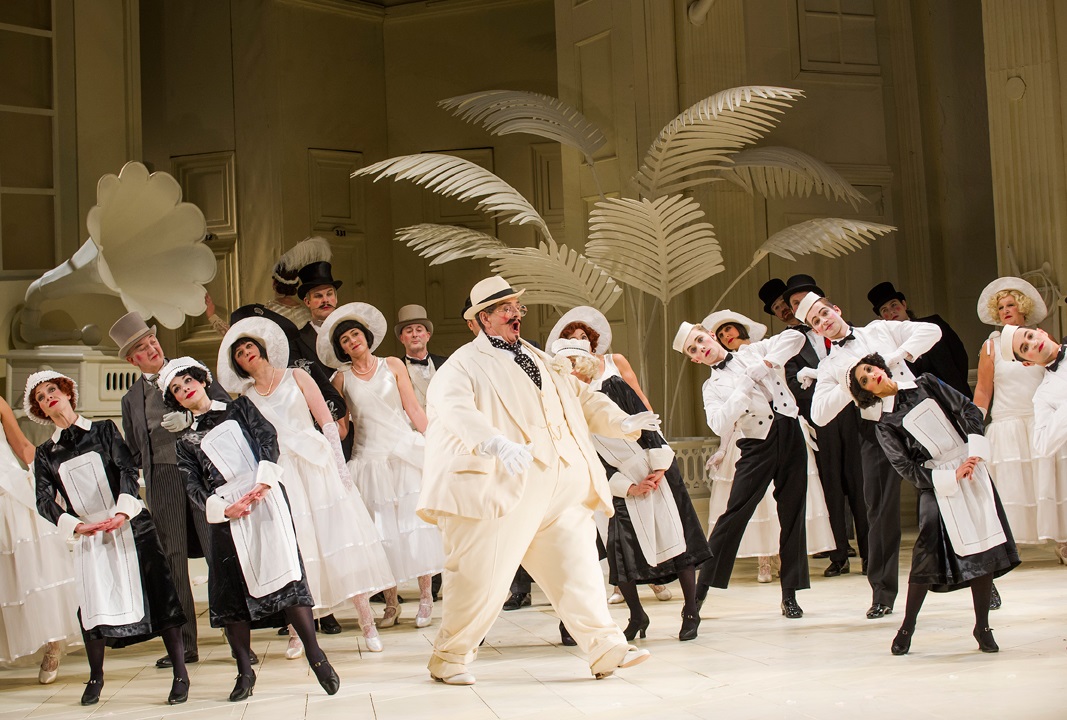
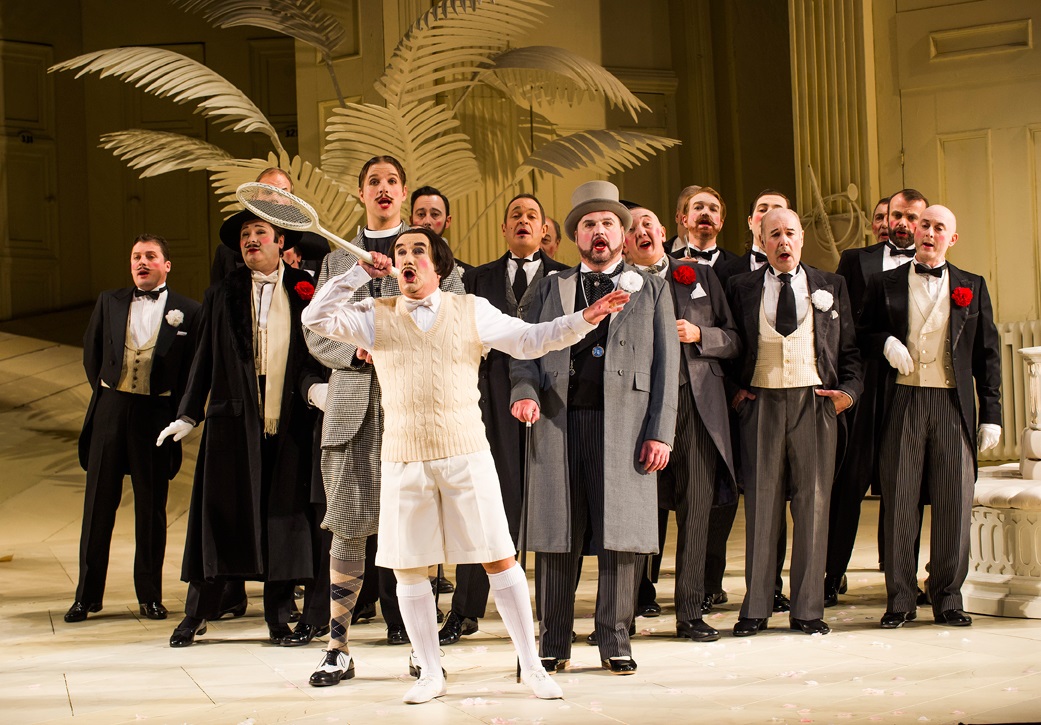
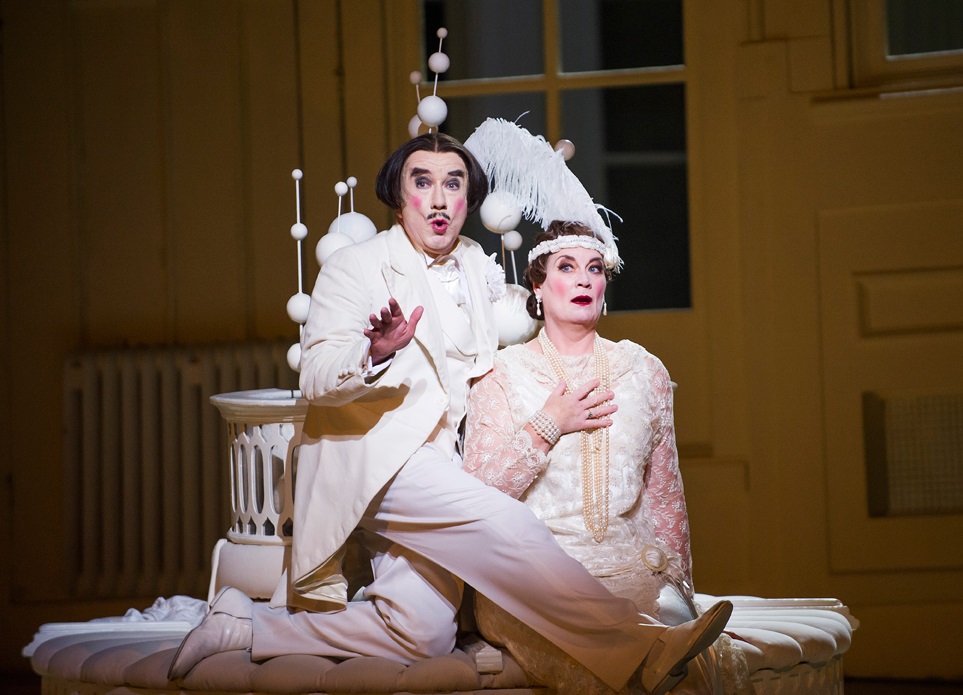
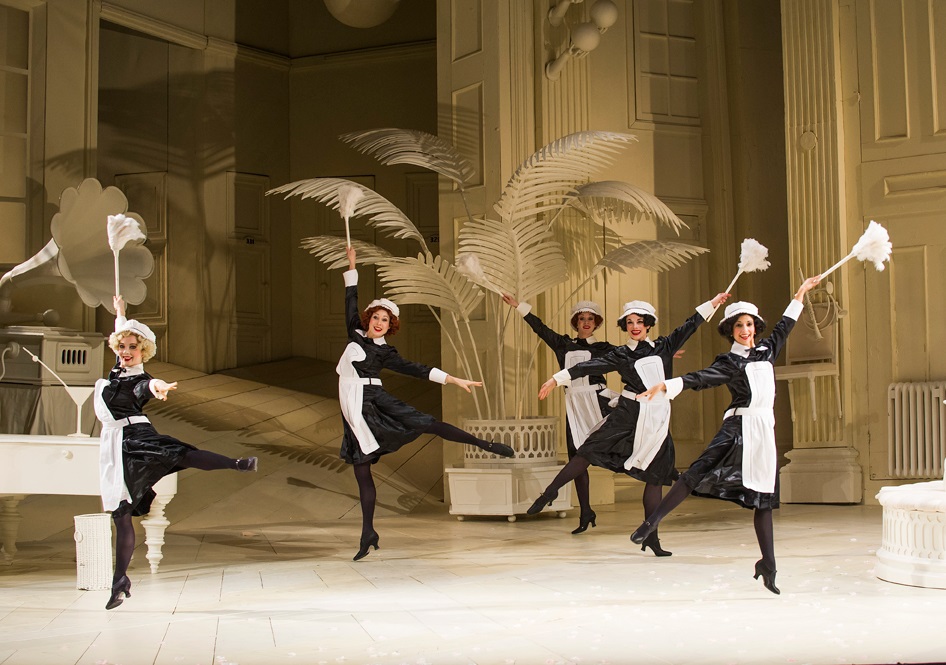
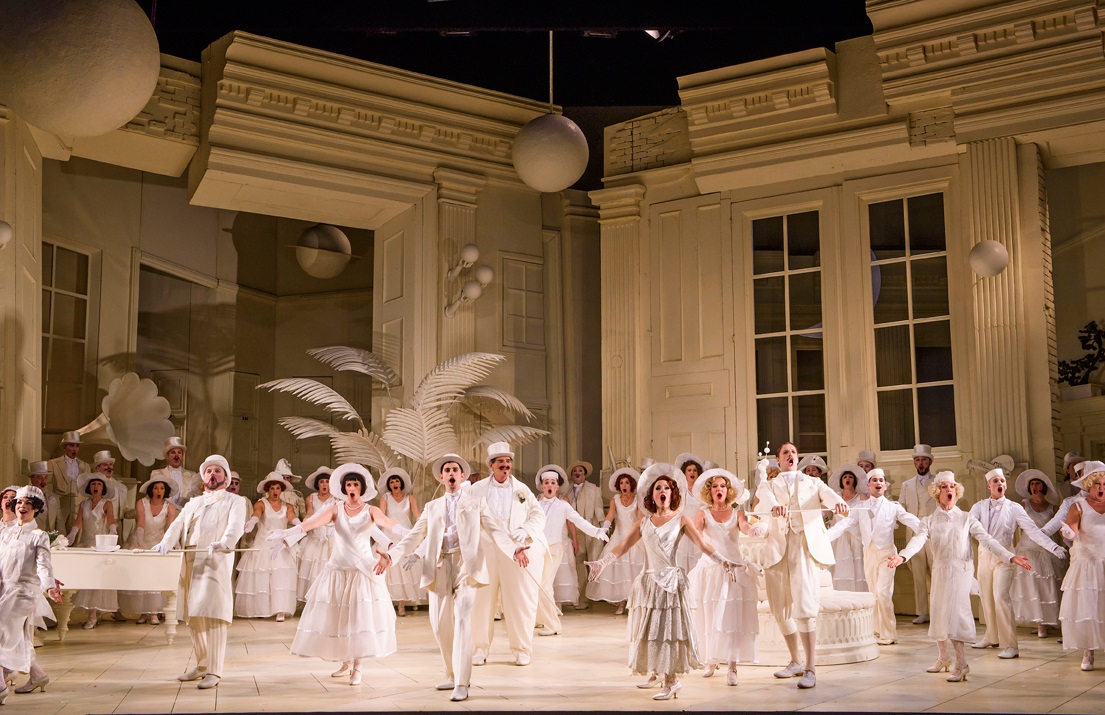
One reason it was and still is deemed so radical is because the set and costumes are all cream and black, the people are smart 1930s society types and it’s set in a genteel seaside resort.

Not a hint of oriental, cherry blossom Japan.

I could hardly contain myself at times, at the cinema. I was desperate to join in. Not just with the songs  – but the dancing. Tap dancing.

I challenge anyone to see this production and keep their feet still. It’s utterly, utterly joyous.

But.

Lest you think this depressive leopard has changed her spots, there was something. More than one something.

The cast resplendent on stage (photo ENO web page 2015)

The cast resplendent on stage (photo ENO web page 2015)

I was not feeling too hot, world getting me down, life passing me by – you know, the usual stuff. It dragged me out of myself and threw me around like a Scottish dancer in a reel. I loved it.

But (again).

G&S are – IMO – great social commentators. As relevant now, in many ways, as they were in the nineteenth century.

And I couldn’t help but notice the parallels.

Mikado is the big man cetnre of course (photo ENO web page 2015)

Mikado is the big man cetnre of course (photo ENO web page 2015)

Titipu – the mythical place where the action is set – has an Emperor – the Mikado. To steady the young men of Titipu he’s set a law that ‘all who flirted, leered or winked (unless connubially linked)’ should be beheaded.

One poor chap, Ko-ko, was found guilty of said crime – but escaped by virtue of becoming the Lord High Executioner.

Ko ko the Lord High Executioner (phtoto ENO web page 2015)

Ko-ko the Lord High Executioner (photo ENO web page 2015)

The Lord High Executioner has a little list of people ideally suited to execution because they would not be missed.

I laughed, with everyone else, at the revised and updated version to which we were treated.

And I thought about Isis/Isil/Daesh. And Saudi Arabia.

Well, wouldn’t you?

Decapitation is something they seem to have in common.

It’s no laughing matter. But laugh we did.

And then there was the corruption. Epitomised by the Lord High Everything Else. And by the Mikado being able to say something was so to make it so.

Ko-ko and Katisha (photo ENO web page 2015)

And the discrimination.

The  agèd and ugly Katisha. Struggling to marry because of her looks and age.

I saw a fun amateur production in which Katisha was in real life a reasonably elderly lady.

She growled and prowled and shook her walking stick at Ko-ko (never mind how we got here) and asked:

“You won’t hate me because I’m just a little teeny weeny wee bit bloodthirsty, will you?

Ko-Ko: Hate you? Oh, Katisha! is there not beauty even in bloodthirstiness?”

And here’s Ko-ko, hoping for an answer in the negative,

“Are you old enough to marry, do you think?
Won’t you wait till you are eighty in the shade?
There’s a fascination frantic
In a ruin that’s romantic;
Do you think you are sufficiently decayed?”

The game Katisha responds:

“To the matter that you mention
I have given some attention,
And I think I am sufficiently decayed.”

The maids being exuberant (photo ENO web page 2015)

The maids being exuberant (photo ENO web page 2015)

There was more that rang contemporary bells – I won’t bother you with it though (not even the blade and the vertebrae – no don’t ask). I’m aware that sometimes my perspective is a little warped.

And  I haven’t enjoyed myself so much in a long time.

But there’s still a teeny worry, at these contemporary parallels.

See, there’s this in Ko-ko’s list:

“… that singular anomaly, the lady novelist —
I don’t think she’d be missed — I’m sure she’d not he missed!

(Chorus:)

He’s got her on the list — he’s got her on the list;
And I don’t think she’ll be missed — I’m sure she’ll not be missed!”

♩♪♩♩♪♩♩♪♩♩♪♩♩♪♩♩♪♩♩♪♩♩♪♩♩♪♩♩♪♩♩♪♩♩♪♩♩♪♩♩♪♩♩♪♩♩♪♩♩♪♩♩♪♩♩♪♩♩♪♩♩♪♩♩♪♩♩♪♩♩♪♩♩♪♩♩♪♩♩♪♩♩♪♩♩♪♩♩♪♩♩♪♩

  1. Promo video ENO

2. The 1987 version featuring Eric Idle of Monty Python fame as Ko-ko we saw  filmed (not very well) for TV – after this video of Act 1 Act 2 will follow. To see abit of the tap dancing go to 55 or 57 minutes mins on video 1 or for the glorious, exuberant  finale go to minute 58 in Act 2

Posted in Art, jaunts & going out, Britain now & then | Tagged , , , , , , , , , , | 9 Comments

The British Prime Minister  has, it is reported, described political opponents who do not agree with his proposal to extend our involvement in the Syrian conflict as “terrorist sympathisers”.

I am not alone in being both shocked and angry.

I am not a terrorist sympathiser.  I have read, carefully, the cases that he and others have made, for and against the action he proposes. I am not convinced by his arguments, This makes me, I believe, a citizen with an informed viewpoint – not a terrorist sympathiser.


Posted on by memoirsofahusk | 17 Comments

Jesus weeps. The Pope, Christmas, war – and lemon myrtle soap

The pope gave a sermon last month which was widely reported. It was timely. The western world was turning its thoughts to the annual winter ritual of overspending and over-eating. No surprise, then, that the resulting headlines all seemed to focus on the ‘charade’ of Christmas.

I looked up the sermon but couldn’t see where – or if – Pope Francis used that word. Many other words, though, were worthy of headlines. More worthy. Especially now, as Britain decides whether to support France, our neighbour and ally, in bombing Syria.

What the Pope actually said about Christmas was this:

“Today Jesus weeps … because we have chosen the way of war, the way of hatred, the way of enmities. We are close to Christmas: there will be lights, there will be parties, bright trees, even Nativity scenes – all decked out – while the world continues to wage war. The world has not understood the way of peace.”

He had more to say about war and peace, but before we get to that – a glance at Christmas, in passing.

I saw some research recently that suggested British families expect to spend, on average, around £800 celebrating Christmas in 2015. And to do so, many families will go into debt – in 2014 the UK topped the European Christmas-induced-debt league table.

Fine – if that makes you happy. But I suspect it doesn’t. And that’s just one reason why I’d agree that Christmas is, indeed, a charade.

But there’s more to this charade than hopes raised and dashed, than parents plunged into self-inflicted debt and children dissatisfied with even the wildest largesse.

Especially this year.

Especially here, in Europe.

I’m afraid there’s much to be miserable about at the moment.

The weather is vile. Dank skies and squelching gardens. Pelting rain and roaring winds. Grey flagstones and sodden raincoats.

Friends and acquaintances brim-full with sadness, rooted in reasons more serious than mere weather.

Libraries closing, children’s centres closing, police stations closing.

Cars by the side of the road with handwritten signs buckling in the window: ‘For Sale’.

Our economy supposedly growing, but foodbanks busier than ever.

More homeless people on our streets.

Updates from our local soup kitchen make desperate reading – which young, vulnerable person has died from lack of care lately?

Terrorism stalks the world. In Paris, Nigeria, Egypt, Beirut, Tunisia – too many places to list.

Waves of refugees are washing up – some half dead, some wholly dead – on the beautiful shores of the Mediterranean. More camp in squalor twenty odd miles across the sea, in France.

And our government wants to start bombing Syria.

At this point, then, let’s return to what the Pope said.

“Everywhere there is war today, there is hatred.
What shall remain in the wake of this war …?
Ruins, thousands of children without education, so many innocent victims:
and lots of money in the pockets of arms dealers.”

The situation in the Middle East is far too complicated for a blog post of a few hundred words. But anyone who reads any analysis knows that we’re already playing, as a nation, a complicated cat’s cradle of peace and war.

Our arms industries sell to regimes like Saudi Arabia. Saudi Arabian interests fund extremist supposedly-Islamic groups.

Our government once wanted to take us to war against the Assad regime in Syria. Now it wants us to go to war with those who would keep it in power.

Because ‘we’ want to support our allies in the wake of the Paris atrocities.

Surely even a fool can see this is madness?

Precision bombing?

‘Oops, we accidentally bombed a hospital’, admit our American allies.

Today, in the ‘Independent’, a letter from Dr David Lowry of the Institute for Resource and Security Studies, Cambridge, Mass, cited a report on the US bombing, during the Vietnam War, of Ben Tre city. It was 7 February 1968. Associated Press correspondent, Peter Arnett, reported:

“ ‘It became necessary to destroy the town to save it’, a United States major said today. He was talking about the decision by allied commanders to bomb and shell the town regardless of civilian casualties, to rout the Vietcong.”

Dr Lowry fears the same fate awaits Syrian civilians in Isis strongholds.

I can’t say that emulating anything that happened during the Vietnam War sounds like a good idea to me.

And bombing in Syria and Iraq hasn’t exactly worked so far.

So, why do it?

Here’s Pope Francis again:

“War is the right choice for him who would serve wealth: ‘Let us build weapons so that the economy will right itself somewhat, and let us go forward in pursuit of our interests …’ The men who make war are cursed, they are criminals. A war can be justified – so to speak – with many, many reasons, but when all the world as it is today, is at war – piecemeal though that war may be … God weeps. Jesus weeps.”

Now before you have a go at me about Christianity and war – I know. Christianity has no proud history in warfare. I studied the Crusades as my special subject at university.

But we have, I hope, learned our lessons – at least, some of us have. There are, sadly, supposedly-Christian extremists just as there are supposedly-Islamic extremists.

I do not believe we should commit further to a ‘war’ that we cannot win, cannot fully understand and whose ‘planned’ outcome seems like the equivalent of sticking a tail on a donkey while blindfold.

It’s easy to feel dejected by all the misery stalking the world.

It’s tempting to go back to bed and hide under the covers with a good book till it’s all over.

Yet I’m sitting at my desk, feeling like there’s hope in the world.

I unwrapped a bar of special soap this morning and had a long, hot bath – what a luxury.

The soap came all the way from Australia. From a kind and thoughtful person (I know this, despite the fact we’ve never met) who reads my blog and whose blog I read.

The uplifting scent of that lemon-myrtle-goat’s-milk- soap changed my mood in an instant.

Thank you, Elladee, for brightening my day. Despite everything.

And in that new, brighter spirit, I’d like to give the final words to radical poet and playwright, Adrian Mitchell:

adrian mitchell poem


Posted in Thinking, or ranting, or both | Tagged , , , , , , , , , , | 15 Comments

The Lady in the Van meets a surfeit of anoraks

There’s something disturbing about modern cinemas, y’know.

Have you tried shedding a surreptitious tear in one?

It’s light enough to see, that’s the problem. Yes, you can find your seat without crippling half the audience – or yourself – in the process, but the intimacy of the dark – it is no more.

I sort of imagined that, what with the crowd being predominantly beyond middle aged and more than 50% female, a few other folks might be blubbing, but no. So I held my breath and dabbed as unobtrusively as I could at the tears.

I was terrified I might actually sob.

But I was brave. I coped.

I loved the film. Maggie Smith is superb. But I was also skewered by the twin Alan Bennetts. A writer (Alan) and a person (Alan) living his life – or not, as author Alan jibed. Piercing as only self can pierce the self. (Well we are talking writers, here.)

I came out happier in an odd kind of way. Determined to finish my latest book (76,000 words now) and basking in the glow of a few kind words uttered by a few kind people over the years.

Yes, more than once my writing has been likened – I blush to say it – to that of Alan Bennett. And having seen the film, I shudder to think what would happen if a van turned up outside – I can just imagine …

And then, what would the neighbours think?

(Dear friend who’s contemplating buying a van and living in it – you know who you are. Please, don’t paint it yellow, with a dish mop, if ever you plan to visit.)

But, seriously, I think what those people meant, when they said it, was that I notice what ordinary people do in ordinary situations. I notice ordinary things happening.

And I suspect those people are also the kind of people who smile a small smile at the mention of Alan Bennett’s name – and categorise him as gentle. The kind of author one sets alongside tea and a toasted teacake, in a genteel tea room in Harrogate, at half past three in the afternoon.

Well, if they do, the might try reading The Laying on of Hands. I found it at the bottom of a box when we moved and realised I hadn’t read it. Cosy? Forget the tea and teacake. A little vial of vinegar, perhaps?

And as for me. Well, my book is giving me nightmares. I mean that – the sleep-related kind.

Causing me to reassess a lot of things I’ve quashed in mental self-defence for many years.

Warfare, nuclear weapons, protest. The people we trust and the assumptions underpinning the world of the everyday.

And that’s why this post is short. And why there haven’t been so many just lately. I think I should get on with it.

If ever it makes it to film (I, who should know better, the optimistic pessimist, still live in hope), then I doubt if the audience will be composed, as Sunday’s was, almost entirely of elderly men and women wearing anoraks.

I mean, yes, it was raining. But anoraks? Some, even, matching?

And yet – I noticed something odd amid the rustle of showerproof zip-ups.

Red – solid red – has gone.

Where once every ramble was punctuated by visions of mature heads nodding a greeting above matching red anoraks, now they are navy blue, fawn, or black.

Me?

What was I wearing?

I, dear readers, was wearing my expensive, resorted-to-in-desperation, navy blue raincoat with distinctive white buttons.

Fortunately, the pockets were full of tissues. I could have passed spares around if needed.

But they weren’t.

I wonder why no-one else cried?

Alan Bennett, no doubt, would know.

Posted in Art, jaunts & going out | Tagged , , , , , , , , , | 4 Comments

Romantic ruins and inner visions

I’m elitist and snobby. Unadventurous. Uncultured.

And worse.

They’re just a few of the things I’ve been accused of being. No, not by trolls, nor disgruntled readers. This is some of my friends I’m talking about.

Why?

Because I’ve not seen ‘The Lord of the Rings’ films. Or ‘The Hobbit’ films.

And you know what? I never, ever will unless someone handcuffs me to a chair, tapes my eyes open and forces me. And then, trust me, I will sing ‘la la la’ throughout and forever hate him or her, whoever it is.

When I was very young I read – and loved – ‘The Hobbit’. A little older and I read ‘The Lord of the Rings’ for the first time. The first of many times. So many times my original copy (all the books in one volume) fell apart and I had to buy a new one.

But it is a bit of a Marmite thing, ‘The Lord of the Rings’. Someone I know (you know who you are) calls Marmite the Devil’s earwax. There are probably people who think ‘The Lord of the Rings’ is … well, best not go there, perhaps.

But, it seems either you either love it – or think it’s sad, silly and childish.

When I was eight ‘The Hobbit’ was deemed appropriate. A children’s book, read by a child.

By the time I reached my teens and became one of many fans of ‘The Lord of the Rings’, a bit of a backlash was beginning, notably in the USA where ‘Bored of the Rings’ took off in 1969.

Even way back then, some merchandise was circulating – though I only recall posters. I had one, of Shadowfax. Still have it. But a poster of a white horse and generic wizardy bloke wasn’t enough to spoil my inner vision.

You see, that’s why I won’t see the films.

The book – its characters and its settings, its rugged mountains, dwarves and elves and Ents – has taken root in my imagination. I have my own vision of Tolkien’s Middle Earth – I don’t want anyone else’s.

So when, on Sunday, in Cheshire, I hear:

‘Tom Bom, Jolly Tom, Tom Bombadillo!’

the jolly, lusty voice in my head is the voice I imagine. The bounding chap in yellow boots – who isn’t there, but could be – he’s the figure I imagine.

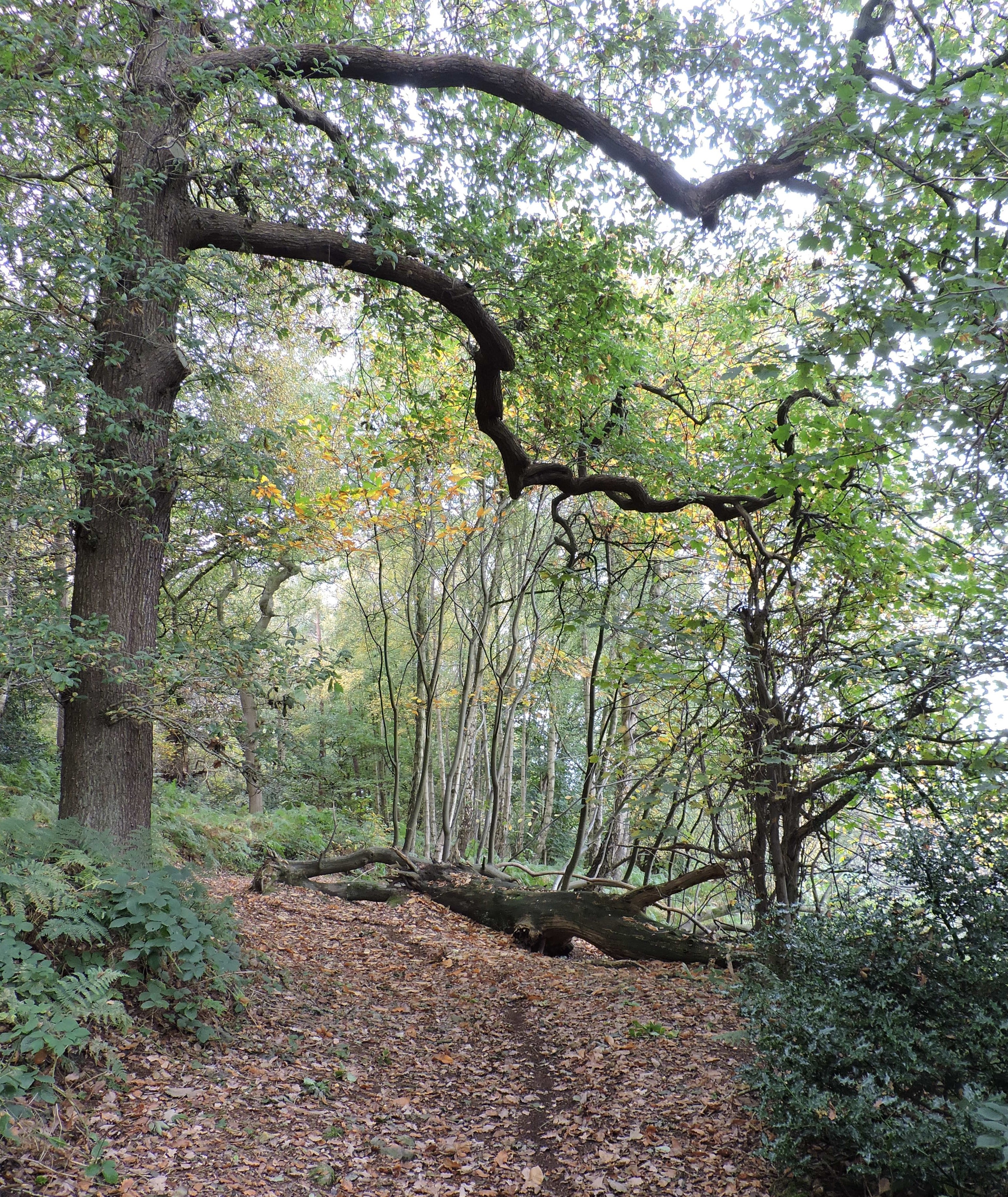
The biggest of the many trees around me are not just oaks but Ents – my image of Ents.

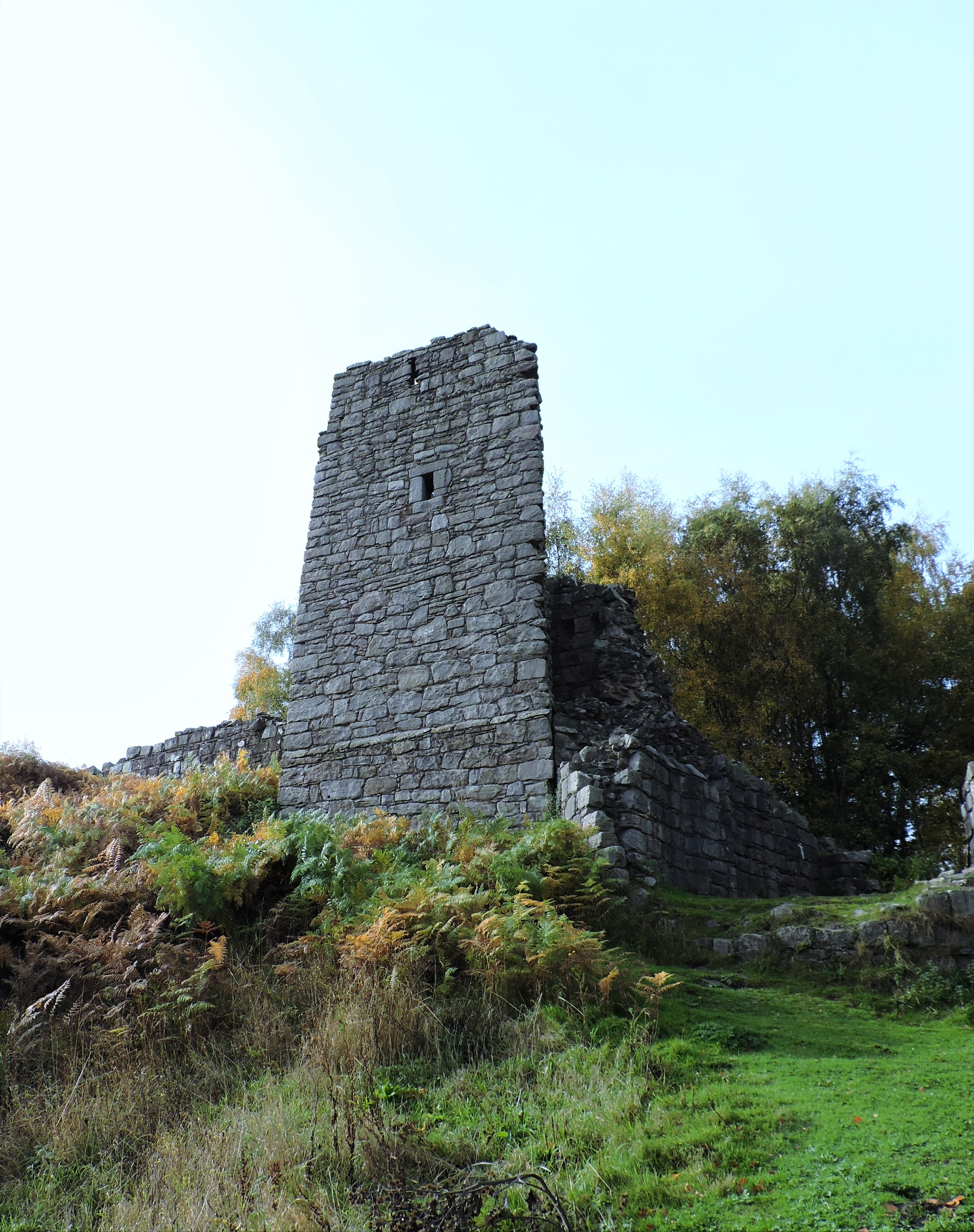
We’re walking in woods. They’re wrapped like a scarf around the base of a castle mound.

I’m captivated by the ancient oaks. I don’t even try to take a picture. It would be an intrusion. The real image could never be captured.

It’s as if the Ents are making ready to speak.

Hrrum.

Telling me their image is too slow, too old, too living to imprison in pixels and bytes.

I suppose it’s the castle making me feel all fairy tale and romantic. Ruins do that, don’t you find, when the weather is right? Misty, thundery, moonlit – or gorgeously autumnal, like today.

DSCN1112

Climbing up to Beeston Castle

Beneath the jagged castle’s beaten battlements lie remnants of Bronze and Iron Age settlements.

Humans have long lived here – you can sense it. The site feels deep, dense with once-lived moments – and still alive.

Teeming with natural life, if not – any longer – with humans. Except for tourists.

Part of a gatehouse

Part of a gatehouse


The castle was destroyed in our civil war. Parliamentarians versus Royalists, the interpretation boards call them – I knew them as Cavaliers and Roundheads.

Whatever their names, they fought each other, there was a siege, the building was ravaged – and who knows who really won in the long, long run. Except nature.

As befits a fortress, the climb up is fairly steep – but nothing compared with drop beneath the bridge that spans the gaping defensive ditch to the castle itself.

That ditch goes a long way down!

That ditch goes a long way down!

‘Sheer drop’ says the notice. No kidding. It’s terrifying.

Eyes straight ahead, hand clasping the cold metal rail, I try hard to think of something nice. Like lunch.

DSCN1124 (2)


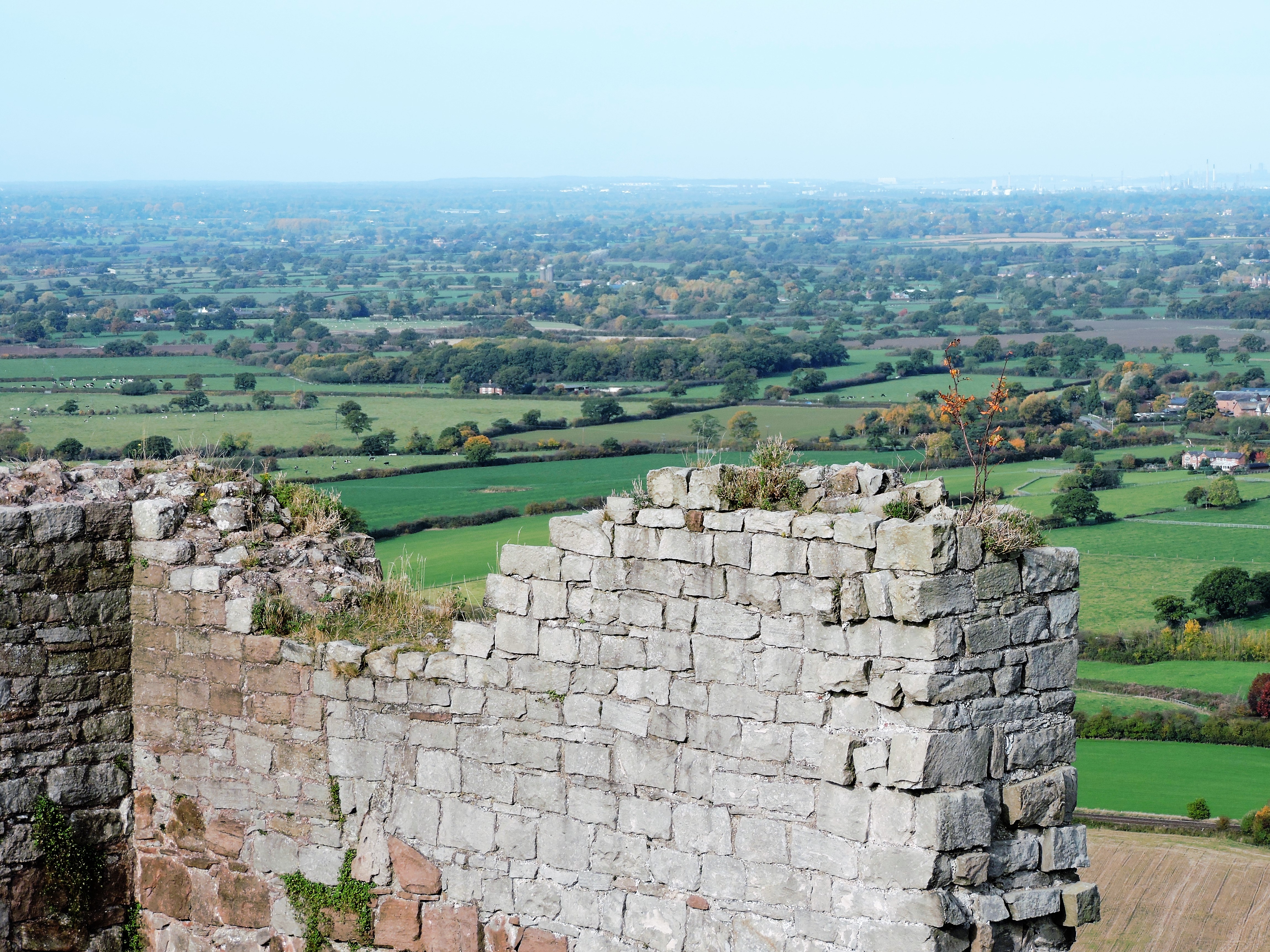
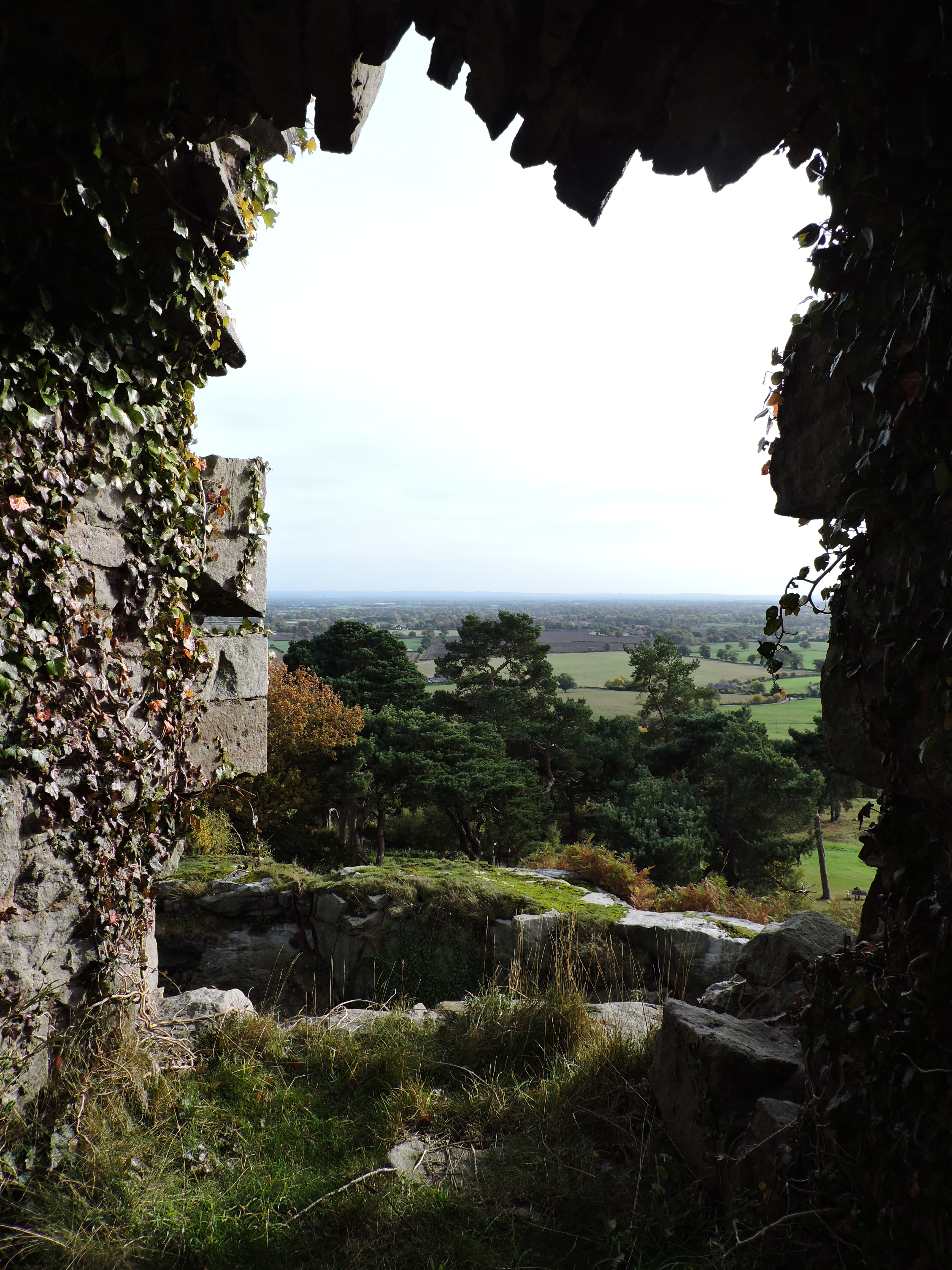
It’s worth the fear for the views.

A hazy day, but even so, there’s Liverpool, twenty two miles away and both cathedrals visible – just – to the naked eye.

There’s Jodrell Bank’s huge radio-telescope.

And there – the Welsh Mountains.DSCN1135

Vistas stretching in all directions.

A strategic location, close to a border – one of those invisible man-made lines on a map that tend to encourage conflict.

Dropping down, towards the base of the mound, the woods begin.

A strange, large black bird makes an odd call, impossible to describe. Then it clicks its beak, quickly, a sound like an expert knitter, plying metal needles.

Perhaps it isn’t a real bird. Perhaps it’s a witch’s familiar – or an emanation, a ghostly rara avis?

It’s this place. These woods. They’re enchanting, if not enchanted.

I stand, dumbstruck, before a vast oak. Huge, barrel of a trunk bristling with former branches. Dark, gnarled limbs bared by the dying foliage as it descends.

DSCN1154

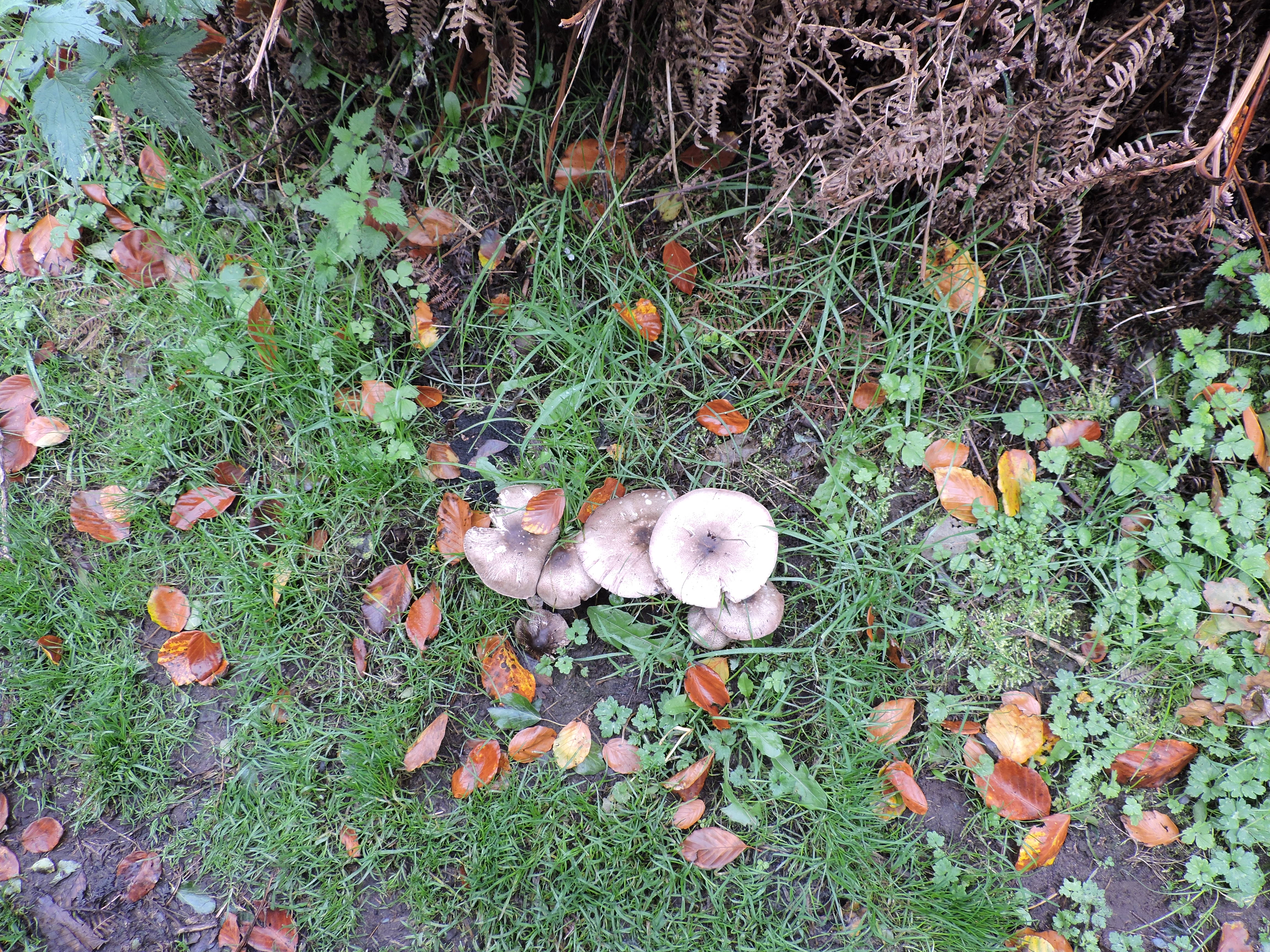
Off the path, a clutch of fungus

The path beneath our feet glows yellow and orange, leaves outlined in blackness – the dark soil. Created by centuries of leaves dying. Being eaten by worms. Excreted as a life-giving food for the greenery that will burst forth next spring.

Acorns crunch underfoot.

And so branches become trees …

Some trees have fallen – but are still rooted. Just. Enough so that what should be branches now shoot upright like small young trees. Seeking the sun above the birches and beeches, hollies and hawthorns.

English Heritage runs the site.

They’re losing Government funding and we decide to join. We’ll drop the National Trust. Seen plenty of stately homes.

We’ll make do (happily) with ruins and earthworks. Places imagination can roam free.

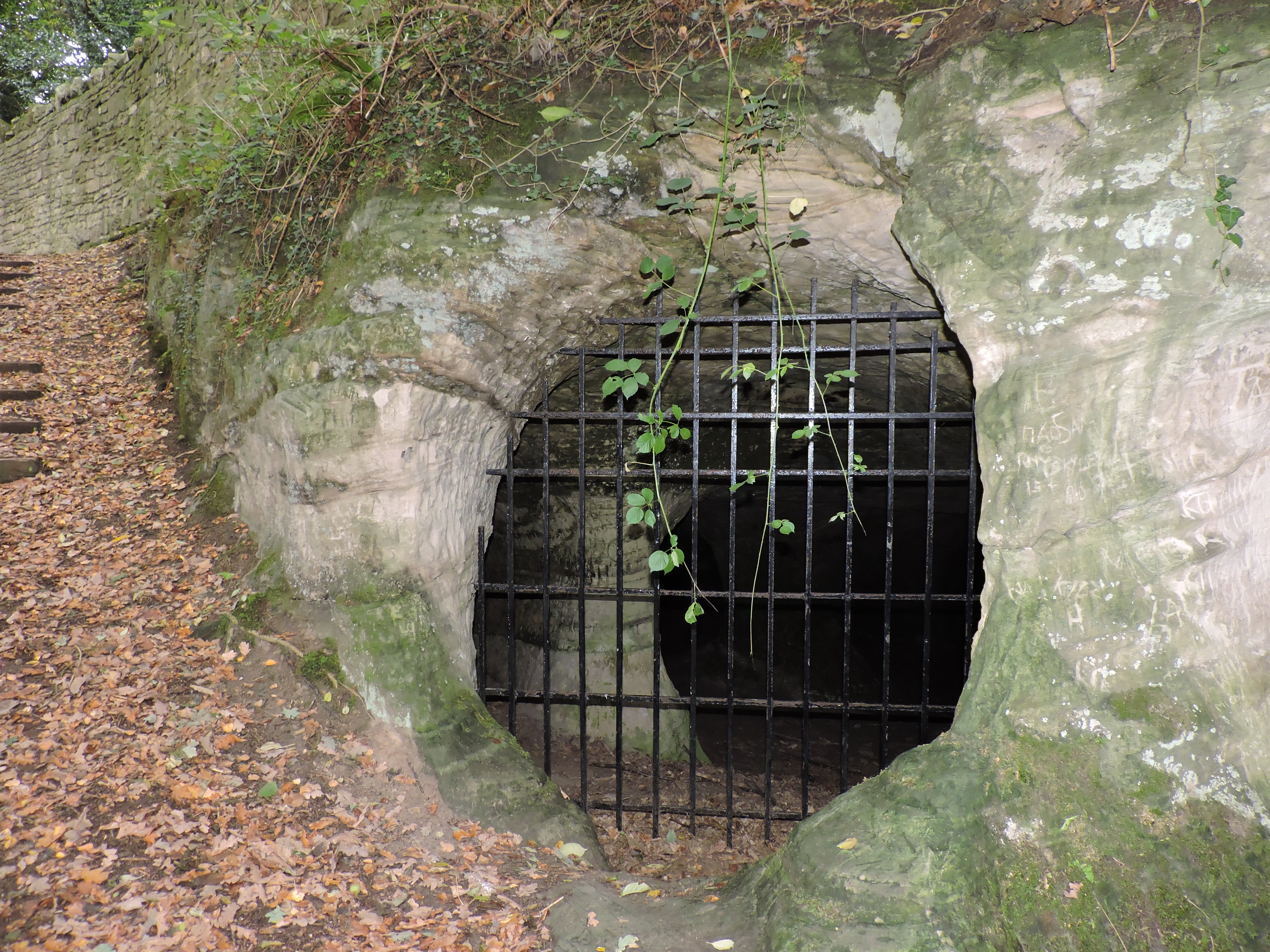
And who knows what lurks within

And who knows what lurks within

With isolated chapels and ghostly barrows.

Barrow wights? Yes, I’ve imagined them, too.

All of a sudden the world turns cold.

Imagination – a powerful, personal thing.

[And I haven’t seen Titanic, either, btw.]

Posted in Art, jaunts & going out, Britain now & then | Tagged , , , , , , , , , , | 10 Comments