A man walks into a bar. . . Pub conversation, Zambia-style

Football. It’s a universal language – well except in the USA of course.

(What’s that? That other game they play with the pointy ball that isn’t rugby? American football. Doh.)

Anthro-man walks into a bar. In Zambia.

Not this bar. Old Trafford,  Kasama northern Zambia

Not this bar. Old Trafford, Kasama northern Zambia

‘Hello, how are you?’

‘I am fine, how are you?’

That’s the ritual. Then curiosity bubbles up with the beer as the barman flips the top off a bottle of Mosi*. The beer with Victoria Falls on the label.

‘Where have you come from?’

Not as easily answered as you might think. Especially if you’re Anthro-man.

Born in the USA, like ‘the Boss’? A yellow rose of Texas? (Sorry, slipped into Wars of the Roses mode there.) The UK?

Boring.

Liverpool. Yay!

One word and you’re connected. The man you’re talking to (it’s mostly men) says, ‘Ah, Stevie G!’ – or something like that – and we say – ‘yeah, we live not far from him’. Or, ‘Jamie Carragher lives nearby’.

And so on.

We’re not footie fans. Anthro-man preps for a trim at the barber’s by skimming the news about Reds and Blues. We’ve learnt to call Blackpool the Tangerines and Oldham the Latics. I’ve schooled the man in iconic names like Accrington Stanley and Preston North End, Hamilton Academical and Queen of the South – and that’s as far as it goes.

But recently a new universal’s arisen.

‘When you think how much Rooney gets paid . . .’

Put any top player’s name in there, especially if they’re inclined to be a bit naughty. Or very naughty.

Zambian man-behind-the-bar makes the best observation I’ve ever, ever heard. The observation  to end all observations, in my book.

Here it is.

‘In my father’s house I know where the candles are, I know where the matches are, I know where the chairs are.’

He wipes a glass with a tea towel.

‘If I am in the president of Zambia’s house, still I know my father’s house.’

He shrugs.

‘If I am in the White House, in America,  still I know my father’s house.’

He shakes his head.

‘These footballers – ah! They have forgotten their father’s house.’


*Mosi-oa-Tunya – the smoke that thunders, Victoria Falls

Posted in Thinking, or ranting, or both, Zambia | Tagged , , , , , , , , , , , | 2 Comments

HP Sauce, pipe tobacco, betting slips – and standing room only at ‘our local’

A bank holiday. A beautiful sunny day, the spring-blue sky marked only by a very few fragile clouds. A relief after all that glowering gloom and incessant snow. Sparse incessant snow. Enough to remind you it’s wretchedly cold, but too mean to settle and paint a pretty scene. But then, it’s not Christmas. Not even winter. It’s spring.

So what to do, this glorious day? Something joyful, noisy, wild and abandoned? A walk somewhere pastoral and leafy? A stroll by gurgling streams or crashing waves?

I know, how about joining a load of other people in a big cold place. then reflecting on torture and death?

Atheist-man’s a hard task-master. Lent draws to an end and he still hasn’t ‘done’ the ‘Stations of the Cross’. So that’s where we’re going, this morning. In Liverpool’s Catholic Cathedral.

Despite the mood-enhancing sun, my own mood’s far from bright. I’m grumpy. Very grumpy. We drive in silence into town.

It’s quiet, as befits a solemn day. We park under the cathedral. It’s my favourite car park, this one. An odd thing to say, I know. It’s quiet in a padded kind of way, but warm, too. As if some energy lives there, sustaining the great empty church above through its quiet hours. Sometimes when I park here alone I stand and listen a while. No people, just insulation. Hmm.

My grumpishness dissipates. Sun sparkles through the jewel glass that’s everywhere in this modernist interior, pale and subtle, strong and bold, different moods in every side chapel round its circumference, rainbow bright in the lantern above the central altar, the heart of the circle.

We wait for the priest, eighty or so of us wearing coats, scarves, gloves and sober expressions. He arrives in a black cassock with red buttons, looking not exactly mournful but certainly sad, as if some deep, repressed inner torment is worrying away at his head. As it is, I suppose. He is, after all, about to lead us around those 14 ‘stations’, take us through the accusations, torture and condemnation, the gruelling climb and immolation, the death of the man who, just a week ago, rode in glory to Jerusalem.

Another ritual comes back to me without a conscious thought as we follow him from one to two. I genuflect and repeat words I did not know I knew.

The priest weaves magic with humble words. A local man, brought up in Scotland (Scottie) Road, one of Liverpool’s most famous addresses. He tells stories, provokes thoughts.

He has been privileged, he says, to be with many people as they died. Often in pain. How extraordinary to feel that as a privilege.

He talks of the women of Jerusalem, the women of Liverpool. Of Veronica the carer, wiping the face of Jesus with her towel as he climbed his way to death with the burden of the world on his shoulders. Of matriarchy and Mary.

But he also talks of memories. Of loved ones gone. His dad, evoked by pipe tobacco, HP Sauce – and (after a pause and a smile) betting slips. We smile with him. A human being, then.

And so the ritual of the morning over, we drive back home and prepare for the next. Oh yes, the day is barely started, in religious terms.

At almost 3 pm we step into ‘our’ local church and I am gob-smacked. The place is not just full, it’s packed. People are standing. We shoe-horn our way into a row near the back. My view is limited, but Atheist-man being tall can see for himself what he never really believed when I told him – the priest prostrating himself. He turns to me and mouths, ‘he’s done it, he’s lying down.’ Plainly shocked.

I’ll leave it there. You don’t need to know about the empty tabernacle, its doors wide open, the procession, the entire congregation (except, natch, Atheist-man) one-at-a-time kissing the feet of a crucifix at the front of the church.

Or the queue of traffic leaving the car park.

This has been a momentous day for me. How come the sky was not grim? How come the Church was so full? This isn’t the Catholicism I grew up with. It should have been cold and dark and lonely and – yes, gritty.

But it was more than that, even if it was less than that.

And now I’m beginning to wonder about Atheist-man. His grandfather, after all, was an evangelist. A larger-than life Texan with a deputy sheriff’s badge and his own God-channel on the radio. Atheist-man said he could see the appeal, today. The ritual. The priest so obviously a frail human like us. What if he’s catching the bug, after all?

I tell him about the Easter vigil. It’s 9 pm on Saturday night.

Do I want to go to that, he asks?

No, not really, I say.

Thank God, he says.

That’s more like it.


[The black cassock’s red buttons suggested he was a bishop – I checked and he is.]

Posted in Religious for a year: Atheist-man's experiment | Tagged , , , , , , , , , , , | 2 Comments

Small town, big lives

Snow has etched white lines into the wet, dark furrows in the fields. Spring is shivering underground, hiding under bark, cowering inside buds, slowed almost to a halt by the bitter winds from the east and the fallen, frozen flakes.

So it is, then, that we make our well-wrapped way to Mass, Atheist-man and I. Crosses made of palm-fronds lie in piles inside the door, waiting for the sprinkle of holy water that will render them blessed. I take two. Atheist-man looks slightly puzzled but says nothing. The puzzlement deepens as he turns to page 8 in the Mass book to find out what’s going on. By the time I sort him out (a number dropped off the board, obvs, it’s page 83) the first hymn is done, the first lesson begun.

Today’s different. You could say it’s bipolar but I probably shouldn’t. Let’s just say that it’s a service of two very distinct parts.

The vestments are red, the statues shrouded in purple. The priest, the deacon and altar servers process as we sing. The palms we clutch are now holy-water-blessed.

But the palm-waving crowd of the first part is fickle. A mighty fall is coming. In rides Jesus to Jerusalem, to praise and adulation. Minutes later – well, in today’s time – the end is nigh.

It’s a long gospel. The kindly priest tells us we may sit, if we need to, but no-one does.

The tragedy unfolds, doom-laden words intoned by three people on the altar – and by us.

Crucify him! Crucify him!

There. We have all done it. All said it. How easily we are swayed.

I’m one of the braying mob, if only for pretend, if only for today. Inflicting a cruel injustice on an innocent but dangerous man. A man from Galilee not Jerusalem, a man who threatens the powers that be, challenges the status quo.

It’s easy to blame the outsider. Anyone who’s different and – possibly – dangerous. The illegal immigrant or benefit scrounger, gangster scum or bogus asylum seeker. Anyone we don’t understand.

I look around the church as we ‘offer each other the sign of peace’ – shake hands, smile, make eye contact.

A whole lot of shaking’s going on. Not just handshakes but jolly waves across many rows of pews.  This is more than the polite and temporary breakdown of the cell walls that divide strangers, the kind of ‘kiss of peace’ I’ve been used to from churches I’ve attended over the years.

I feel a deep pang of envy. Not a serious, ‘I-hate-you-why-not-me’ kind of envy, but more of a ‘sigh, I wish, if only’ kind of envy.

Saints Peter & Paul is full to the brim with families, friends and – for all I know – foes. People who were born here, grew up here, went to school here. People who married, procreated, worked, played, retired here. People who were happy and sad, healthy and sick here. A couple on their golden wedding anniversary, waiting with their friends for a blessing after Mass.

I’m an outsider. Born a mere 25 miles away I might just as well be from Texas, where Atheist-man once belonged. A real outsider.

People talk a lot about roots. Where are mine, I wonder? They aren’t geographical that’s for sure. Yes, I can slip back into the comfortable armchair of ritual, the church – but still, it’s not my roots. I’ve been a pot plant a very long time, on many a different windowsill. I took my chances and this is the price.

No, I’ve never been part of anything like this. Well, except maybe school. And I don’t just mean the church – it goes beyond that, it’s the town. The people here form a very real community, whether they know it or not (I suspect many of them don’t). They may not act like a community in public, but in private, it’s there, like sinews beneath the skin.

It’s something special, in this day and age. It’s a family of a kind. A family of many families, of many generations.

And, yes, families can be claustrophobic, restricting, limiting – maddening. But at least then you have something to kick against, to spur you on to rebel. To be different. To be dangerous. To become an Archbishop, a trade-union leader, an actor, musician, footballer, paralympian, radio-presenter. Like some of this town’s finest.

To make a difference.

The irony is that, for all the friendliness, humour, community and embedded-ness that we admire in this place, we are outsiders in a town of insiders, Atheist-man and I. We’re more at home – more welcome, perhaps – in places without the community we admire. With other pot plants on another windowsill.

As we walk to the car a woman speaks to us. Someone we don’t know (of course). That’s nice. We talk about the wind, the weather.

Behind her the graveyard forms a backdrop. It should be bleak, on this oh-so-wintry day, but somehow it looks comforting. Serene stone angels smile, their hands forever joined in prayer. Row after row of crosses, books and urns. Plain stones inscribed with messages of love and hope, sadness and wisdom.

I think of what Atheist-man said the other week.

‘I don’t remember seeing graveyards when I was growing up in the US. It’s healthy, living with them, don’t you think?’

Strange. But possibly true.

Posted in Religious for a year: Atheist-man's experiment | Tagged , , , , , , , , , , | 2 Comments

Full in the panting: on dealing with disappointment and dodging the black dog

We’re still conducting the grand experiment, Atheist-man and I. A year of living religiously – well, in the sense of religiously going to church each Sunday, anyway.

It’s making a big impression on both of us. We relish the time to think  –  about life, society, others, not ourselves. We revel in the language and the stories. Assemble some animals for sacrifice, says God. Cut them all in half. Except for the birds. Leave them whole. Why? On all  sorts of levels, why? And of course, there’s the chance to sing. ‘Bread of heaven’ twice in two weeks. Amazing the roof’s still on. (Join in, go on!* )

But this Sunday I confess (well, it is a Catholic church) I’m a tad disappointed. What with a new Pope and all, I hoped we might sing Full in the panting – a hymn to, ‘our Pope, the great, the good,’ in which ‘the note redouble till it fills with echoes sweet the seven hills’. I loved the words as a child. (Yes, it is redouble not redoubles. Just because.)

We don’t sing Full in the panting. It’s not even in the hymn book.   

It wouldn’t normally register as a disappointment – and it’s not much of one. But black dog’s circling at the moment. He can sense I’m disappointed in more than just a hymn. His baleful eyes are on me and he’s dribbling, waiting for me to acknowledge his presence. I ignore him and stare at my computer screen.

I write. At least, I try. It’s been a while since my last blog and I write many pieces. Rubbish pieces. Boring pieces. Priggish pieces.

 Disappointments.  Self induced.  

I disappoint myself quite often – that’s what attracts him, the sniffer dog of self-flagellation.

 It’s bad enough when you let down people you respect.

 ‘I’m disappointed in you.’

 Chilling words from a parent, teacher, friend. How demoralising, then, to disappoint yourself. Day after day.

A spark of life emerges from my fingertips.

Detective Inspector Mike Gorman jumps from the page. Friend of motorbike-riding priest and amateur sleuth, Gerry Carroll, he of whom I blogged a few posts back. Another bit of back-story, to give you a taste for the book.

I finish it with a flourish and show it to my mentor (Atheist man has many guises). He loves it. I ready myself to put it online. Then I re-read it.

Ping. That unmistakable dart of conscience.

My shoulders droop with my morale.

There’s an emotional twist, a vulnerability, an Achilles’ heel in the tough cop’s life. A fictional tragedy, part of my character’s life ever since I created him. But now it has befallen someone real, someone I would not wish to hurt.  I cannot put it online.

At this point black dog’s come nearer. He’s sitting at my feet. But I turn my back on him. Apply my fingers to the keyboard. Seek my solace in words.

Inspiration strikes once more.

It’s one of those days when my fingers can’t move fast enough, when exhilaration trips along the keyboard as I write. I’m breathless as the words gush out. It’s not always a good sign. Sometimes I read what I’ve written – and cringe. But this time it’s worked.  I can feel it. My entry for MsLexia’s short story competition, sorted.

I set it to one side, excited, tense, wondering if this time, maybe, possibly, it will be short-listed. Or win. Black dog wanders away, dejected. I wash dishes with gusto.

Mentor-man reads it while I hide in the kitchen.

‘Wow.’

I hear a long sigh as he finishes. Then silence.

‘That’s good. That’s very good.’

I format it. Edit it. Check it again. Then – ping.

I lie awake at 3 am on the day I have to submit. I can’t do it.

The story’s inspired by a trauma, a trauma I was closely involved in, which affected me deeply. But it was a friend’s tragedy. That friend, is far away. That time was long ago. But this is the internet age. Nothing is long ago, or far away.

So this is all I’ve salvaged. This piece. Not a lot. Not a story. Not a breathless piece of prose. No competition entry. Not even a great blog.

And yet, I feel a little bit better. I’m not disappointed in myself. I may have lost the best chance I had of winning a short story competition. But I’ve been true to what really matters.

And the sun is out.

I’ll hop on my bike and leave black dog howling in the garden. Let’s hope he’s vanished with the early morning fog when I return.

 * Make your day!  http://www.youtube.com/watch?v=QJCxt2DjZK0

I didn’t post the You Tube version of Full in the Panting because they used the Wrong Tune aaargh! Is there no end to the disappointments?

Posted in Religious for a year: Atheist-man's experiment | Tagged , , , , , , , , , , , , , | 3 Comments

Eleven footballs* and a five letter word – a thought for the day

It’s dark. Curtains are drawn. If the outdoor light goes on when we lob the footballs over the fence the people inside won’t notice. (I retract that ‘we’. The man of this house will lob them over. Throwing balls was never my forte, though I did make the rounders* team at school. Desperate, I guess they were.)

One by one, eleven balls soar over the wall and thud as they land on the Astro Turf. Always green, always clean, never growing, that’s the ‘lawn’ in the ‘garden’ backing onto ours. Three boys live there. Boys who like football. Boys who have footballs. Boys who are watching TV, I hope, and don’t hear the noise.

But why did we have eleven footballs? Why haven’t we thrown them back? They’ve been here for months, why haven’t the boys been round to claim them?

The screen goes wiggly, we step back in time …

In our small, verdant garden, the walls are lush with climbers – with ivy and wisteria, with roses and honeysuckle. We value our privacy, but we’re not obsessive. Trees do a moderate job of screening us from our neighbours. We can’t see them when they’re in their garden, though we hear the lads on a sunny summer’s day. Boys will be boys. Boysterous – ha ha!

But back to our green oasis. There’s a gap in the planting, a spot that doesn’t see much sun. Seeking inspiration we visit a nursery for ‘specimen plants’ which promise instant (if expensive) gardening gratification. We stroll through the rustling aisles where a showy shrub stands out.

Not what we had in mind.

Dark shiny leaves. A profusion of perfect – almost too perfect – blooms. Just this side of tarty, a deep, royal crimson, not a bright, blowzy scarlet.  The price?  Sharp intake of breath.

Camellia flutters her flowers. She’s sold.

We plant her feet in special soil. She blossoms in the lee of the wall, under the dappling  leaves of an elegant, if immigrant eucalyptus. My, but she’s pretty.

But – just a minute. What’s this?

I’m standing in the window. A man’s wandering round in the garden behind ours.  How come I can see him?

And look – the ivy – it’s flopped off the wall. No, hang on, everything’s flopped off the wall. The wooden panels that everything was attached to – they’re gone!

Tangles of greenery tumble over Camellia. She’s wounded. Limbs broken, shape distorted, she’ll never be the same again.

We wait, dumbfounded. Surely they’ll come and tell us what they’re doing?

Two days later new panels replace the old, panels so short I can still see Mr Destructor strutting.  And I can see him setting up goalposts against our wall.  Their wall.

Three balls fly over. We throw them back. More rain on us.  And more.

We put up our own, higher fence. Do our best to pin the greenery back in place. Camellia, no longer the pretty girl she was, hides her blooms and drops her leaves in shame.

We cease to return the balls.

Nearly three years. Not one apology. Not one ‘please may we have our ball back’. Nothing.

So here we are, on Christmas Eve, throwing back eleven. A minor Christmas truce.

I anticipate a note of thanks, a token something thrown over the fence, a card pushed through the letterbox.

Nada.

At Mass on Sunday (yes, that’s where this was going) – a thought occurred to me. Well, many did, but here’s just one. Catholics grow up with guilt. I know, I know – you may laugh, people do. They also grow up with words like contrition and repentance, penance – and absolution.

We spend our lives with ‘sorry’, but also ‘I forgive you’.

But here’s the thing. If you never feel guilty, how can you say sorry and mean it? And if you never say sorry, isn’t it hard to be forgiven?

So, my thought for the day:

  • admit it when you’re guilty, practice saying sorry, enjoy being forgiven.

*Dear Americans, Footballs here are the round kind used in what we call football and you call soccer; Rounders is a game or sport like baseball, but without the fuss and helmets – and much enjoyed by girls. (Incidentally, the ‘man of the house’ is American and has one of your ‘footballs’ which broke my finger one memorable day as I made to catch it. )

Posted in Religious for a year: Atheist-man's experiment, Thinking, or ranting, or both | Tagged , , , , , , , , , , | Leave a comment

The fall of the Fort of Ussher?

We’re in a taxi heading back into Accra from the University at Legon, our first and only attempt at sightseeing on this very short visit. As we near the coast, the throat-searing fumes spewed from elderly vehicles stuck in stagnant traffic give way to a more organic odour. I worked in sewage (well, the water industry) and I’d know that smell anywhere.
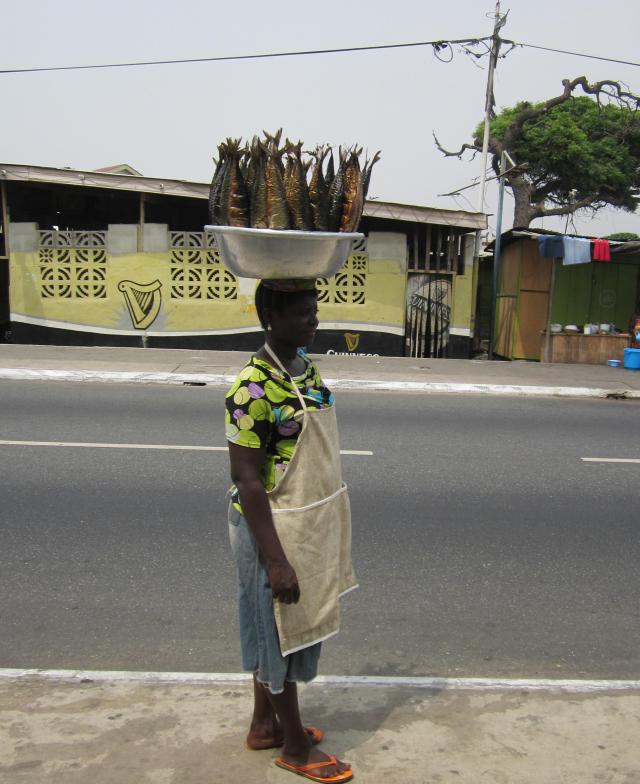
Carrying mackerel past Guinness in Usshertown

Carrying mackerel past Guinness in Usshertown

The ocean vista opens up and as the road bends to follow the shore we pass a lagoon dotted with boats. The source of the great stench. And fish, I guess.

Our taxi driver, a big fan of Flight Lieutenant Jerry John Rawlings, erstwhile dictator of this nation, is plainly embarrassed – tells us there are plans to drain it, smarten it up. But he doesn’t have anything good to say about Jamestown or Usshertown – where we are heading – and despite our guide book’s encouraging words we won’t be wandering the streets on foot.

The taxi slows alongside a tatty, pale building that looms over a street lined with small bars, shops and market stalls. It’s one of the historic forts for which this coast is famed, Fort Ussher.

Do we want to go inside? Of course we do.

He drives up onto the pavement, parks and carefully locks all the doors.

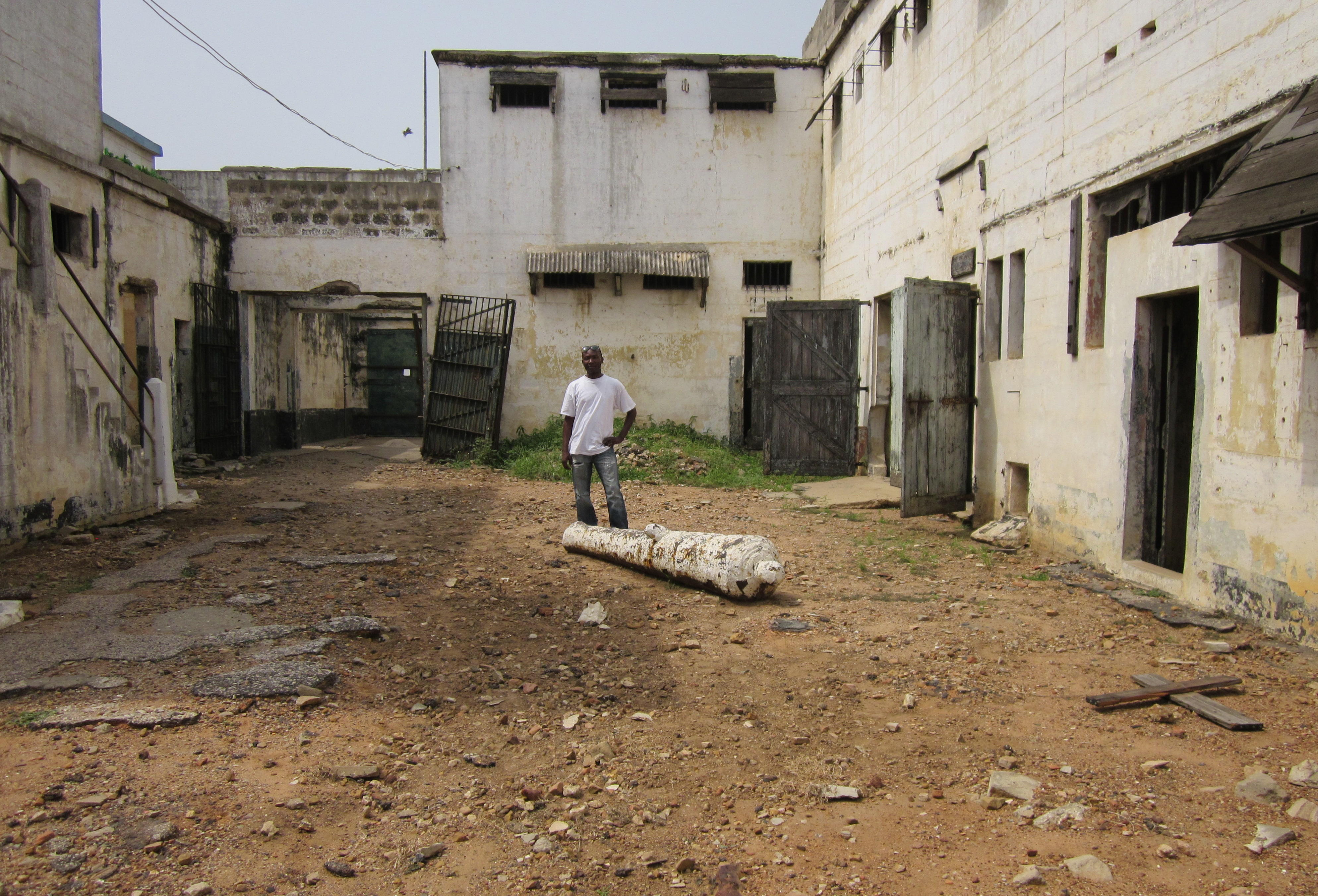
It looks like a corner of some strife-torn city that’s been utterly abandoned. Peeling paint, shutters hanging open, courtyard strewn with debris and a loose, lone cannon lying stranded on the ground.
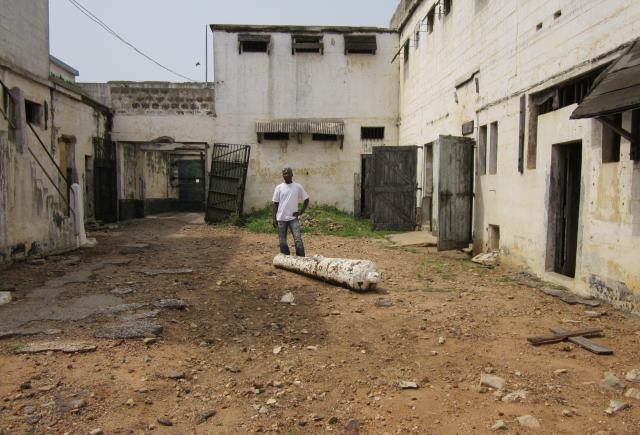
Entering Fort Ussher

Entering Fort Ussher

Only after we’ve left do we realise that this was – till the 1990s – a prison, that we were standing where executions took place, that in the rooms above us the first leader of the country after independence, Kwame Nkrumah, was imprisoned.

We start to scale a steep flight of stairs. Archaeo-man sees someone lurking in the courtyard. Taxi driver shrugs, says nothing and carries on. I’m bringing up the rear. Suddenly there’s a man right behind me and someone behind him. My anxious western mind segues straight from tourist to hostage. I put one foot in front of the other – and pray.

The terrorist of my imagination is a youngish man dressed in clean, western-style clothes with a large, ornate crucifix around his neck. It looks like ivory. The man works at the fort, it transpires. He takes the seat vacated by the guide, whom we disturb from his reading – a history of western Europe. We opt to pay for his wisdom.

The historian ushers us through a door marked ‘Beyond here, no return’. The room’s a mock-up of a slave-holding vault, with two life-sized figures. One has been cooperative and sits. The other, an uncooperative soul, is shackled hand and foot and standing. There is almost no light and the heat is suffocating.

View from the top of Fort Ussher on a hazy February day

A typically hazy day in February, the view from the top of Fort Ussher

The heat in the larger, lighter exhibition room is just as oppressive, but this story’s much too serious to be rushed. When at last we reach the far side of the room the guide opens a window. The sea breeze teases us, it’s cooler, but delivers yet more air-borne punishment to our guilt-laden western lungs. In the picturesque harbour, below, with its bobbing pirogues and its bustling traders, a great heap of rubbish is burning. There’s no escape.

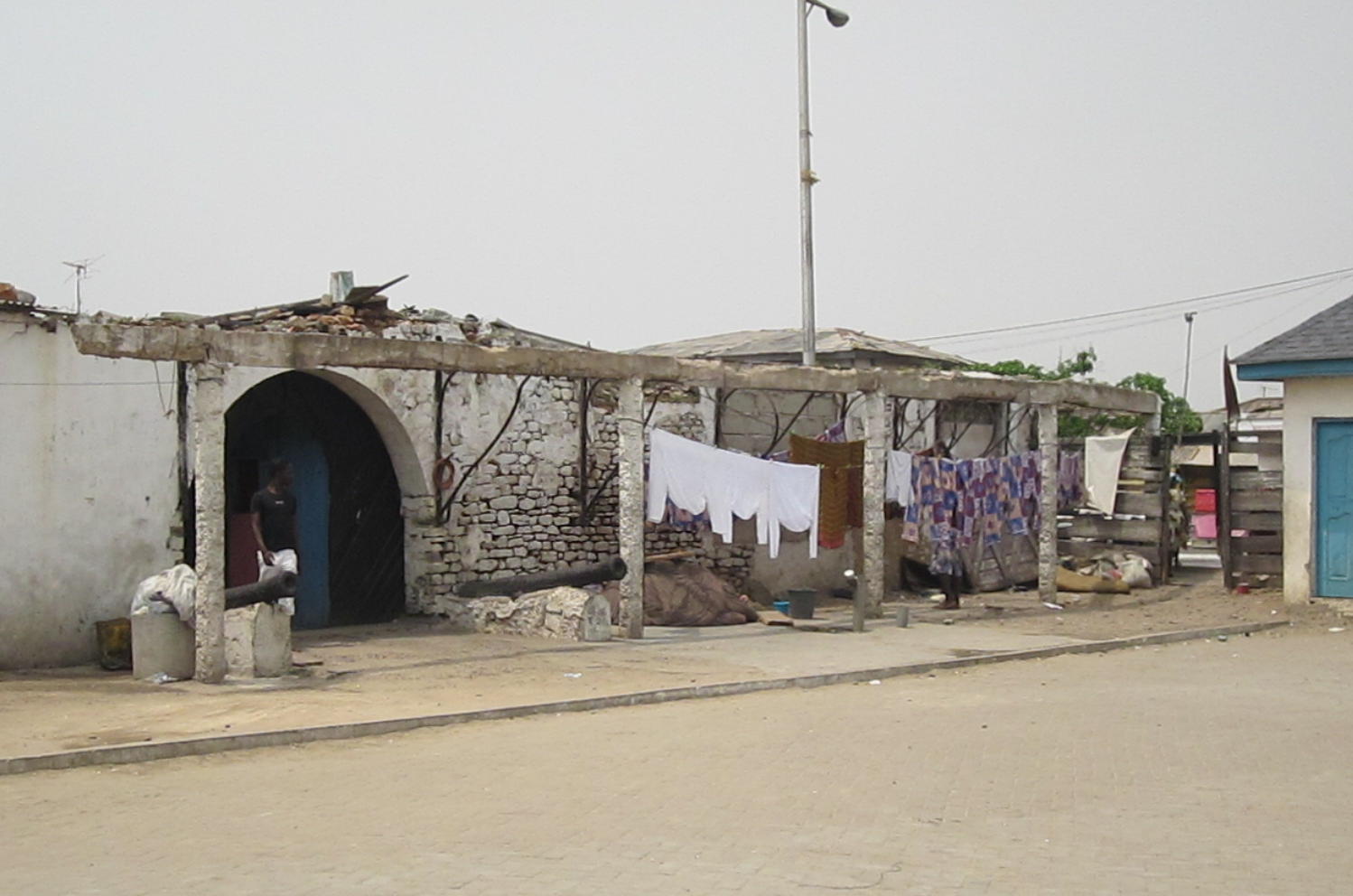
As a special favour we’re allowed to leave by the staff exit, down a shorter flight of stairs. Here we find two more cannon, an empty visitors’ car park behind locked gates, a fishing net and lines of washing drying in the dioxin-laden air.
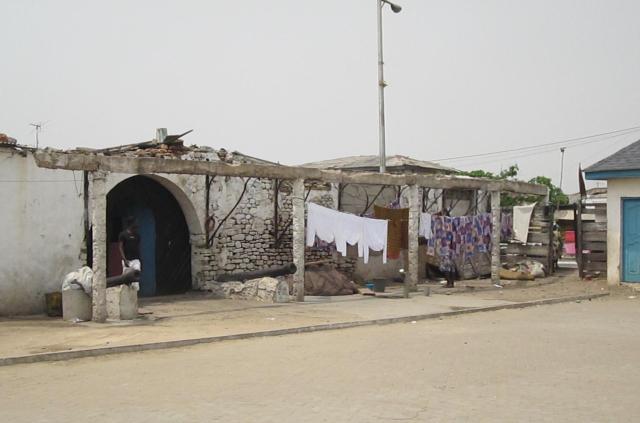
Today's use for Fort Ussher

Fort Ussher

I’ve been thinking about this a lot since then.

What if Fort Ussher were left to decay, to fall down, to cease to be? Could I accept that thought and not be upset? Could I know it was happening and do nothing to stop it?

Well, yes.

I know – such a prospect should be anathema to a middle-class, middle-aged history graduate.

Ban plastic windows! Banish garden gnomes! God save the National Trust!

That’s more like it.

But do the people of Accra love this building? I guess not. Does it remind them of a painful past? I guess so. Do they want to be reminded that the man who led them to independence, their first President,  was imprisoned here? Well, I’m not sure, what do you think?

This is not South Africa, with its former white overlords still kicking round, where evidence of their misdeeds is conserved, a witness to moral victory, a testimony to their defeat. No, this fort was established by white folks who have packed their bags and are gone. Long gone. It’s not an Ashanti shrine, nor a place of veneration for the Ga or any other tribe. It’s a place of pain. A part of Ghana’s history, yes, but a remnant of a colonial past that is anything but missed.

Standing atop Fort Ussher, looking down the coast, you can see the current presidential residence – a castle. A colonisation of sorts. This year the current President might, at last, move to the new palace, a garish monstrosity that’s cost more than $60 million to build.

Behind the Fort

Behind the Fort

In Usshertown, this small, decaying part of the city, my reflex reaction to the crumbling state of the fort and its surroundings is outrage.

Save Fort Ussher! Conserve the town!  Your heritage is vanishing before your very eyes! Shock, horror! Think how many more tourists you could attract if only . . .

But it’s not my town. And it’s not my country.

Fort Ussher is part of Ghana’s history. In this nation, where ever more poor people flock to live along the coastline, using the sea, the beach and railway embankments as lavatories and rubbish bins because there’s no alternative, maybe one day the fort will be valued more highly by the powers-that-be.  More highly than a monument to a former president’s folly that cost millions. But maybe it won’t. We can’t tell people what to value.

History, a deep history, makes for a stable foundation for a nation, a town, a community. A source of pride, a resource for learning. But what if it is all too painful?

Archaeo-man mentions Auschwitz and I see his point. But I’m confused.

Am I distressed that Unesco has Fort Ussher on its ‘tentative list’ of endangered world heritage? Yes, sort of. But, on the other hand, I feel for those African Americans who come here to find their roots and find instead that they are not Africans, but Americans.

This is Ghana’s story. We have ours. They may be intertwined, but one less building won’t change a thing.

[Plenty to disagree with here, I know. I’m still wondering myself. That’s it for Ghana for me for now. Thanks for reading.]
Posted in Ghana, Travelling | Tagged , , , , , , , , , , , | Leave a comment

Pirates, pirogues and the pain of the past

Don’t worry, we’re on the wrong side of the continent for Somali hijackers, but I can just imagine the pirates out there, lurking behind this celestial net curtain of hazy sea and sky.

There’s a mini-flotilla of fishing boats, pirogues, lined up towards the right-hand limit of my view. Thin black shapes, almost flat, like parentheses, or the eyebrows of floating giants, their bodies submerged – no, it’s a silly analogy, I’ll stop right there. But they still look like eyebrows. They’re in pairs, side-by-side, that’s why.

This coast is infamous for its sea-borne troubles. First came the lone trading posts. Then the treaties. After that the skirmishes, the battles, the colonisations. But always there were the slaves. Between Africans at first, captured enemies. But then it becomes a trade. Then a bigger trade. More money. More inhuman.

Thank God for the conscience of the ones who brought it to an end, but frightening to think that in the wild and wonderful Luangwa Valley of Zambia, where we’ve spent such happy times, the last Arab slaving raids took place just over a hundred years ago, in the early twentieth century.

So, there to our right, invisible in this humid atmosphere of sand and salt, is the lighthouse and the Fort of Ussher. All along the coast are castles and forts which once were merely trading posts, gold the lure. But then came the building of vaults for storage. Then the escalation of the trade in goods that lived and breathed. And then the human cargo, stored before boarding in the sweltering darkness.

I’ve only seen one fort – but I didn’t need to see it to feel the agony, the pain, the inhumanity. Our hotel gift shop has a pair of slave irons for sale. I can’t bear to look at them, let alone touch them.

The last time I felt this way was at a beautiful spot high above the Luangwa River, where it wends its way to confluence with the Zambezi. Gazing out from our breakfast table a large iron anchor interrupted my view. An anchor from a slave ship.

I don’t know whether the beauty of the view is sown with sadness by the history, the misery, the souls that once cried out and fought against their fate in vain, or by my knowledge of what happened.

It doesn’t matter.

The book I bought to read on my way here, ‘Never let me go’ by Kazuo Ishiguro, takes the reader places where we really don’t want to go. So does visiting Accra, Luangwa Bridge and Liverpool Maritime Museum’s slavery gallery.

It’s what we humans can do.

LEST WE FORGET.

[flying home today, more anon]

Posted in Ghana | Tagged , , , , , , , , , , , | 2 Comments