Sax and the city*

A bottle crashes to the ground in an alleyway off the main street. Jewel-green splinters frame the edge of a dark puddle, iridescent with oil in the dull glow of the street light.

Somewhere a tyre squeals, a youth shouts and laughter erupts – then dies.

Night, in the city. This city. Any city.

Buildings rise towards a sky that no-one sees.

The moon’s a crescent – if only you could see her.

Light, ending its journey of millennia as pinpricks, twinkles through to earth whenever a cloud scuds by. Unseen, by the noisy, dirty, vibrant, cruel, lively, charming – and exotic – city.

Busy people hurry and scurry. Returning home, going out. Sobbing, kissing – falling over drunk. Begging – or sinking to the ground, dying.

Rats – and hungry humans – scavenge. Homeless men, foetus-like, while away the hours on damp cardboard in urine-stinking doorways.

Lovelorn girls pick their way on teetering heels to bus, or train or taxi, with mascara streaked cheeks and puckered lips. How could he? Why would he?

The behemoth of a concert hall squats on its corner, bright lights dissecting the night like scalpels piercing its elegant windows. Glass doors stand open to let in the crowds with the last gasping drifts of cigarette smoke and the seeping, damp, chill.

A siren wails by. An anxious man in a smart suit jumps, eager to arrive, from a taxi cab. He looks around, sees no friendly face and wanders off to slump against a wall, waiting. In vain. She won’t be keeping her promise. But he doesn’t know that yet.

Inside a slender woman with thin grey hair, puts her hearing aid back in her bag, before anyone can see. It’s vanity, she knows, and foolish at a concert. But tonight might be the night he sits beside her, after all this time. She grasps the arms of her seat, pushes away thoughts of tomorrow, the next day, the next week. It’s enough, for now, to make it through the night.

A balding man wearing a fringed suede cape hobbles his way up the steps, one at a time, whistling. Stands, swaying slightly, at the end of his row, surveying the waiting crowd. Mind on the prairies, by the camp fire. Or – perhaps – singing with Johnny Cash in Folsom prison.

Young women – one with statement hair piled as high as a coiffure can go – perch on the edges of their seats, staring at the stage with moppet eyes. Fidgeting, standing then sitting, swapping seats – then sitting. No laughter, some chatter – and moppet eyes.

I sit next to them, wondering. Marvelling at the vivacity leaching from them in this mature, warm, doze-inducing concert hall.

The house lights dim.

The saxophone and minor key. It’s not an ode to joy. It’s not uplifting. It’s music to drag a person down – then out.

Out with Philip Marlowe. Hat tilted over watchful eyes. Cigarette dangling from thin lips. A curl of smoke.

A skinny blonde in a grey raincoat – everything’s grey in black and white – leans on a lamp post. Draped to entice.

The PI flicks his cigarette butt away.

It lands in a dark puddle, iridescent with oil in the dull glow of the street light.

Sax – and the city.


*This is mostly fiction. The concert, ‘Sax and the city,’ was real and featured the Royal Liverpool Philharmonic conducted by Vasily Petrenko, with soloist Timothy McAllister playing the alto Saxophone in a concerto written for him by John Adams in 2013. To be fair – Gershwin’s ‘An American in Paris’ which preceded it was a gorgeous, uplifting, heart-swelling performance and Petrenko – to quote the local paper – was up there ‘shimmying’ it to perfection!

There was also an engaging party of young women, one with amazing hair, all studying saxophone at the Royal College of Music in Manchester – their teachers played superbly in the Gershwin.

Posted in Art, jaunts & going out, Fiction, probably | Tagged , , , , , , , , , , | 1 Comment

One pig’s trotter, two pigeon carcasses and a soupçon of smoked sea salt

I read a recipe for coq au vin jaune in the weekend paper. It didn’t have the above ingredients, I should make clear, though they did make appearances elsewhere.

In fact, the coq au vin jaune recipe seemed unusually (for our weekend newspapers) make-able –except for that ‘vin jaune’.

The writer, helpful soul, explained that the wine is:
‘made from late-harvest savagnin* grape and matured in oak barrels beneath a layer of yeast’

*[not a typo, I copied it directly]

Ten pages later came a page of ‘Great French wines’. And, lo! A bottle of vin jaune, an ‘idiosyncratic’ wine from ‘the foothills of the Jura mountains’.

Apparently it’s a ‘must-have’ at the best restaurants.

It retails at – wait for this – £49.95! I’m not even going to bother converting the currency. It’s plainly expensive.

And this is in the Sunday edition of one of our lefty national newspapers. Yes, lefty.

Lefty, it’s plain, no longer means embattled working class, earning a hard crust (scraped with dripping). Nor public sector worker, poorly paid but following a vocation. Nor over-mighty trade unionist bringing the country to its knees. Or whatever you think lefty means.

But let’s not get into that today. I want to write about food.

Because I’m tired of the metro-centric media and their attitude to cooking.

Tired of recipes with ingredient lists as long as a child’s Christmas wish list. No, scrub that, they’re longer. And probably more expensive. And even less likely to be played with after the novelty has worn off.

Cookery writers, it seems, delight in searching out the most obscure ingredients. Not, I suspect, because they’re necessarily terrific additions to the taste of a dish, but because they want to perpetuate the elite status of the food writer.

It’s just a way of showing off. An ever-escalating treasure hunt for the newest, most obscure, most expensive ingredients.

‘Oh, dear,’ says supercilious food writer, glancing down at a serf.

‘You can’t find ptarmigan liver puree in Chesterfield? Poor you. I get it from my local Anatolian shepherd’s market in Notting Hill.’

And the foodie goes off to order an amuse bouche of tender bamboo shoots, plucked by baby pandas, cleansed in Icelandic volcanic springs, fried in peacock fat with larks’ tongues and finished in fairy dust.’*

*(I made that up. No one uses peacock fat.)

Seriously, if we want people to cook, eat well – and not become obese on high doses of nasty transfats, high fructose corn syrup and the like – we need to be sensible about food. Make good food easy to cook. And not suggest everyone should be cooking with the latest Mongolian delicacy dug up by some precious ‘expert’. Or (pet hate warning) the latest variety of chilli.

People, fish pie does not need chilli.

So, stop reading now if you’re just here for the fun and frivolity. Here comes my first recipe post. There will be some more, now and again, on the same theme:

‘simple food for simple folk (like me)’.

————————————————————————————————————

Simple food

This time it’s a meaty dish. Veggie next. Fish occasionally – maybe on a Friday.

Health warning: I’m not a one woman Good Housekeeping Institute – this is how I do it, all measures are approximate, based on my experience, my oven (electric), my hob (gas) and my taste (not too much salt and no chilli please).

Don’t blame me if you get it wrong!
SIMPLE CASSEROLE OF BEEF, SLOWLY-COOKED

This will feed two, three or four people depending on what, if anything, you add, eg, potatoes. If you can set a timer on your oven to start while you’re out this is perfect for an after-work meal on a wintry day.

beef

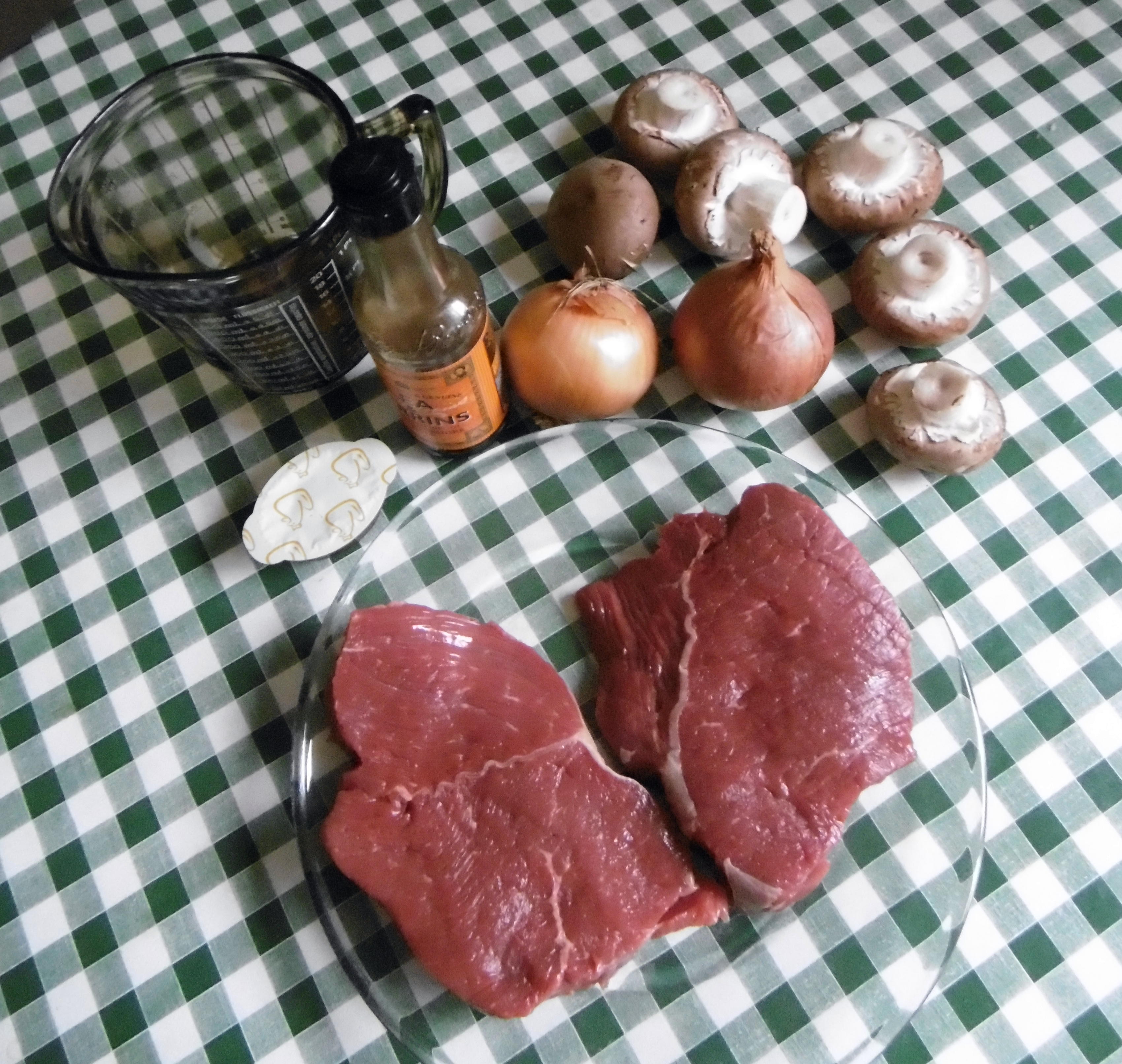
Oops! That’s a chicken stockpot – recommend beef or veggie actually! Nice mushrooms though …

Ingredients

1 large slice of braising steak* around 1 lb/450 g (more if you like) or 2 smaller pieces
*(thick flank, from the hindquarters)

1 or 2 onions

3 large flat mushrooms, or 5 or 6 medium closed cup ones or none if you don’t like them

1 pint/500 ml or so of liquid – enough to cover the meat and onions.
Options include stock, red wine or cider, or wine mixed with water and/or stock, or cider mixed with water and/or stock.

Seasoning of your choice – eg, pepper, Worcester sauce (despite the label, Worcester not Worcestershire sauce), a bay leaf or two, herbs such as thyme and marjoram.

Cooking

Slice or chop the onions and place them in a casserole (fry if you want, but not essential).

Place the meat on top (again, fry if you want but not essential).

Add the liquid.

Add the chopped, cleaned or peeled mushrooms.

Add some seasoning. You can always add more towards the end.

Put on a close fitting lid and leave in a slow-ish oven – say 160 (fan)/170 (conventional)/325 old-fashioned degrees, gas mark 3 – for at least two and a half, preferably three hours

Serve.

Optional variations and extras

Gravy/sauce:
If you want the sauce thick, you can either start at the beginning by flouring and frying the beef before you add the liquid, or, as I do, at the end use cornflour (check pack for instructions) to thicken it. Transfer the liquid to a pan if the casserole is not hob-proof, if it is, just take out the meat and keep warm on a plate in the cooling oven while you heat and thicken the gravy.
You can add a dessertspoon of tomato puree or even a tin of chopped tomatoes before cooking to make it richer.

Extra/different veg:
You can add more or less whatever winter veg you like to this dish – or even a tin of chopped tomatoes.
Chopped leeks work well with mushrooms. Or use a couple of big carrots chopped in thick rounds and one or two sticks of sliced celery instead of the mushrooms.
Small potatoes or chunks, with skins on to maximise the food value and help keep them from disintegrating, make it a meal in a dish.
Experiment!

Accompaniments:
Mashed potato/sweet potato, a 50/50 mix, is good with this dish. Add a bit of butter, a bit of milk (you need less with sweet potato than ordinary potato) and if you like, a spoonful of mustard or horseradish sauce, or a sprinkling of ground mace.
You can steam a green veg like kale or broccoli over the potatoes while they’re boiling.
Bon appetit.

Posted in Simple Food for Simple Folk (like me) | Tagged , , , , , , , , , , | 10 Comments

The Queen and I

I can’t imagine we have much in common, her majesty and I. Other than being British. What with me being a commoner and Catholic and all.

My sister’s called Elizabeth – that’s a kind of connection. Tenuous, I know. But there is one more thing. And on Sunday I hear it calling.

It’s the first jaunt for our new, slightly used car. We haven’t christened her yet – but she’s definitely not a Jezebel. More a Snow Queen – but that’s not a great nickname, is it?

Turning children’s hearts to ice? I don’t think so.

I can’t tell you how far we travel – we’re too busy checking the miles per gallon.

‘Ooh, 60 now!’

Impressive – and it keeps on getting better.

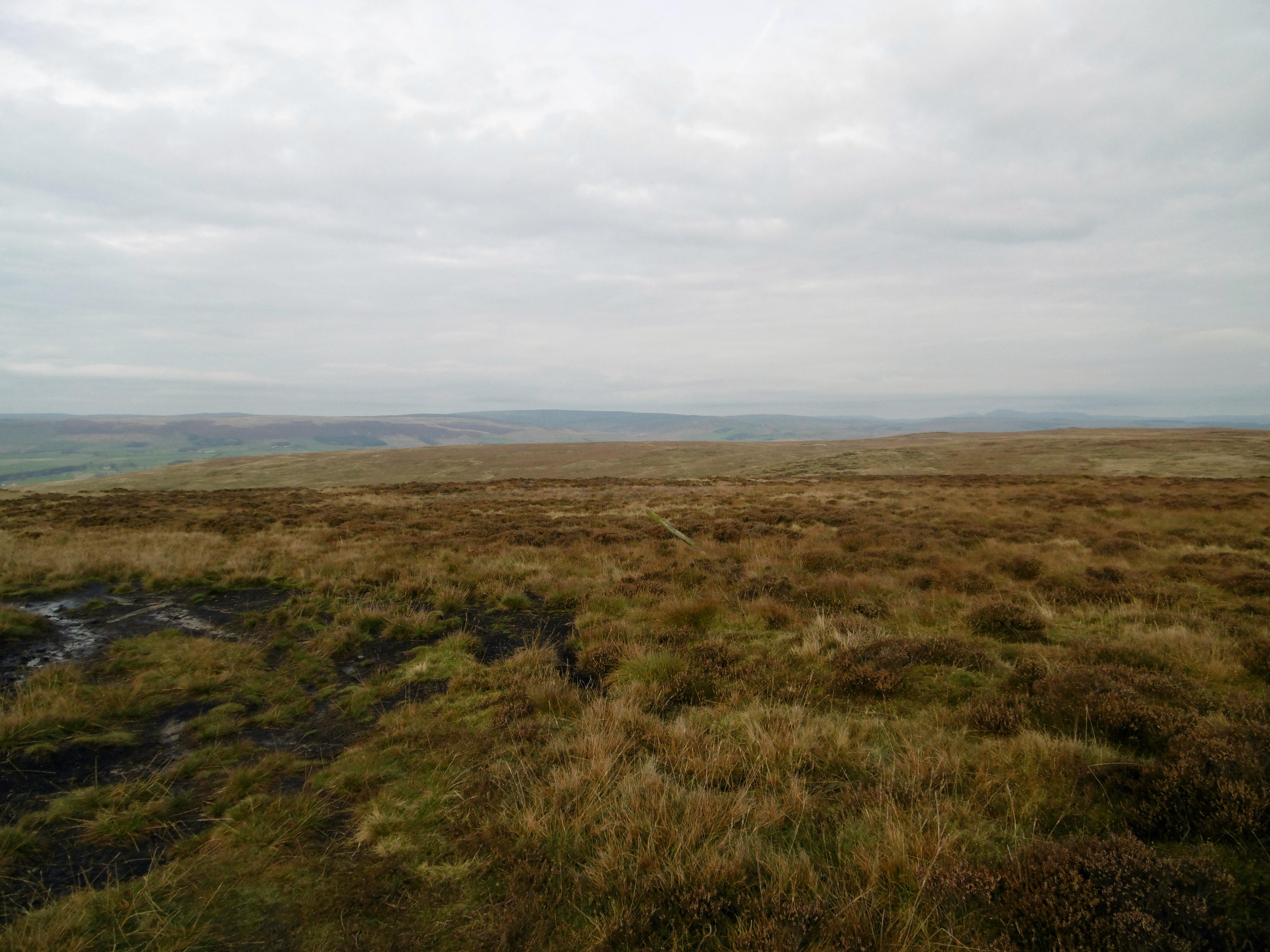
Passing over the first cattle grid, the car glides to a lonely halt in a parking place with a view. It takes us about three steps to realise the path heading downwards might just as well be a chute into a bog. It’s been raining so much the peaty ground’s saturated.

Across the road the drier path heads upwards. Steeply. But I have walking poles for such challenges and soon we’re huffing and puffing at the top.

pendle in the distance

Pendle’s at the back, the white speck’s not-the-Snow-Queen

The blunt contours of Pendle, the Lancashire witches’ hill, are dark against the skyline.

The moors dip and rise. The heather is scrubby, drained of its autumn colour, the purple whinberries long ago scoffed by nibbling sheep.

looking the other way from pendleThis is the edge of the Forest of Bowland.

Officially an ‘Area of Outstanding Natural Beauty’, it’s not ‘forest’ in the sense of woodland, but an area once outside the law – from the Latin, foris, outside – a term dating back to medieval times. The Kings of England used the designation, ‘Forest’ to deter development and protect the habitats of their favourite hunting grounds.

A grouse, startled, rises into the air. It’s the only living thing, bar us, in sight.

Our usual goal here’s a tea van, set by a babbling brook. If the weather’s good and the time of year right, it’ll be there, nestling in a valley surrounded by grouse moors and sheep-grazing hills. We’ll have mugs of strong tea and Chorley cakes – round slabs of pastry spotted with currants, not to be confused with buttery, currant-stuffed Eccles cakes. Chorley cakes are real walkers’ stodge (or very guilty treats).

Today we’re feasting on a different, upland view – and magnificent though it is, it’s also bitterly cold. The wind’s biting slices out of my nose and ears – or that’s how it feels. Plus, I left my gloves in the car. Five minutes’ exposure and my hands are already numb.

A glance at my watch shows we’re nearing the lunching hour. Reprieved, we slither down the hill, hop into our clean white car.

Motoring back to the village of Waddington (60.8 mpg) we have fun trying the ‘B’ drive that brakes our descent as we wind our steep way down.

It’s the perennial Yorkshire/Lancashire tussle in miniature, Waddington. In the fifteenth century, Henry VI (house of Lancaster) hid in Waddington Hall for a year after his defeat at the battle of Hexham during the Wars of the Roses. He was captured by the Yorkists in 1464. In modern times, until 1974, this Lancashire village was in Yorkshire.

waddington country kitchen cafeToday the Country Kitchen café’s buzzing. Clattering, actually.

(Have you noticed, cyclists’ shoes clatter like a tap dancer’s? They do, trust me.)

There must fifteen or twenty of them, the cyclists. All skinny, all in Lycra, all embarrassingly fit for chaps (mostly men) older than me – well, they look it.

We shoe-horn ourselves into a tiny table for two and prepare to wait for hours. But, hoorah, they’ve had their tea, their beans on toast – they’re on their way.

It’s two years since we first sampled the game pie here. Last time it’d run out – we made do with corned beef hotpot and pickled beetroot.

The pie’s a treat – only in season when game is in season. I push aside thoughts of the chirpy grouse. They live a carefree life, until they’re shot.

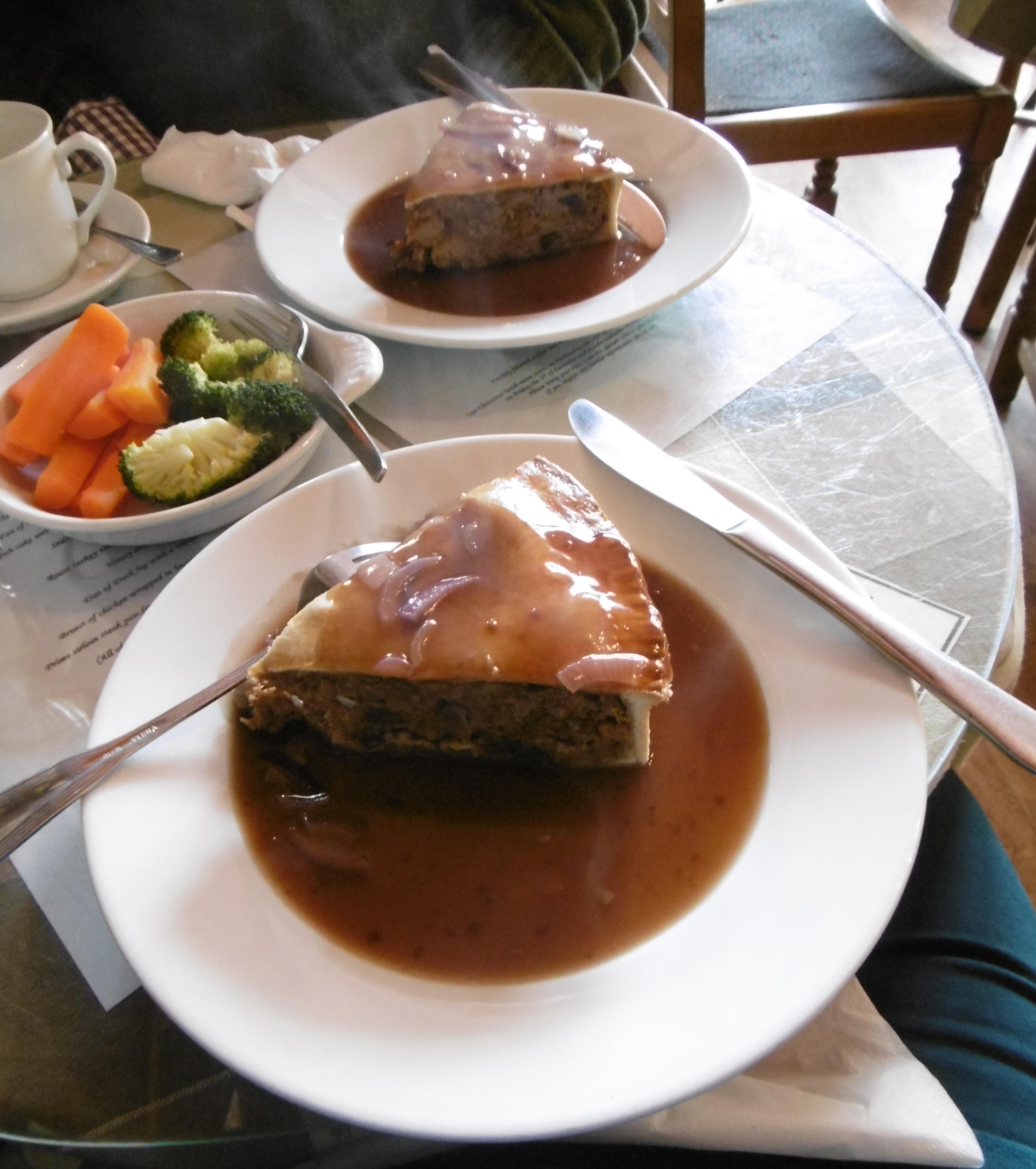
game pieOur pot of tea’s half gone by the time the pie arrives, steaming in a puddle of gravy – red wine gravy, says the specials board – with one dish of boiled and mashed potatoes, one of carrots and broccoli.

I doubt the Queen’s tried it. But I can’t imagine she’s had better.

The man in charge, a cheery soul, isn’t here today, but six Lancashire lasses scurry to and fro. In a café seating 35, that’s very good service.

Anyway. I asked the boss what the pie’s secret was, its filling all stuck together, but not with gravy.

It’s no longer a secret: sausage meat and egg white.

This pie’s the food of the northern gods, believe me. A winter’s day, a cup of tea, tasty chunks of game with seasoned sausage meat. In pastry. Yumph.

More than half the potatoes are left untouched.

No room for jam roly-poly, nor baked egg custard. No energy left for another wintry walk.

We sneak away from the hills and valleys and streams and copses, heavier and happy. Wend our way through Clitheroe – a small town overlooked by a small castle – and homewards.

Ooh, 62.8 mpg – and rising.

As dusk creeps in, I wonder where, in Bowland, the Queen would choose to live.

Because that’s what the Queen and I have in common.

It’s said that someone asked her where in her kingdom she’d retire to if she had the choice.

The Queen answered …

Bowland.

If it’s good enough for her majesty, who am I to disagree?

And if she should feel a little hungry, out walking the royal Corgis, she could always try our café. Because there’s a notice in the window.

Dogs welcome.

P1010209

A stream running through Waddington


Posted in Art, jaunts & going out, Britain now & then, Lancashire & the golf coast | Tagged , , , , , , , , , , | 10 Comments

Sacrifice

Tonight could be emotional. I grab a handful of tissues, stuff them in my bag.

Braving twenty-seven sets of traffic lights, we drive into Liverpool. Stow our car in the warm space beneath the circular cathedral. Choose seats on one of the hard wooden pews and wrap our winter coats around us against the draughts.

I’ve been anticipating this concert with a little trepidation.

Not because of ‘Death and Transfiguration,’ by Richard Strauss. Nor the Elgar cello concerto – that holds no demons for me.

No, it’s the Fauré Requiem. If you’ve read my post ‘In Paradisum,’ you’ll know this has a special, sad, place in my heart.

It’s the first time I’ve been to a live performance of the work and the auguries are not good. The lighting’s so bright that looking at the centre, where the orchestra’s arranged, is painful.

As the concert’s about to begin, two women slide in next to us – on seats clearly labelled ‘Reserved’.

‘Um, those are reserved,’ we whisper.

‘So? We’ve got tickets,’ one responds, settling in.

It takes a while to vanquish my rule-follower’s annoyance. But soon Strauss wraps me up in a wave of emotion, sweeps me off – and deposits me in a calmer space.

The cello concerto, for some reason, fails to work any magic. Perhaps the acoustics are wrong. So I turn my attention to the surroundings and focus on a, small, ethereal figure rising over the altar.

Knees bent, arms outstretched, there is no cross, just a representation of a figure that died on one.

A sliver of a man, like soap worn almost to nothing by the cleansing of many hands.

Can that be Jesus? Why no heavy cross, no tortured body, no blood?

A massive installation hangs from the roof. It’s a vehicle for lighting, but also represents a vast crown of thorns. This heavy burden hovers over the sliver of a Christ. A burden one man took upon himself, for the sake of his fellow men.

Clapping signals the end of the concerto and we mill around, chatting until the interval is over and the requiem begins.

The tears come, but not where I expect.

Not in the ‘Pie Jesu’ – beautiful, but almost too sublime. (One of the women on the reserved seats, though, dabs at her eyes. I’m ashamed I was so hostile.)

Not in the heavenly notes of the ‘In Paradisum’.

It’s the Sanctus that sets my tears free. Glorious voices raised in praise. Hosanna in excelsis! The last notes dying away, like a leaf, fluttering to the ground on a still autumn day.

And that’s how Sunday dawns.

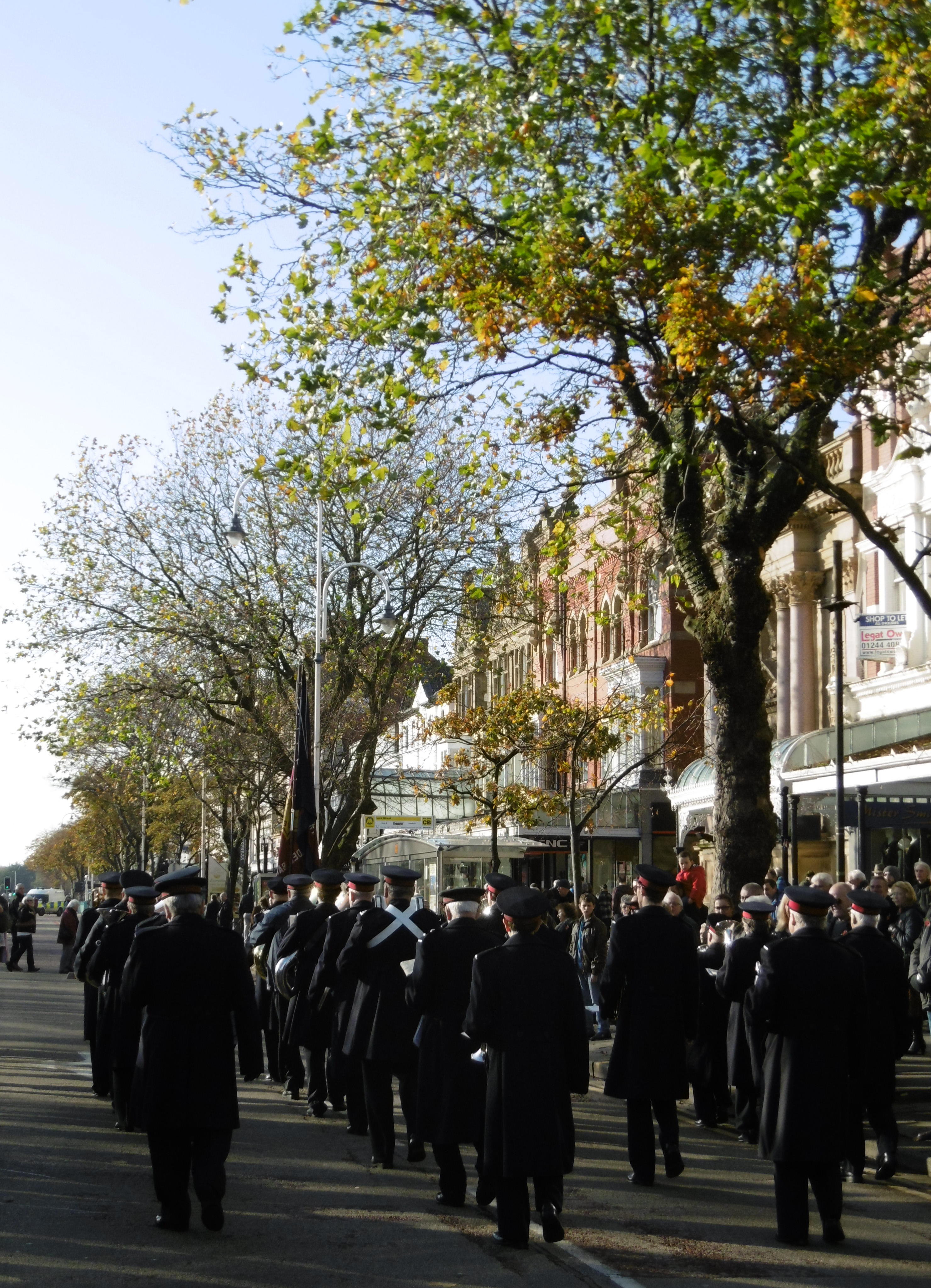
sally armyBy ten to eleven we’re in our local town. Standing under cool, clear skies, basking in sunshine, singing, as the Salvation Army band plays ‘Abide with me’.

An elderly woman steps into a picture I’m trying to take. Her gloved hand clutches a small wooden cross, at its centre a poppy. On it, written in blue ink, are words I can’t decipher.

Small as a child, with hair of steely grey, she’s all alone, wearing ear muffs against the chill of this sparkling wintry day.

I rebuke myself for my moment’s irritation. The picture’s not important. We’re here for her. For her and countless other ‘hers’ who’ve waited in vain for fathers, brothers, uncles, sons – and lovers – to come safely home from the wars.faithful to her we fell

It’s not all men, of course. Sisters, mothers, wives, aunts – and lovers – their names, too, live on in the vast monument by which we congregate today.P1010133 (2)

It’s the Sunday nearest the eleventh day of the eleventh month.

We’re waiting for the eleventh hour.

The hour the madness stopped in 1918.

I think of all those couples who married one hundred years ago today. The babies who were born that year, the architects on whose buildings that date was engraved, proud and bold.

None of those people would ever tell of the year of their birth, the year of their wedding, the year of their great commission being built, without a pang of pain.

1914. The start of the Great War. Millions dead. But not forgotten.

lord streetThe road on which we’re standing – an elegant, tree lined boulevard for which this town is famed – is partially closed to traffic.

Motorists rev by, far enough away to be ignored, impatient. An extra minute or two added to their journey to the temples of mammon. Or sport.

It’s always moving, Remembrance Day at local war memorials. Here, though, the monument is dedicated not to war, but peace.

I understand those who prefer the white poppy, those who feel the horror of war is masked, exalted, even, by our sentimental reaction to the scarlet ones.

But the red of the poppies says bloodshed, not just foreign fields.

look upwardSometimes the cause may be misguided, but that’s not the fault of those who fight.

Which is why, in two silent minutes, at eleven o’clock, we remember the dead. People who fought because they had no choice – or had a choice, but risked their all for their fellow humans.

Two minutes. A small enough gesture for those who sacrificed a life.

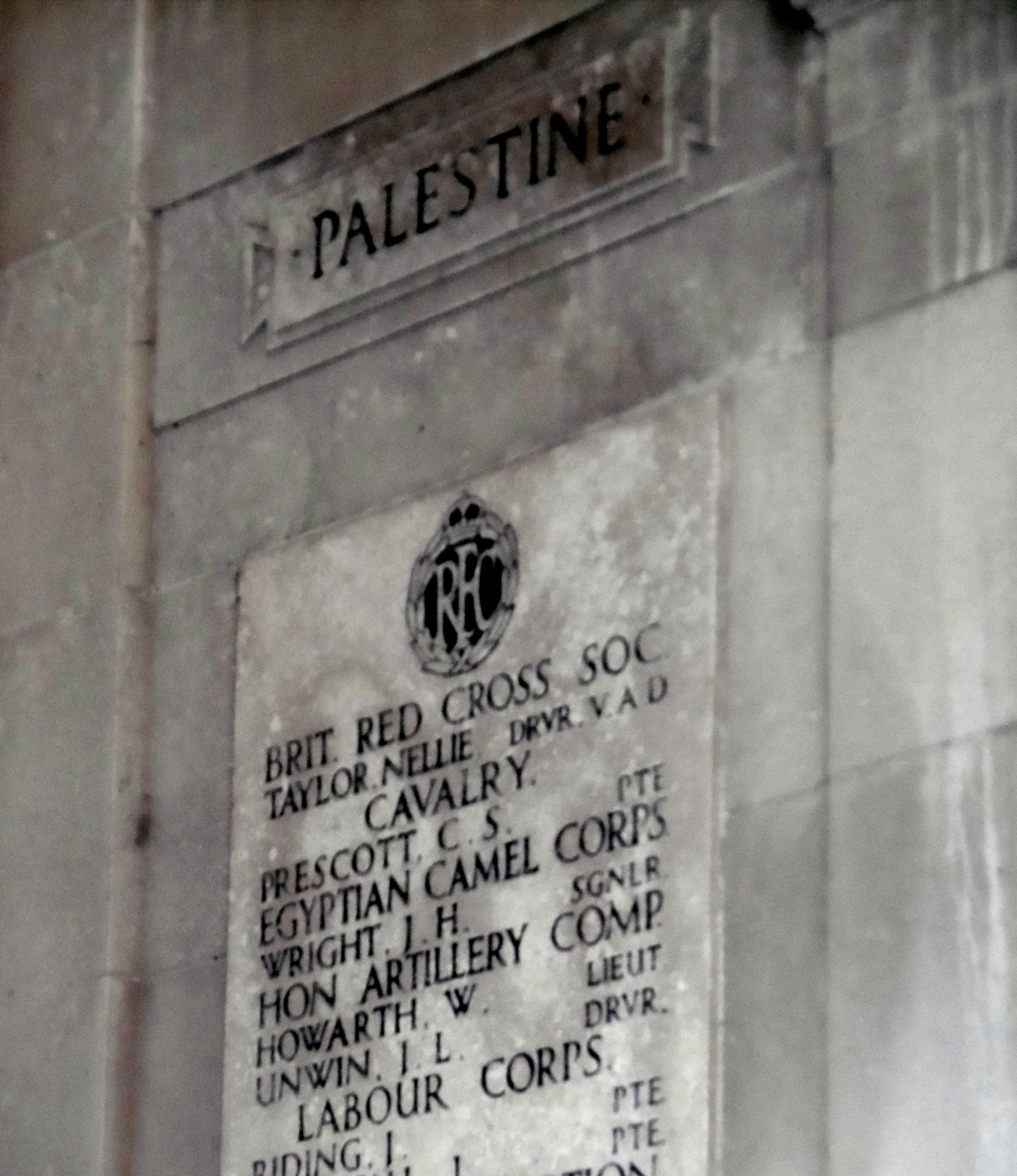
After the service we peruse the lists of the fallen.

A member of the Egyptian Camel Corps.camel corps

Men of the Polish Air Force. Merchant seamen. Salvation ArnyNurses.

Place names resonant with death.

Passchendaele. Ypres.

With the fleeting days of empire.

mesopotamiaMesopotamia. Burma.

Many walls, many lists, many names chiselled again, and again.

Many families losing their young – to what? To victory, sometimes. But at such a price.

A young army man in shorts – showing his prosthetic limb – marches out to lay a wreath.

Remembrance.

The slender figure without its cross, beneath the crown of thorns.

The grand monument to the ugly deaths of so many.

We all have our memories, our painful memories.

‘We will remember them.’

P1010185

P1010190burma star standard

Posted in Art, jaunts & going out, Britain now & then, Lancashire & the golf coast, Liverpool, Thinking, or ranting, or both | Tagged , , , , , , , , , , | 4 Comments

Something for nothing – and proud of it

Does IFLS mean anything to you?

It’s ‘I F—ing Love Science’ (the dash is where ‘uck’ would be) and it often hosts thought provoking posts. About Science.

You can pretend you don’t notice the name, call it IFLS for short. I do.

IFLS recently posted this image of a Tweet.ifs tweet

One of my ‘friends’on Facebook, who has a PhD, ‘liked’ it, which is how I came to see it.

Now, that doesn’t necessarily mean the friend actually ‘likes’ it.

And it’s possible IFLS posted it to stimulate a debate, not as an endorsement.

But judging by the few comments that I read (of gazillions), I suspect I’m being generous – unlike the people who posted links to sites where students can download illegal free copies. And yes, I know that they know they’re illegal – they use the word ‘illegal’.

Before I vent my spleen on this one, I want to make a brief personal comment.

As a writer (even if that’s as mythically as a unicorn in my own mind) my creativity – such as it is – is splurged for free on an unsuspecting world through this blog.

You’re reading it on a URL I pay for, so you don’t have to see advertisements and I don’t have to include ‘.wordpress.com’ in the site’s address.

You don’t pay me anything, I don’t ask you for anything. Well, except fair treatment of my stuff as regards copyright.

I have, however, written – and published – a book. It was a chastening experience.

Imagine you spend a lifetime acquiring the expertise to do something. Spend years – or many months – distilling it. More months honing it – and possibly your own money publishing it.

A friend says, ‘I’m enjoying your book.’

You smile, possibly ask where she or he bought it.

‘I borrowed it off Annabelinda.’

You smile back, with gritted teeth.

‘That’s a shame.’

Puzzled look.

‘Well, quarter of the proceeds from sales of the book goes to …’ a good cause.

Bewildered look. Money? Book?

‘What does it matter as long as I enjoy it,’ thinks the casual reader, ‘isn’t that why you, dear author, have written this masterpiece?’

I’m used to it, now. It’s a risk I took – and I accept it.

BUT …

what really, really angers me about the idiots who responded positively to the IFLS post, who displayed such nonchalance about behaving illegally, was their sheer, obtuse, ignorance about what goes into making the books they seem to need.

My husband has written three academic books as a sole author, one as a co-author with a colleague in Oxford. He’s edited one volume based on an international conference which he organised and for which he raised the funding. Two, possibly three of these books could be regarded as ‘textbooks’, albeit somewhat specialised in scope.

Each time he writes a book our world changes.

Life revolves around it. Spare time dribbles away. Deadlines result in stress, tension, overwork. We share some of the strain, because of my expertise in editing and proof reading.

We eat too much cake (the brain uses a lot of energy, I learned that from his most recent book) and grow chubby.

This takes months. Can take years.

If you add the learned expertise, or field work (many years of it) necessary to be able to write the wretched thing in the first place – well, it’s not just a matter of slapping a lecture series online and adding a few pictures, as one IFLS commenter suggested.

Pictures, for a start, have to be sourced. Grants have to be sought for travel to take the pictures. Museums have to be paid for photographing images. Specialist illustrators have to draw archaeological specimens.

Permissions have to be sought for quotations and illustrations. Copious references have to be read and amassed as lists. An index has to be written, or funding raised for an indexer to do it.  And then there’s the checking of the editing. And proof reading. And so on.

The author does all this, not the publisher. And mostly in his or her ‘spare’ time.

If you Effing Love Science, isn’t that knowledge – and work – worth something?

If no-one writes the books (because there’s no reward), how will that learning be recorded and transmitted? Is that worth paying for, or not?

But, let’s back to real, expensive books.

I have a rather daring suggestion to make.

If you’re at a university or college, chances are you have this thing you could use called a ‘library’.

Libraries tend to have lots of books -including textbooks available as e-books – for students to use, for free. Legally.

Radical, eh?

Until recently I was an academic publisher, in a very small way. I know how Effing unrewarding scholarly publishing can be if you’re not a giant conglomerate.

And who in their right minds, you might wonder, would want to write a book these days?

Well, it seems there are lots of mad people out there – and I’m one of the many.

But what a shame there are also so many lazy, law-breaking ignoramuses. People who’d rather exploit the limitless possibilities of our amazing, knowledge-sharing, liberating technology in illegal ways than log-in to a library and download an ebook.

Call me old fashioned. I believe in paying taxes, too.


Posted in Thinking, or ranting, or both | Tagged , , , , , , , | 6 Comments

A rose by any other name might smell as sweet, but …

… roses don’t indulge in matrimony, to the best of my knowledge.

They do have individual names, so you know what to expect by way of leaf and blossom and flowering habit. Some are silly, some are serious and some are like gaudy ‘SALE!’ signs – Silver Wedding and such like – slapped on by ruthless marketeers.

Humans, by and large, don’t tend to be called ‘Human’ first, then ‘Tall, pale, curly-haired and short lived’ as an afterthought, to help with identification. No, we have personal names and family names.

You know where I’m going with this, don’t you?

I live with my personal name – which is Mary – and my father’s surname.

My husband lives with his personal name, Lawrence, and his father’s surname.

And here I have to make an admission.

For once, even if I try very hard, I really, really, REALLY don’t understand something. (Well, in addition to infinity and the concept of multiverses.)

I don’t understand why women change their names.

I’ve read the arguments for and against. I can sort of understand wanting to have one name for a family when there are children, just to make life easier. Sort of.

But I have a lovely friend with four children whose surname is her dad’s. Whose husband has his dad’s surname. Their children don’t seem to mind being apportioned either one of their parents’ surnames.

By way of contrast, I had the central heating boiler serviced recently – no, hold on, it’s relevant.

Nice chap – I’d say he’s in his thirties – drives up in a smart red van with his name on the side. Hewitt, the surname. We get chatting – as you do – over a brew.

He tells me about his father-in-law, who does electrics. Been in the business donkey’s years. Young Hewitt gives me a business card. Hewitt, one side, for heating, Hewitt, the other for electrics.

But, hang on a minute? It’s dawning, a bit slowly (it was a Monday).

‘Um – your surname…’ I flounder.

‘I took my wife’s name,’ he says, ‘easier than my French one.’ He’s right. He told me what it was.

Now, I can understand changing names when one name is genuinely awful or difficult to spell.

But I can’t understand why so many young women of the ‘me’ generation rush to become someone else’s appendage.

Like, Mrs John Smith. Well, no, I suppose being married to a beer brand would be quite a laugh. But hang on, it’s John Smith’s bitter, isn’t it? Not so good after all.

Perhaps because the rest of the subjugation no longer comes with it – being just a sub-section of your husband’s tax return and so on – it feels less of a surrender of self.

I know, we aren’t our names – in theory. But I feel, somehow, I am. Or maybe I’ve become my name.

I’d reached the age of 30 by the time I married –  old, for marriage, in my day.

At school, like most girls, I’d tried writing my first name with a series of boys’ surnames. Hidden in inconspicuous places. Inside textbooks, on the plain brown paper or scraps of old wallpaper I’d used to cover them and keep them clean.

The names changed as my crushes came and went. Mary Mychalkiw, Mary Breslin, Mary Dyball – well – you’ve got the idea.

But by the time I was thirty I felt like me. I felt like my name.

My surname’s a solid, earthy, northern English name. The first (only) time I had a major article published in a national newspaper our neighbours – two gay guys from London – went wild about it – they’d never heard it before.

I’d gone through my childhood and teens hating my name. But at thirty, it had become my skin, metaphorically speaking. And I no more wanted to change my skin for someone else’s than my name.

My mother-in-law, believe it or not, before our wedding, sent me name tapes. Just initials. They’d been organised years since for her daughter, whose own initials would have been like mine, had I changed my surname. I didn’t use them, you’ll not be surprised to hear.

The ‘Mary’ bit of my name, though, has always been a trial – ‘quite contrary’ and all that. I’m sure it moulded my character. And people use it in the most annoying ways. Ouches come from all around, especially popular music.

Cat Stevens, before he converted, sang about a Mary dropping her pants on the sands – pants, I suspect, in the English not north American sense.

Bruce Springsteen settled for Mary: you ain’t a beauty but – hey – you’re all right.

Hendrix wailed, the wind cries Mary. Actually I like that one.

But you see what I mean.

And don’t get me started on all those variants of ‘Mary had a little lamb’.

All in all, I’d have been keener to change my first name.

Anyway. I’m going to stop right there – I’ve nothing else to say.

Because I just, don’t, understand.


Posted in Thinking, or ranting, or both | Tagged , , , , , , , , , , | 8 Comments

Of tinkers, magic – and the perils of mixing grape and chain.

I’m holding a small piece of black plastic with a hole at the top, like a short, fat, dysfunctional needle. Or a midget-sized witch’s magic wand.

I waft the holey end in front of a little light and – abracadabra – a metal grille groans its way up, letting me into a cage where I can stack my bike for safe-keeping.

It would’ve seemed like magic to little-girl-me, back in the days of three channel telly and a ’phone line shared with neighbours.

But it’s not magic, it’s just technology.

We’re at our local train station, setting out for an evening of who knows what. I have an inkling – I’ve looked them up online – but my partner-in-jaunts is heading for the ‘Corduroy Folk Club’ totally unprepared for the Oldham Tinkers. Well, other than being married to a Lancashire lass, that is.

A few minutes later we’re in town, the Sardinian restaurant bright and lively. It’s early, just six o’clock, but puddings are already arriving for a nearby couple. I stare at a sundae glass of mixed ice creams with a lust that I know will remain unfulfilled.

We start with a glass of Italian bubbly – delicate, but tasty.

Sardines – for him – arrive in a stinky cloud.

‘They taste better than they smell,’ says he. I would hope so.

My rocket and parmesan salad zings with lemon juice. Mmm. Never thought I’d feel  smug and virtuous!

Sardinian gnocchi – with sheep’s cheese and meat – succeed his smelly sardines. Gorgeously plump parcels of aubergine and smoked cheese ravioli for me. Grilled under more cheese and tomato. You can see why the ice cream’s a no-no.

A glass each of Canonau – dark, red Sardinian wine –– and we’re gooey-eyed, reminiscing about a very happy holiday on that island, many years ago.

https://i0.wp.com/www.theatkinson.co.uk/website/wp-content/uploads/2014/07/outside-building-web.jpgAlmost ftb (full to bursting) we saunter over to ‘the Atkinson’, a grand, newly refurbished town-hall style building in this fine, seaside town.

As we head for our seats we’re accompanied by a trio of musicians, lurking by the stairs. Squeeze-boxes a-flexing, singing shanty style, it’s a, ‘take your seats, wait for the Tinkers, don’t expect this to be formal,’ warm-up.

Eight o’clock arrives. Three men of more than a certain age amble onto the stage.

They’re no longer ‘little tinkers’ – as my parents used to call us as mischievous children. There’s serious effort involved in bending to put pints of beer on the stage – and picking them up again. And a bit of sitting down.

Tales are well-told, jokes well-rounded after many years of sharing. Playground songs winkle out childhood memories – and soon the room’s a-hum with many voices – including ours – joining in familiar-sounding choruses.

In this year when we remember the start of ‘the war to end all wars’ – oh, would that it had been so – the Tinkers strike up an old music hall song, ‘Up to mighty London came an Irishman one day’. Funny –  and poignant  – you might know it better as, ‘It’s a long way to Tipperary’.

I step out to buy a drink at the bar, join a queue. Chat with a man who’s travelled many miles, with his wife, to be here.

‘We’ve been singing these songs for years,’ he says. ‘Drunk, at dinner parties.’

A shame they don’t live nearer.

It’s my turn to buy.

At folk clubs, you really need a glass in your hand. We could have a soft drink, but when Southport Brewery has an ale called Dark Night, in a pint bottle, at only 3.9% alcohol …

After the encores we wend our way to the station through a glowing Victorian shopping arcade – to the sound of more singing. Tribute night at a local restaurant. Chock full of happy smiling faces with flushed cheeks – and cheery voices raised in song.

The train, by contrast, is subdued. Just a gaggle of under-dressed girls on over-high heels heading out to Liverpool as we’re heading home.

Back at our station I wave the magic wand and conjure my bike from the rack.

Hills are few and far between, round here. But our station sits atop one. We decide to stick to the pavement – it’s broad enough for bikes and people – and there’s no-one much around.

Which is just as well.

I apply the brakes to my rather too rapid descent. Try to keep a straight line, but find it hard. The night air’s cool, the stars bright, the autumnal suburban shrubbery distracting. That’s my story.

As I dismount by the garage door my fellow pedaller’s face shows obvious relief.

Ah. I know what he’s remembering. My old bike, with the dodgy handle-bars. Stopping at a pedestrian light, one night, the front wheel turned beneath me.  I went crashing to the floor. And the chain came off.

My waterproof’s elasticated wrist kept the torrent of blood nicely contained. Months later a chip of bone finally made its way to the surface of my elbow.

Tonight we made it home without incident, despite the erratic ride.

I look fondly at my plum bike as I put her to bed. She wouldn’t let me down. But next time, perhaps, I’ll skip the second beer. Or take a taxi.

Whatever, we’ll be joinin th’Corduroy Folk Club again.

Oh, aye. It were a grand night out.


Here’s the Tinkers’ website: http://www.oldhamtinkers.com/

This (possibly copyright infringing but it’s on YouTube) recording is taken off a scratchy record but have a listen to the first track it’s a cheery respite from 2014: http://www.youtube.com/watch?v=1R-xHj4Q5_U

Posted in Art, jaunts & going out, Lancashire & the golf coast | Tagged , , , , , , , , , , | 2 Comments