A fraud journeys over water, encounters a naked man and brings home some reindeer

It’s been a bit husk-memoir-lite, lately, this blog, so I thought I’d retrieve a little episode from the 1980s from my mental archives. One I’ve been puzzling over recently, for no particular reason.

Here goes …

I’m working for an American company that publishes technical magazines. ‘European editorial office’, my card says (inaccurately), Boston being unwilling to fund anything more exact after their last experience of employing me. And, yes, the fraud, that’s me.

You see, as a journalist – I use the term loosely – I’m not too bad at researching, quite good at editing, but my knowledge of telecommunications – the main sector I cover – is what you might call basic.

Yet people keep sending me on trips to interesting places.

The only condition seems to be that I visit a factory or an exhibition or an army base (I also cover ‘defense’) or something. In return I stay in top hotels, eat fab meals and travel in little planes and chauffeur driven cars. Well, that’s on the good trips.

Knowing nothing – or not much – might be a serious handicap, you’d think, but actually it’s not. Kind colleagues often help me out. They know I work on a monthly, across the Atlantic. That my work flies out in bundles every Wednesday – and it’ll be ages before my report’s in print, if ever.

In other words, I’m no competition. And we all go out drinking together, anyway.

But.

Odd things sometimes happen. And on this trip, they do.

We stayed last night in a hotel in Stockholm, but today we’re on an overnight ferry, to Finland. To a place called Turku.

Now, you may read that word, Turku, any way you like, but for me it’s forever a sound. It comes in the sentence, ‘Welcome to the Turku Telephone Company,’ spoken in a hoarse, gruff voice. Barely more than a whisper, but deep and loud.

Each word bounces along like a rubber ball.

The man speaking has a tremendous white moustache. And a twinkle in his eye.

He explains why his voice is so gruff. It’s permanent and – I may be making this up – something to do with World War II and the shortage of medicines.

Mr Gruff tells us lots about telecommunications in Finland. Details I soon forget – like everything technical thing about this trip. Even the scoop that my friend from Electronics Weekly picks up while we’re having after-dinner drinks with a Top Boffin.

Never mind. By the time my deadline comes around her report will be out, I can read it.

Picture of Turku Castle by Markus Koljonen (Dilaudid)

Turku Castle Picture: Markus Koljonen

The roofs of Turku have a quaint charm and there’s much to see and buy in the indoormarket – but soon we’re leaving it behind, heading for a castle.

There we drink lingonberry champagne and snack on smoked reindeer canapés. And say farewell to Turku.

At the airport, later that day, I invest in a bottle of Finnish vodka and a pack of smoked reindeer to take home.

But what about the naked man, you ask?

Strictly speaking he’s already happened. A couple of nights back, in Stockholm. I kept him to last to entice you to read on.

So, to Stockholm …

I’m in a rather smart hotel, in my room, at night. A knock comes on the door.

Outside stands a naked man.

‘I’m on the press trip,’ he says, probably seeing how blank my face is (I’m trying hard to keep it that way), ‘I locked myself out of my room.’

He has a heavily accented voice, seems a bit agitated.

‘Please can you ring reception, ask someone to open my door?’

Of course I say yes. Offer him a cushion to cover his – embarrassment. He gives me his room number and I shut the door on him, leaving him out in the hall.

I can’t say anything quite like this has happened to me before.

Next morning we’re waiting for a coach and I’m chatting to Della and Bob, a couple of British journalists. A man wearing glasses taps me on the shoulder.

‘Thank you for last night,’ says the man, sotto voce.

For a moment I’m puzzled, then recognition dawns.

‘Oh, sorry, ’I say, in my normal everyday voice, ‘ I didn’t recognise you with your clothes on.’  Then, being a polite person, I add, ‘You’re welcome.’

He scurries off. Della and Bob look at me. I explain to a burst of semi-muffled sniggering.

I know it’s hard to believe – especially me saying that – but, honestly, it’s true.

Anyway – here we are, now, in 2015 and I’m talking about this event. To my husband.

‘You know,’ I say, ‘I’ve always wondered why he got locked out of his room. And how he knew … You don’t think …?’

Husband shakes head. Looks like he’s thinking, oh dear, oh dear.

‘Of course I do.’

Those were the days.
 

Posted in Travelling | Tagged , , , , , , , , | 11 Comments

I am not a number. Je suis humaine.

If you recognise the first part of the title as coming from ‘The Prisoner’, award yourself a silver star! But, be warned, that’s as cheerful as the mood of this post gets.

Today I was planning to write something superficial about massacres and kidnappings. Forgive me if that sounds shocking. It doesn’t mean that I don’t care, or that they don’t matter, it’s just that I’m not knowledgeable enough to delve deeply into the subject.

The idea started brewing a couple of months ago when we went to a concert. There I heard a song about a massacre.

In that massacre, I read later, eleven people – nine men, two women – were killed and four hundred wounded.

It took place in Manchester, in northern England, in 1819 and later became known as Peterloo*.

There’s a plaque commemorating the event on the wall of what was, until 1997, the ‘Free Trade Hall’. Built on St Peter’s Field, the site of the massacre, it’s now a Radisson hotel.

The plaque tells us fifteen people were killed and 600 injured, but we’ll never know the exact figures. Given the context and our distance from it, that’s hardly surprising.

Then, a week ago I saw a report of a massacre in Nigeria. It was in the Guardian newspaper. A smallish item compared with the pages devoted to the Paris killings. But at least it was there – a rarity, at that point.

‘As many as’ 2000 people were feared dead, according to Amnesty, the report said.

Yesterday, six days later, images from Amnesty were shared on Facebook and reproduced in other media showing clusters of homes burnt to the ground.

I don’t have the resources of a news organisation, nor the confidence to explore the complex underpinnings of Nigerian politics and the havoc being wreaked by Boko Haram terrorists. But there are things we know.

In Nigeria an election campaign is underway.

The authorities in Nigeria do not agree with Amnesty’s estimates of how many have died.

And on this they have form.

Step back in time a few months.

Remember the kidnapping of schoolgirls in Nigeria?

Do you remember how many there were?

The Nigerian authorities’ figures have varied wildly. It was initially claimed that 85 girls were abducted, then that 129 had been kidnapped but 100 had escaped. Finally, it was admitted that possibly 276 had been taken. Since then some plucky girls have escaped.

How could the authorities slice a hundred or more human beings – girls – off the figures, for appearances’ sake?

How did anyone have the gall to quibble about numbers when they should have been doing their damnedest to get them back?

Do you know why so many girls were at that school, overnight, at that particular time?

They were there so they could take their exams in safety. They had come from all over the area that is worst affected by Boko Haram. They wanted to make a better life for themselves through education.

Boko Haram apparently means ‘Western Education is forbidden’.

According to Africa Factcheck, it’s probable 219 young women and girls remain captives.

I suspect there’s little hope, now, they will be freed in any condition fit to carry on their former lives. To take their certificates of secondary education.

Amnesty also claims that the Nigerian authorities had at least four hours’ warning that the kidnappings were imminent. Who knows the truth? I don’t.

The girls have not been entirely forgotten.

Every now and again I go onto Twitter, jaded, to see if the hashtag #BringBackOurGirls is still running. But Twitter can only raise virtual storms, it can’t change the weather. Yes, Michelle Obama famously Tweeted the slogan – but ‘our’ girls are still not back – and the world moves on.

Meanwhile, in the northern hemisphere, we have, for the last few days, been bombarded with news of twelve murders in and around the Charlie Hebdo offices and four at a Jewish supermarket in Paris.

We’ve seen videos. Heard eye witnesses recount their experiences.

We’ve followed the trail of the terrible tragedy with countless reporters, shipped-in, post-haste, like ghouls at an unholy feast.

In Britain, we’ve watched and listened as BBC newsreaders and radio presenters popped up on the streets of Paris – introducing the BBC’s own correspondents, who were already there. ‘Me too, I want to play,’ it felt like they were saying.

But at least – conspiracy theories aside – thanks to them we know how many people were killed, how many murderers there were – and how many extra copies of Charlie Hebdo were published after the event.

We know world leaders linked arms, actors wore pencils on the red carpet.

And everyone learned to say Je suis.

Please, don’t think I am belittling this terrible tragedy.

I do understand why it has been given so much attention in the western, northern media.

It was horrific.

It’s close to home.

It concerns freedom of expression and religious tolerance.

It’s reportedly the work of terrorists. (Though here I side with the commentator who suggested that these men be called murderers – in one simple word detaching them from Muslims everywhere, whether they sympathise with the killers or – more important – whether they do not.)

We proles can’t take too much death or too many refugees – literally in the latter instance in Britain’s case. So I also understand that some big things, like Syria, will always slip from the news.

But,  ‘as many as’ 2000 people driven from their homes and killed?

Probably 219 girls held captive by Boko Haram?

In the wake of Peterloo a new newspaper was founded. A newspaper that told the truths other media – controlled by the frightened authorities and upper classes hundreds of miles away in London – would not.

That newspaper was the Manchester Guardian.

The Manchester Guardian is now just the Guardian – and has its feet firmly cemented in London.

But at least it can still muster the humanity to cover the massacre of 2000 (or so, who’s counting?) far away at a time when we also mourn the sixteen, close at hand.

RIP


*More about Peterloo:

The plaque: http://openplaques.org/plaques/768

The words of the Oldham Tinkers’ song, Peterloo, give you a simple locally expressed snapshot of what it was all about, here’s a link to their website and the lyrics and a You Tube of a performance:

http://www.oldhamtinkers.com/peterloo.html


Posted in Thinking, or ranting, or both | Tagged , , , , , , , , , , | 7 Comments

Scents and scent’s ability

A squeeze, a touch and there it is.

A white plastic shrine, four or five inches tall, no more. Two tiny doors that open outwards. Inside, the figure of a slight, wistful-looking woman in blue, hands joined in prayer, standing on a sphere that may be the world.

This long-lost treasure was brought to life by a handful of ancient lavender, wrapped in a square of sheer pink organdie – a scrap left over from making a party dress, perhaps – tied with nylon ribbon. It’s old, very old, yet still it works its magic when I come upon it in a drawer.

It was bought at a sale of work held at the first nun-run school I attended. Hence the  statue of Our Lady of Lourdes.

I was thinking about it over Christmas – a particularly fertile time for scent-awakened memories.

Cold December afternoons. Children running home from school, making slides and throwing snowballs. Counting the days, the hours.

At last the tree goes up, perfuming the air. Fairies dance on the branches – just electric lights to grown-ups, but mythical creatures to little, screwed-up eyes.

It still works, as the years sneak by, the Christmas tree. Its scent, its decorations.

And lifting the lid of a small cardboard box sets free a scent that yanks the modern world right out from under my feet.

In a trice I’m standing in a small back garden – not much more than a yard – with a bright green, cheap plastic torch, what my in-house American calls a flashlight. My first, ever. A silver, sliding switch to keep it on, a plastic push button for flashing. English torch, American flashlight.

I can sometimes re-create that magic-carpet of a scent if I close my eyes and just let it happen. It’s a bit like looking at the Pleiades, though. If you stare straight at the stars you can’t see them – and so it is with this delicate scent.

I have to skim my thoughts right past it to find it.

The scent has a colour – green, but not a bright green. A dark, dusty green. An image of ferns comes to mind, but not because of any picture.

For years the nearest thing the world could produce to match my memory was something called ‘French Fern’. An inexpensive perfume. But not cheap, as in tawdry or cloying.

A scent of fine soaps and delicate talcum powders. Of eau-de-colognes, sprinkled on cotton handkerchiefs.

Or so I imagine.

In our boxes of baubles and tinsel, there was always one that, when opened, set loose a fleeting hint of this scent.

But now it’s gone.

A whole box of boxes is gone, and with it, the memories. That’s to say, the memories are still there, but that’s all they are, not a pinprick for the senses, tearing a shining rent in the dusty fabric of time.

And this Christmas also made me think about how wrong we can be about obvious things. That what’s important to me, for example, may not be important to my nearest living blood relative.

When my father had died and my mother was temporarily – finally, as it turned out – living far from her own home, with my sister, I had the melancholy task of emptying her house. I, with my long-suffering husband.

Among the treasured possessions were the Christmas ornaments.

I wanted to keep them all.

For nearly forty years I’d watched them emerge. Helped distribute little figures and paper ornaments around the house.

P1010428A robin on a log in a box of cotton wool – he always sat near the lavatory, by tradition. An imp adorned my bedroom door – this year my study.

I’d watch my father set up the crib and arrange glass birds in the Victorian glass dome. Watch as he decorated the tree then later, did it myself, for my mother.

My favourite tree decorations – a white bear in a red aeroplane. A blue and yellow plastic tricycle. A bell-shaped glass bauble that rings.

There were many more.

A turkey wishbone.

Clowns strung on cotton threads (I didn’t like them) and my parents’ home-made ornaments from the immediate post-war years. A crystal button on wire. Paper cut outs decorated in ink. Wooden cotton reels painted yellow, red and gold.

Small glass ornaments in shapes like pine cones and Father Christmas. Brown cardboard boxes of plain glass balls. I loved them so much that it almost hurt to put them away each year.

There were two boxes of those – two sizes, many colours.

I wanted them all.

I gave the bigger and better (I thought) ones to my sister (there, I’ve lost the virtue by telling), along with the clowns she said she liked, in a box that once held a xylophone.

I gave her the wishbone – well, it came from the first turkey that she and my parents had, years before I was born.

I suspect I gave her things she didn’t want, didn’t find evocative in the way I did. I don’t know, and may well be wrong. But by then she had three grown children, her own traditions, her own decorations. Her own scents and sights and triggers for memories.

And perhaps like everything else, scent’s evocative power eventually fades if it’s never used – or used too much.

I can still remember my box, can catch the scent if I set my mind past it. But perhaps it’s time has come – and gone. Like Christmas.

Posted in Britain now & then, Thinking, or ranting, or both | Tagged , , , , , , , , , | 6 Comments

Moon over the meanygates

Dark clods of earth, like sticky remnants of Christmas pudding,* form ragged ridges over deep, ice-filled ruts. What once were puddles, ruffled by angry winds, now double as skating rinks – for voles and weasels, mice and stoats.

A wintry, Midas of a sun reaches down and touches the ice. A myriad shimmering reflections turn to gold in the last few minutes of the dying day. Then the pudding crumbs and lemony ice turn back into a field, into work for the farmer, into food for the birds and beasts.

Way up in the cold, clear sky, a sickle of moon watches the sun subsiding. Waiting for her time to shine.

And way beneath her, driving along the meanygates, through the moss-land, I wonder. Why meanygate? Why moss? Why Ralph’s Wife’s Lane?

The moss-lands. Bogs. Some are protected – Sites of Special Scientific Interest. Some undesignated, at risk of drying out because of drainage, or irreparable damage thanks to peat cutting.

I once helped save a moss. Not in a pretty rural area, but in an unloved patch of land between noisy, dirty motorways. It was threatened with development for waste disposal – but it’s safe, for now, with its special plants and animals and insects. An unlikely haven in an unlikely place.

A local inhabitant of the moss

A local inhabitant of the moss

More rural, isolated mosses – isolated not by distance but by nature – still have their own traditions, or so I’ve heard. A history of hardship. Of livings wrested from that fickle friend, the land and, round here, its ruthless partner, the sea.

Meanygates, or narrow roads so-called, criss-cross one of our local areas of moss-land.P1010413 Some would have it they were toll roads – ‘mean gates’, so-called because of the meanness of the landlords who extracted the tolls.

P1010418Others say the term relates to the farmers who were excused the tolls when taking produce to market. Yet others claim it’s simply a corruption of ‘main gates’ – I’m not sure anyone really knows.

And I’m not sure it matters. It’s just a quirk that adds a little more individuality to an already individual part of this small world.

P1010410

Rural world, urban rubbish … sadly

Approaching the coast we drive down Ralph’s Wife’s Lane. Who was she, why a lane? Fodder for speculation – for fiction, even. But not for me. I just drive it, wonder, then forget about it until the next time.

Edging the coast, now, the marshes are black with standing water.

Small fowl rest afloat in patches not yet turned to ice. Their bottoms must be chilled, their poor feet numb. Or, perhaps not. They’re born for this, after all. Maybe they don’t feel the morbid cold – or not the way we do.

Along the coast road we drive, then up through the village. Christmas lights twinkle down the high street. In gardens, on hedges and in front room windows.

Back home, as evening tiptoes in, the sentinel trees stand silent and still, as they have all the day long. Inside, our own tree scents the air. Sheds a few needles as the heating warms up and the curtains are drawn.

The night draws in.

An almost mystical time of year, that’s how it feels tonight. A time of hibernation for the lucky ones. Of scarcity and harshness for others.

It’s a time of year I love, when the wind stops and the rain leaves us be, for a while. I love the dark days, the long nights.  I love the frost, the skies, the moon journeying with the sun.

But, already nature’s had enough. Like those households who throw out the tree on Boxing Day, tired of a month long advent-cum-Christmas.

We choose the other way around. Just a few days into our tree, it’s still a joy each morning, afternoon and evening.

And now the lights are on and seasonal music playing. The bottle clinks as it’s taken from the fridge. A special wine with bubbles, to mark the end of a winter’s day, the start of a winter’s night.

Warm and snug. With a fish pie yet to come.

Out on the cold, dark, moss, the owl will be hunting those skating voles. The world lying dormant, hoarding its energy for spring.

Already the moon is waxing. And the new year’s wiping its feet on the doormat.

Tomorrow we’ll awake – all being well – to 2015.

So – here’s wishing you health, dear reader
and happiness and inner warmth – whatever your weather.


*Christmas pudding, my in-house American reminds me to tell north Americans, is not a creamy pud but a dark, rich, dried-fruit-stuffed, dense steamed heavy cake-like pud. Best served hot with brandy butter. Before long walks!

Posted in Britain now & then, Lancashire & the golf coast | Tagged , , , , , , , , , , | 10 Comments

Seagulls’ wings, the Snow Queen and a musical time machine

High wind. The seagulls riding it like rodeo stars, their wings ‘like parentheses drawn in the sky’.

I’m hearing a song in my head.

‘Listen to the oh-shun, echoes of a million seashells …’

I’m back, for an instant, in the house where I lived my first few years on earth. A terraced house, sandwiched between two sets of neighbours who were both fascinating (Canadian Uncle ‘Rainy’ aka René) and diverting (Mrs Vernon, who taught me how to embellish twigs with glitter-wax flowers).

Our house had a tiny kitchen, as they mostly did in those days – cooking being for sustenance not lifestyle. It had a breakfast room, a front (or sitting) room – and it had a middle room.

The middle room was my father’s special place. His study.

P1010299

From my father’s hand-drawn 1947 Christmas card

As a boy, my dad lived in a part of our northern industrial town called Mill Hill. He won a scholarship to the Catholic College for boys, the other side of town. Eventually, after a spell as a draughtsman, he did a history degree. Until his forties he was the history master at his old school, living in East Park Road.

Mill Hill to East Park Road. It says it all.

He never stopped educating himself and amassed a good collection of classical music, records which I still have.

The arrival of the stereo gramophone was greeted with great excitement. A shiny wooden box on black legs with brass feet. Fabric-covered speakers that could be opened out like ears for us to listen better, or even be removed so they could be set further apart.

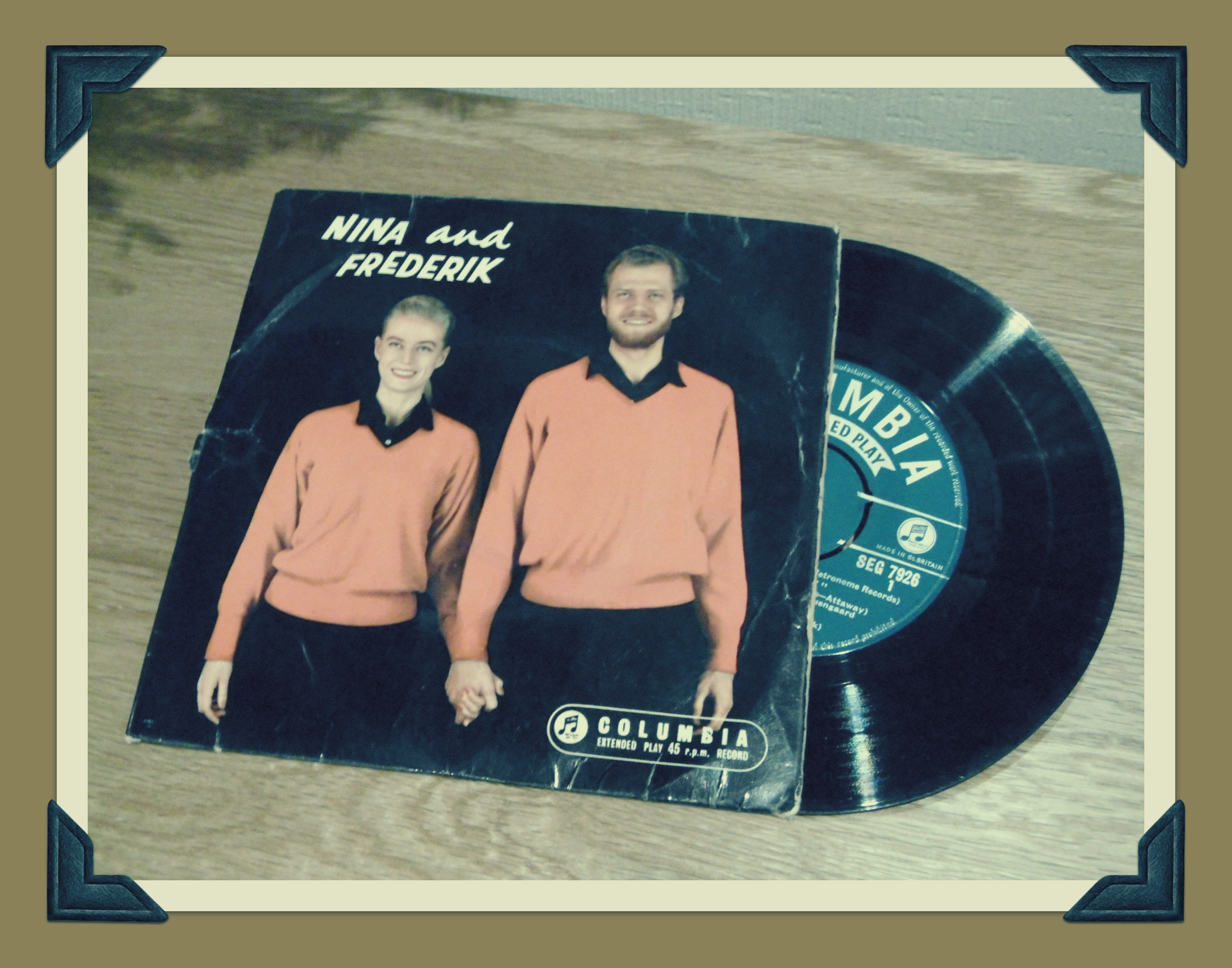
In that middle room little-I danced to the Toy Symphony (and scratched it, to my father’s great displeasure). There I sang along to Seven Little Girls (sitting in the back seat). There I listened, spellbound, to Nina and Frederik. For which I have my mother to thank.

The Nina and Frederik ‘EP’ – an Extended-Play, 45 revolutions-per-minute vinyl disc, for those who are too young to know the shorthand – had four songs on it, one of which we used to sing in the car on trips.

‘The sweetest girl, I ever saw, sat sipping cider through a straw-aw-aw.’

But it was ‘Listen to the Ocean’ that stayed in my head, that popped out when I watched the wind and seagulls playing their buffeting game.

I still have that record, still have a record player, but not the rosewood box on legs that I kept for many years till it ground to a beautiful halt.

I clean the disc and put it on the turntable.

Tears come easily at this time of year, don’t they?

It’s a thing of beauty, the song. Voices as clear as an Alpenhorn, yet warm and mellow. The unadulterated notes of guitar and flute. And, for me, the memories.

It takes me back to that red-brick terraced house. To the breakfast room. To the roaring fire and my new birthday chair, sitting close by. Turquoise and white woven plastic, a very modern, miniature ‘60s bucket chair, for newly six year old me.

It takes me back to our black and white television, flickering in the sitting room as I sit, transfixed by the Snow Queen.

Six year-olds, it seems, still like that story. No matter if the edges have been softened into ‘Frozen’ for today’s tender-hearted young.

For several years in succession the version I grew up with was shown on my birthday, a dull day in between Christmas and New Year. When everyone’s fed up with Christmas but not yet ready for new year.

When King Herod slaughtered the innocents, the little boys under the age of three. Quite a day to be born, eh?

But back to the Snow Queen of my youth. Black and white and somewhat sinister. As befits a tale of evil sprites, glass splinters and a beautiful queen of ice.

Translated from some foreign tongue, the little boy’s name sounded like Guy, but now I know it was Kay. And the little girl – not a princess, just a girl – who saved Kay, she was called Gerda.

Kay’s vision turns ugly, as his heart freezes to a block of ice. He uproots the roses the two children used to admire each summer together. And he vanishes, one wintry day, with the queen of the snow.

Gerda battles magic and ice and betrayal. Help comes from unexpected quarters, though – like the Little Robber Girl.

But in the end comes summer.

Kay and Gerda, two grown-ups, sit in their childhood chairs.

And the roses bloom again.

So there you have it, a trip back in time thanks to one fondly remembered song – and a soaring seagull on a high wind.

What magic one song can work.


And, with that, may I wish you a Happy Christmas, dear reader.

I hope there’s some magic in the air for you.

nina and frederik


Posted in Britain now & then, Thinking, or ranting, or both | Tagged , , , , , , , , , , | 14 Comments

Considering coruscating modus operandi

No, it doesn’t make sense. Let me explain …

A couple of weeks ago, I was watching a television programme about the assassination of President Kennedy. A clip of original footage from 1963 showed an interviewer, in Britain, stopping passers-by, seeking their views. Doing ‘vox pops’, as they’re called nowadays. From the Latin, ‘vox populi,’ meaning voice of the people.

Filmed in black and white, in a drab city street, the interviewees were serious-looking, well-dressed adults. Men in hats, women with shopping bags over their arms. All wearing coats to their knees. The kind of people you see in 1940s films, like ‘Brief Encounter’. Or The Third Man (my favourite old film).

But there was something very unusual about the people in these interviews, to ears  more used to contemporary vox-pops.

These were the kind of people often referred to as, ‘ordinary decent, working-class folk’.

And, what stuck out like a sore, red thumb among the black, white and grey was … the way they spoke.

Not their accents, but the words they used.

They used Big Words.

A few mornings later, over breakfast, we were listening to the radio – BBC radio – when the reporter used the word ‘coruscating’ before moving on to talk about a ‘modus operandi’.

It was unusual enough that the two of us stopped with our spoons (porridge with added raisins and cinnamon) part way to our mouths.

‘Blimey,’ I said, not being very articulate at 6.45 am.

The absent-minded professor nodded and raised his eyebrows.

We listen to ‘Today’ each morning as we drink our early-morning cuppas. Aired between 6 am and 9 am, it’s the programme the media, politicians and businesspeople can’t afford to ignore.

Financial results announcements and political press releases are timed to ensure coverage. It holds leaders to account, probes business news, reports scientific breakthroughs. It’s not unknown for the Prime Minister to be grilled in the big-hitter slot, just after eight o’clock.

All this makes it doubly – triply – disturbing that we were so shocked to hear a reporter use the word ‘coruscating.’

Words can, of course, be used to exclude us. Or to obscure what’s being said. Sometimes it’s intentional – and sometimes not. Academics are among the worst offenders.

This morning I had to look up ‘ontological’ for the umpteenth time. It’s such a nebulous word that I can never quite pin it down. I’m sure people use it just because they, themselves, don’t really know what they mean.

Or perhaps because they do know what they mean, but they think it sounds too simple.

But back to the radio.

I’m wondering how it’s happened, this ‘reduction’ of popular language.

As one who grew up to value words and meanings, to understand their usage so that other people would understand me in turn, I find it perplexing. Bamboozling. Depressing.

One of the things I love about Liverpool – widely regarded as a non-conformist kind of place, but not particularly associated with erudition despite several rather good higher education establishments – is a sign near the city centre.

Anyone driving to a match at one of the two big football grounds will see it.

The sign reads ‘football stadia’. Not stadiums, stadia.

The BBC no longer lets its presenters do the plural thing with stadium. Or forum. Or any of those ummy words. But Liverpool does it.

Latin, I do realise, is far from being a familiar language to most people. But we used to say things like memoranda,  not so very long ago, without too much trouble.

And then there’s phenomenon/phenomena, criterion/criteria – I never did Greek and I can handle that, it’s not that tough.

If you read stuff, listen to stuff, you get the hang of it.

In all the debate about dumbing down – which I usually ignore, assuming things are just different, not dumber – I never noticed quite how obvious this simplification of language had become.

Not until I saw those articulate, well-dressed, well-mannered people, back in black-and-white television-land, speaking like – there’s no other way of putting it –  well-educated people.

A recent article in the New Scientist discussed research that shows we understand and remember better if we learn to write by hand rather than by typing. That we remember more and have a more in-depth understanding of what we’re reading if we read a book as opposed to an electronic device.

Do we need to be concerned?

What use is memory if everything’s instantly look-up-able?

Why use long words, long sentences, if no one understands or remembers them?

So here we are. Shorter words. Shorter sentences. Shorter paragraphs. (Yes, I’ve adapted to all that).

Shorter books (not yet), shorter attention spans. Sorry? What was that?

It makes me wonder, will we all talk binary, one day, because anything else is just too hard?

Posted in Thinking, or ranting, or both | Tagged , , , , , , , , , , | 14 Comments

What price downmarket pizza?

In a (downmarket) supermarket the other day I overheard a comment which shamed me.

It shamed me because I have the luxury of being a person of extremes when it comes to shopping for food. Now and again, anyway.

Most of the time I shop in two or three small shops – bakeries, greengrocers, a farm shop – and two or three supermarkets towards the lower end of the Great British Class Scale (GBCS).

Occasionally, though, I want to feel glossy and poised and assured.

To swing my basket as I stroll past royal organic meat, expensive flowers and the latest variant on bread.

To mingle with the rich. The ones who’ve left their Porsche 4x4s straddling the lines of the too-small bays in the car park.

I want a respite from the everyday, ‘grrr, shopping for food again,’ state.

But, when I do go somewhere at the top end of the GBCS, I’m often disappointed or angry when I leave.

Disappointed because they don’t have what it takes to improve my day (it’s a tough call, I know).

Angry at the unnecessary, enticing, ridiculous things they sell. Like ordinary food made newly-bizarre by celebrity chefs.

I leave, often having bought nothing, in a fit of pique at such fripperies of foodliness.

And when I’m in the other, ordinary places, I find myself wanting to wiggle my nose – like Samantha in ‘Bewitched’ – to magic our Top Men here, for Instructive Shopping Therapy.

By Top Men I mean Top Politicians. The one who’s head boy of the government (not the Queen, obvs, she’s head of state and not a boy) and, perhaps more important, the one who looks after the national housekeeping money – the Chancellor of the Exchequer.

Our Chancellor presumably knows a lot about wallpaper, including the price, given his family firm makes it. But let’s set aside the £158 a roll stuff and concentrate on pizza.

I wonder if George Osborne knows how much a pizza costs? I mean a real, shop-bought one, not an ordered-and-delivered-in-central-London one.

That comment I heard, at the check-out, it was a man, to his wife.

‘Their own brand pizza’s down from £2.50 to £2.41, can we afford one?’

Wife counts money. They decide not.

At this point, in Dickens, a philanthropist might pass by, drop a pizza or six in their trolley as they left the building. And, no, I didn’t. I did drop a tin of biscuits in the Salvation Army Christmas presents trolley, next to the wheelchairs, though. It was building up a steady layer of soft toys and baby clothes.

I spend a lot of time grr-shopping, here.

It’s a multi-cultural place – and I don’t mean that it’s awash with nationalities, though I do hear Polish, German, Spanish and Italian as I shop.

I mean that it’s a community, of sorts.

A place where inhabitants of residential homes can have a trip out with their carers.

Where a member of staff can chat with an older woman as he stocks the shelves – about the books they’re reading this week.

Where an elderly man with memory problems always goes to the same – very thin, heavily tattooed – check-out woman. He has to come back and ask if he has paid – and she always sets his mind at rest. She has no time for me, for my persimmons and my own-brand claret – but that’s fine. I don’t need her time. Not yet.

I see people sick and disadvantaged, people healthy and privileged.

I see rich, middling and poor. And once-rich, but now poor.

I see pale, tired, women working on the tills – and notice the odd black eye.

I see troubled people being nice to untroubled. I see poor people being nice to rich.

I see those who have and those who have not.

I see drunks. I see anger. I see bad behaviour.

I see life.

Top Men should see this but we know they never will. And it will never seem real, if they can’t see it. Or live it.

Which is why they’ll keep on cutting budgets for the ones who need them most, when they could do what shoppers do. Pay off that debt gradually. Keep it manageable. But keep on eating properly while you do it. You need your strength to work. You need to work to pay off the debt. Earn enough and you can pay your taxes, help the less well off. Pay off more of the debt when you’ve got a bit more coming in.

Perhaps we need a housekeeper in charge.


Posted in Britain now & then, Thinking, or ranting, or both | Tagged , , , , , , , , , , | 20 Comments