
The anaconda swallowed an elephant.
It was, admittedly, a very brown anaconda. Brown like the brown-paper-packages that Julie Andrews liked tied-up-with-string.
I love the concept: a little boy draws a picture of an anaconda that’s swallowed an elephant – but all anyone else sees is a hat.
He’s waiting, waiting, waiting for a soulmate who sees what he sees – but no-one does.
Then he wakes one morning in the Sahara, as you do, after crashing his plane the night before. A Little Prince appears from nowhere and asks him to draw a sheep – but he can’t quite get it right.
Impatient, the boy draws a box and says the sheep is inside.
Lo! The Little Prince knows that inside that box is just the sheep he wanted.
One of the great (and irritating) things about blogging is that you worry and wrangle and wrestle with ideas and words – and meanings – then click publish, only to have someone trip your opinion switch.
You put your metaphorical hat online and all someone can see is an elephant in an anaconda.
In the light of which, it’s appropriate that I’m re-reading Le Petit Prince for a tangential reason.
I’m writing a book set in late 1970s London. At that time a small restaurant was making a big name for itself. That restaurant was called, Le Petit Prince.
LPP served couscous – something I’d newly discovered, thanks to the man I was tagging-along-a at the time. He’d been wandering the deserts of north Africa and with his return came a couscous habit that needed feeding.
It wasn’t easy to find, couscous, but eventually I discovered a delicatessen selling colourful cardboard boxes of the stuff, imported from Francophone Algeria.
On the back of the box was the memorable instruction:
‘stir to prevent the lumps that could have been occurring’.
It’s not just memories of couscous and putative lumps that my new project’s stirring up. As I worked on the first chapter, troubling pre-teenage memories started floating to the surface. Memories submerged so deeply within my psyche that at first I no longer recognised them – bad memories, from a bad time.
But, out of bad comes good.
Re-reading Le Petit Prince, for one thing. How I wish I could have written it. Almost every page has me sighing, ‘oh yes, so yes’.
Reliving interesting times.
Times when interest rates soared over 15%. When prices had risen every time you went to the shops, but pay was nowhere near keeping up.
When oil producers held the world to ransom.
When there were bitter strikes and angry demonstrations.
When daily life in London was lived with the ever-present threat of IRA bombings. An experience which helped me understand – in a very small way – how it feels to live with unpredictable, unsought, mortal danger.
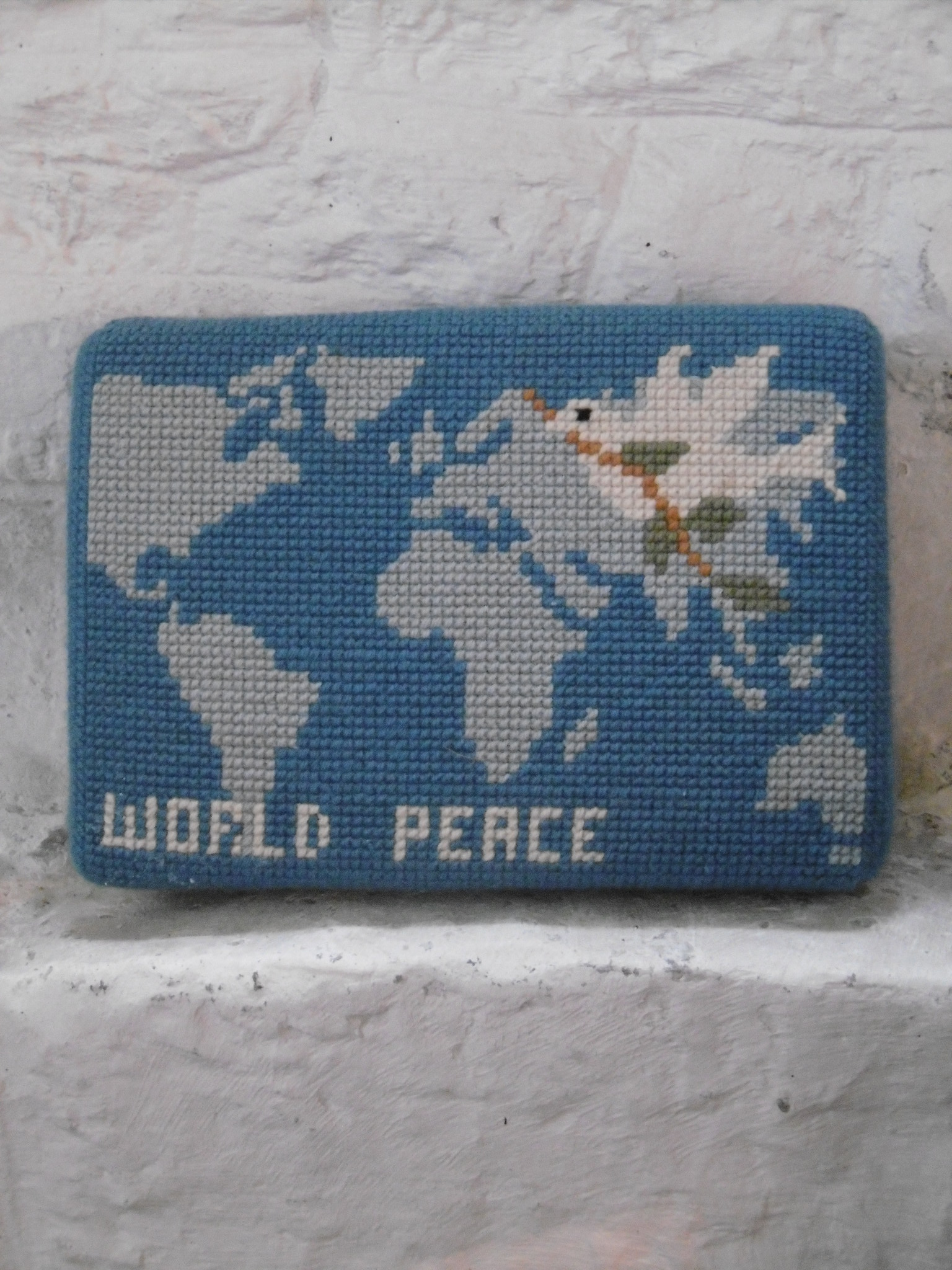
And I’ve been reading about the people who’ve given (are still giving) their time – and sometimes their freedom – to try to save our world from nuclear annihilation. Members of CND – the Campaign for Nuclear Disarmament.
That was then.
The Cold War, the arms race, terrorism, trade wars, industrial unrest, turmoil.
Today we have global financial crises, a different kind of terrorism, a Middle East in foment, climate change threatening the planet – and Ebola.
But what happened to those ‘arms’ in that race?
Britain and the USA have, apparently, been so selective (and weaselly) about fulfilling their obligations under many of the arms limitation agreements they’ve signed that you really can’t take them (us) seriously.
The USA, meanwhile, is committed to ‘Full Spectrum Dominance,’ which is:
‘the ability of US forces … to defeat any adversary and control any situation across the full range of military options.’
‘Options,’ include using land, sea, air – and space.
Yes, the USA is determined to continue as top dog and moral guardian for the world. I can understand why. And that may be fine – if you always agree with the dog’s morals.
Call me a pessimist, but morals can be eroded, warped, suspended – sometimes with the best of intentions. Or perhaps as a side-effect of a rather aggressive approach to the concept of a ‘free’ market?
Our world is fragile. Distance is irrelevant. Even the biggest, strongest, toughest army and the widest, deepest oceans can’t protect the USA, no matter how dominant, from some things. Like climate change.
Like Ebola.
How it is that a nation can spend fortunes defending itself against possible war – with a missile defence system straight out of science fiction – yet get it so wrong on handling one person with a terrible disease?
At times I feel the old anger.
The unmanned spacecraft that landed the other day – what was it doing, circling the earth? Ensuring full spectrum dominance in space?
Europe’s destined to be ‘collateral damage’ on a vast scale if the USA ever engages in a nuclear confrontation. We’re their ‘theater’ of war.
Nuclear trip wires – missiles – are set in countries like Germany, Italy and Turkey with the aim, presumably, of destroying potential aggressors before they can nuke the only nation that matters.
Nuclear winter is one possible outcome of a big nuclear battle. That wouldn’t spare the USA, no matter how far from the ‘theater’ it is, but I take no comfort in that.
I’m trying to write this book quickly, before any more demons crawl out of my sub-cortex. I can feel them wriggling. I hope it’s not too late.
Too late for what? You may well ask.
I don’t know – that rather depends on whether you see a hat, or an anaconda.

Photographed from my 1979 Gallimard Folio Junior edition, originally published 1943. The author, Antoine de Saint-Exupéry, vanished in July 1944 after flying on a wartime mission out of Corsica.




















 MEMOIRS OF A HUSK