When I grow up

‘Fashion designers have those,’ says the little girl, looking up at me as I tromp down the stairs. She’s standing beside the mannequin I bought in a local dress shop’s closing-down sale.

‘I’d like to be a fashion designer when I grow up,’ I say, then wish I hadn’t as she looks at me with gimlet eyes. Nice eyes, but gimlets. What unintentionally morale-destroying thing is she going to say, I wonder?

‘But you are grown up.’

I heave  a sigh of relief.

‘Well – I’m not going to be a fashion designer, then, am I?’

We’ve been showing potential buyers round our house, again. The two playwrights who strung us along for four months pulled out last week. But I’ll put that to one side, for now, it gives me indigestion to think about it and dinner’s nearly ready.

One of the things I’ve managed to avoid this autumn – what with chasing up estate agents, builders, lawyers, removal companies and so on – is the vile, bilious, orange run-up to Halloween.

I hate it.

Nasty, cheap costumes, tangled on the corner of the supermarket aisle, at maximum-exposure-to-little-person-pester height.

Foil-covered chocolates masquerading as eyeballs. Plastic bats and spider’s webs and great piles of pumpkins. Don’t misunderstand me, I love pumpkins. I’d gladly cook them on a regular basis for as long as they’re fit to eat – but the instant All Saints’ Day arrives, they’ll be banished.

My childhood Halloweens were simple affairs. Making a witch’s hat from black sugar paper. Rummaging through dressing-up clothes for the cloak my sister wore to be Boadicea. Turning a stick from the garden into a magic wand – abracadabra – all it took was a tin-foil star.

If someone extravagant had a party we’d do bobbing for apples and ‘stick your finger in the dead man’s eye’ (jelly) – but mostly we’d just make hats and talk about witches.

Which (couldn’t resist that, sorry) takes me back to ‘when I grow up’.

I was born in the English county of Lancashire, my home till I was seven. Now, while everyone’s probably heard of the witches of Salem, fewer have probably heard of the Lancashire witches. Possibly because the book that made them well-known (The Lancashire Witches, by Harrison Ainsworth, 1848), is really quite hard to read.

It’s a story based on the infamous trial of witches in Lancashire in 1612 – and it didn’t, as you might imagine, end well.

Sierra Exif JPEGThe witches came from the ‘Forest’ of Bowland, not a forest as we know it but an area of magnificent hills, moors and chattering streams. Pendle Hill dominates the story and the landscape, its dramatic, brooding profile instantly recognisable to those who know this corner of England. I spent many a happy afternoon in its shadow, picking whinberries as the summer waned.

So I grew up, you might say, with witches.

Now, for a child, witching is mostly about wearing tall black hats, riding on broomsticks and casting spells. But it’s also about women who are frightening – and often the epitome of ugliness, warts and all.

So why, when people asked me the question that plagues a child’s life, ‘What do you want to be when you grow up?’ did I always answer, ‘A witch’?

I don’t know.

The ability to fly? The power? The hat?

It wasn’t the cat, I was scratched early in life and never forgave the entire cat genus.

Was it, perhaps, the association with Bonfire Night? Halloween is just days before we, ‘Remember remember, the fifth of November, gunpowder treason and plot.’

Collecting wood, seeing the bonfire grow. Buying fireworks, one or two at a time, with my pocket-money, keeping them safe in a biscuit tin. Chrysanthemum Fountains and Snow Showers, Bengal Lights and Catherine Wheels. Pretty ones that didn’t go bang.

Snug in my duffle coat, mittens and scarf, spelling my name with sparklers in the cold night air. Holding half a hot potato, gooey with butter and tongue tingling salt in its silver foil skin, baked in the base of the spitting bonfire.

Teeth clamped together by treacle toffee, shards of luscious blackness in a white paper bag, sticking together in clumps as it’s passed around hot little hands.

And the morning after, smoke hanging in the air on a gunpowder-whiffing residue, mysterious and silent after the noisy night before.

Maybe that’s it. The darkness of night and the dancing flames. Magical lights and eerie mists.

I’ve always loved this time of year.

Yes, it could have been the magic of the dark nights that fired my witchly desires.

That and the ability to fly.

And cast spells.

In fact . . .

If I could cast spells, there’d be a couple of playwrights waiting for a decision about their latest plays, being told the contracts are on the way, but never quite signing on the dotted line. ‘We’ll stage it in two weeks’ they’d hear. And every time two weeks was up, they’d be postponed.

But I know I’d give in. Remove the spell. Grudging, but soft, that’s me.

Perhaps that’s why I never became a witch.

That and the warts.

And the cat.

Or the being burnt to death. Yes, maybe that was it, after all.

Posted in Thinking, or ranting, or both | Tagged , , , , , , , , , , , | 14 Comments

Taboo? (I’m talking about Jesus)

Do you cringe when someone mentions Jesus in polite conversation?

I’ll admit it – I do. Not because I want to, or choose to, but because – well – I don’t really know. It’s an unconscious reaction.

I’ve never been a right-on kind of Christian. Not even when I was briefly president of the Newman Society at university (which I did badly, like most things except partying).

I went to Mass, had my private devotions and my Catholic friends – but we didn’t talk about Jesus. Well, most of us didn’t.

We shook our heads and rolled our eyes at the evangelicals and charismatics. The ones who spoke in tongues and said they could feel the spirit move.

But I never felt that people would look on me with pity if I said I was a Catholic. It was just what you were – a brand of Christian. Or maybe a scoffing atheist, but still nice about it, like my friend Janet.

Now, though, friends raise their eyebrows if I let slip the fact I’m going to church. Two of them even tried to persuade me not to go. It was as if I’d gone out wearing six-inch platform soles and a red leather mini-skirt. As if I really was too clever, too old, too worldly wise for such silliness.

‘Creepy,’ someone I know said, after visiting a Catholic school, referring to a crucifix.

‘Just wrong,’ said another about a statue of the Blessed Virgin Mary in the garden of – um – St Mary’s.

Roadside shrines are now accepted as commonplace in this superficially Christian country – as long as they feature a football scarf or a teddy bear. But heaven forfend someone leaves a statue of Our Lady amid the decaying chrysanthemums.

And yet, we revel in images of colourful Indian ceremonies, of many handed – or headed – gods.

We all know about (and respect) Ramadan and Diwali.

We admire peace-seeking Buddhists and Hindus working towards nirvana. Some of us admire white witches. Well, they’re interesting, at least.

We ‘celebrate’ Halloween, but disconnect it from All Saints Day – and All Souls Day.

So why are we so patronising and supercilious about Christianity?

Why the scorn poured on a faith that says ‘do unto others as you would have them do unto you’?

When the new Pope was elected, the priest at our local church said, ‘I think the supreme Pontiff would prefer to be called the servant of the servants of God.’

And it struck me, then, how wonderful it was, that simple statement.  The servant of the servants.

How there’s a lesson in that for all the world’s politicians – and its journalists.

Where does their divine right come from, these high-horsed pontificators who populate our TV screens and newspapers – and run the world?

Jesus (I say in a tentative voice) . . .

Jesus (firmer this time) had (reportedly) a lot of things to say whose spirit they might wish to emulate, even if they don’t believe in a God of any kind.

Jesus said blessed are the merciful.

Jesus said the last shall be first and the first shall be last.

Jesus said it would be easier for a camel to slip through a needle’s eye than for a rich man to get into heaven.

I suspect Jesus wouldn’t have said, ‘Go on, have that bar of chocolate. Buy that expensive face cream and a car that costs more than some people’s houses. Go on – you’re worth it.’

Or, ‘yeah, take massive risks with someone else’s money. Ruin the world’s financial systems. Meh. You’re too big to fail’.

I wonder. Do we (I’m talking mostly middle-class white folks in England, as you probably guessed) feel uncomfortable around ‘Christians’ because while they seem to be just like us, they’re actually focused on something different? Not the latest iPhone or the pink coat that’s so this winter. Well, they may be focused on those too, but they’re not their be-all and end-all. Their end-all is much, much bigger – beyond all knowing, in fact.

Do they make us feel selfish, these Christians? Because they’re like us, but not like us?

OK there are exceptions – the Amish, for example. But then they’re not really like ‘us’ (well I don’t wear a bonnet do you?) – and anyway, there’s been a film about them with Harrison Ford, so let’s put them to one side.

What I’m wondering is, do we allow ourselves to find Buddhists, Hindus and white witches ‘interesting’, because they’re different?

‘Aha!’ you may say, ‘but why haven’t you mentioned Jews or Moslems?

Why, indeed? People who are often subject to far more suspicion, discrimination, abuse, hate and loathing in the west than are mere Christians. Well, that’s a topic too far-ranging for a short post like this – and being neither a Jew nor a Moslem I can’t speak from experience. Plus, I don’t have any answers.

But I do know that fear is at the heart of hatred and mistrust. That fear stokes the flames under martyrs, as well as the engines of terrorism.

At school I learned about Catholic martyrs burned at the stake, here, in England. As children we sang:

Our fathers chained in prisons dark were still in heart and conscience free, how sweet would be their children’s fate, if they like them could die for thee.

I wish to God those days were gone forever, for all religions, all faiths. But they aren’t, are they? The gap between the haves and have-nots grows. Poor countries face famine and natural disasters. The rich throw tons of food away and Western governments build flood defences that Bangladeshis can only dream on.

And so it will continue to happen.

But I’m a pessimistic optimist. It may not be in my time, but one day, surely . . .

[By the way, I don’t wear red leather mini-skirts, or six-inch platforms, but I’d defend my right to do so against all comers.]

Posted in Religious for a year: Atheist-man's experiment, Thinking, or ranting, or both | Tagged , , , , | 17 Comments

Surfin’ downtown for an organ and some blondes

A bronzed surfer dude grabs a board, races into the water. I’m already there, paddling out, rays on my back, tanning through the oil.

Surf’s up – and before you know it I’m riding the crest of a wave.

Not really.

Both hands on top of the steering wheel, smiling to myself, happy to be alive, I’m actually driving into Liverpool.

In an eight year old, bottom of the range, automatic . . . Skoda.

I’m listening to BBC Radio-Middle-Class. The early evening news show. But they’re with some guy who’s driving a VW camper van.

And – they’re playing the Beach Boys.

One minute I’m just me – the next I’m California girl.

Catching waves.

In the warmth of the sun.

On top of the world.

Yeah, baby, yeah!

It can’t last, of course, but it’s an omen for the evening. You know, one of those that starts well and just gets better. (Believe me, it’s been a while.)

The guy gobbing at my feet as I walk along Liverpool’s famous Hope Street isn’t what you might call a great appetiser, but by the time the glass of Spanish rosé has been supped and the chicken liver with rosemary pâté ingested, it’s forgotten.

We opt for the £7 tickets over the £6 and end up – just the two of us – in a box. No, not experimental art. We’re talking a box in the Philharmonic Hall.

You’re thinking that’s not a lot to pay for a concert, right? Or, how did I manage to pass myself off as a student?

It’s not a concert. We’re here to see a film – a special film, on a special screen, with a very special accompanist. He’s playing as we arrive, tunes I recognise – but I won’t admit to it if you ask me. My mother’s generation tunes. The kind they played on the BBC Light Programme, around morning coffee time, in Music While You Work.

Our 79 year old organist, Dave Nicholas – the only resident cinema organist in the UK – began his career over the water in Birkenhead. Stars like Cary Grant once sailed the Atlantic to be at premieres there – but not any more.

Anyway Dave’s come over the water to be with us tonight. Probably not surfing – though he might have done a bit of wave chasing when he worked at Butlins – you never know.

He bounces off the organ bench to take a bow, the personification of a giggle. An aura of chuckles bubbles off him as he introduces himself, the organ, and the spectacle we’re about to see.

Like a budgie bouncing with health (who says advertising doesn’t work?) he’s back on his perch, feet on the pedals, fingers flying over the keys as the ‘Walturdaw rising cinema screen’ materialises from the platform.

Wow.

I mean, serious wow.

I wasn’t expecting this. Never mind a screen, this is an art deco cinema – and it’s rising from the concert hall stage.

There are only three in the world and this is the only one that’s working. It’s unique. (Oh how I wish I could add an adjective, or a qualifier to that – but unique is just – unique, isn’t it?)

It’s a silent film. Alfred Hitchcock’s first thriller. And it’s all there. The angled shots, the spooky lighting, the hand on the banister seen descending several vertiginous flights of stairs.

The blonde in the steamy bathroom undressing without revealing anything. Naked toes wiggling in the clear bath water.

Sinister men and more blonde women – the theatre girls with their ‘Golden Curls’.

And the glass ceiling. The lodger – Ivor Novello – seen from below, pacing as the ceiling light swings beneath his steps downstairs. Is he the murderous ‘Avenger’?

Ivor Novello was just a name to me. I’d never seen the man before and I’m sorry to lower the tone but – phwoar!

The smouldering eyes, the aristocratic profile, the tallish frame just the right side of thin – and glamorous. Soooooo glamorous.

I’m captivated. Despite the garish make-up – and the teeth. They all have terrible teeth. But then, so do I. ‘We’re just the pre-fluoride generation,’ says my lovely female dentist, reassuringly. But hers don’t look like mine. Ah well. I digress.

Tea is drunk. And beer. The older, tired-looking woman polishes the brass fender, cooks the meals, does the dishes. The man of the house sits back with his pipe and his feet up. The fire smokes in the background.

Outside there’s fog, gas lamps – and murders. Of blondes.

This film is mesmerising. The captions archly self-aware and slightly jokey. Despite the fact that it’s a murder mystery.

We don’t see any gore.

We don’t see any torture.

We don’t see any bare breasts or bottoms.

We do see Ivor Novello hanging from the railings, snagged by his handcuffs, being attacked by a baying mob fresh out of a dismal pub in the London fog.

And there’s a romantic ending.

But then it’s all over. The organ signals the end – and so do the big words on the screen.

Mr Music bows, like a human comma in perfect evening attire, to loud applause, then he plays the screen into the ground again.

We trot back down Hope Street, turn the corner past the restaurants.

Under the dim lights of the old street lamps – their gas replaced by yellow electric lights – we pick our way along the small cobbles, past the sooty-looking brick of the Georgian terraces. For a moment I’m back there with the Golden Curls girls, in foggy London town.

From surfer duderina, to silent movie blonde. What a fabulous way to spend an evening.

Only in Liverpool.

THE END

Posted in Art, jaunts & going out, Liverpool | Tagged , , , , , , , , , , | 14 Comments

Forget Rome – if you would valiant be*, I’d go for three Bardseys

It’s all too beautiful.wednesday 025

No, I’m not reliving the sixties (‘Itchy-coo Park’, for the benefit of you bright young things), I’m treading a well-worn path, trodden for hundreds of years.

In wartime, by men from the RAF. In peacetime, by coastguards. In times of war and peace by pilgrims.

They’ve all gone now, except the pilgrims.

Centuries ago, when saintly traffic on the roads to Rome reached its peak, the arduous journey to Bardsey Island was rated worth a trip to Rome – well, that’s if you managed it thrice. The thronging masses seeking salvation had been overwhelming the city of St Peter, so lesser destinations were upgraded, to divert the faithful.

It sounds a doddle, a trip across north Wales (or three), compared with months trudging across Europe, beset by brigands. Wearing out one horse after another, one pair of shoes after another. But it’s never been an easy journey – until now.

Today you can drive all the way to Aberdaron – which feels like the end of the known world, a waterfall on the dark horizon where the flat world ends and the sea runs off.

As you arrive, coasting down the hills in third gear, you’ll catch that first glimpse of the whale back of Bardsey, basking in the glistening sea – and it will sing its siren call. You’ll be enchanted. If you’re not you’ve no soul. Or no aesthetic sense.

Or it’s raining very hard and you can’t see it. Always a possibility.

Boats take day trippers, but it’s not a journey you make lightly, even nowadays. Not for nothing is the island called Ynys Enlli in Welsh. Literally (or so I’ve read) ‘island in very strong currents’ –  treacherous waters.

Once there, you’re stranded on the island for three or four hours before you hear the welcome sound of the boat’s engine starting up. And woe betide you if it rains and the wind howls and you haven’t come prepared.

But by then you may have seen seals, the ruins of the abbey, a lighthouse, some interesting birds – and had a cup of tea, if you’re very lucky. Or maybe you’ll have sat in solitary silence, absorbing the atmosphere that all those pilgrims, saints and sinners left behind. Feeling the might of 20,000 saints praying, the ones supposedly buried here.

Holy places often have an aura. A calm that settles the restless spirit for a while, like an indigestion tablet for the soul.  And I’ve often thought of going on a pilgrimage, to soothe my spiritual dyspepsia, but never achieved more than a feeble trip to Walsingham. By car. Not even doing the last lap on my knees.

So, today, we drive out. My knees are not robust enough for this one, that’s for sure. We’re heading up a hill. A big hill. In a car. With feet for walking. And a stick, just in case.

Tarmac gives way to old concrete and we rattle across a cattle grid. We keep on driving, round and round, up and up, expecting to have to turn back round every little bend.

After many oohs and aahs we arrive at a compact car park almost at the peak.

A few other folk are here, but not many. The kind of folk who’ll exchange a friendly greeting on a sunny day.

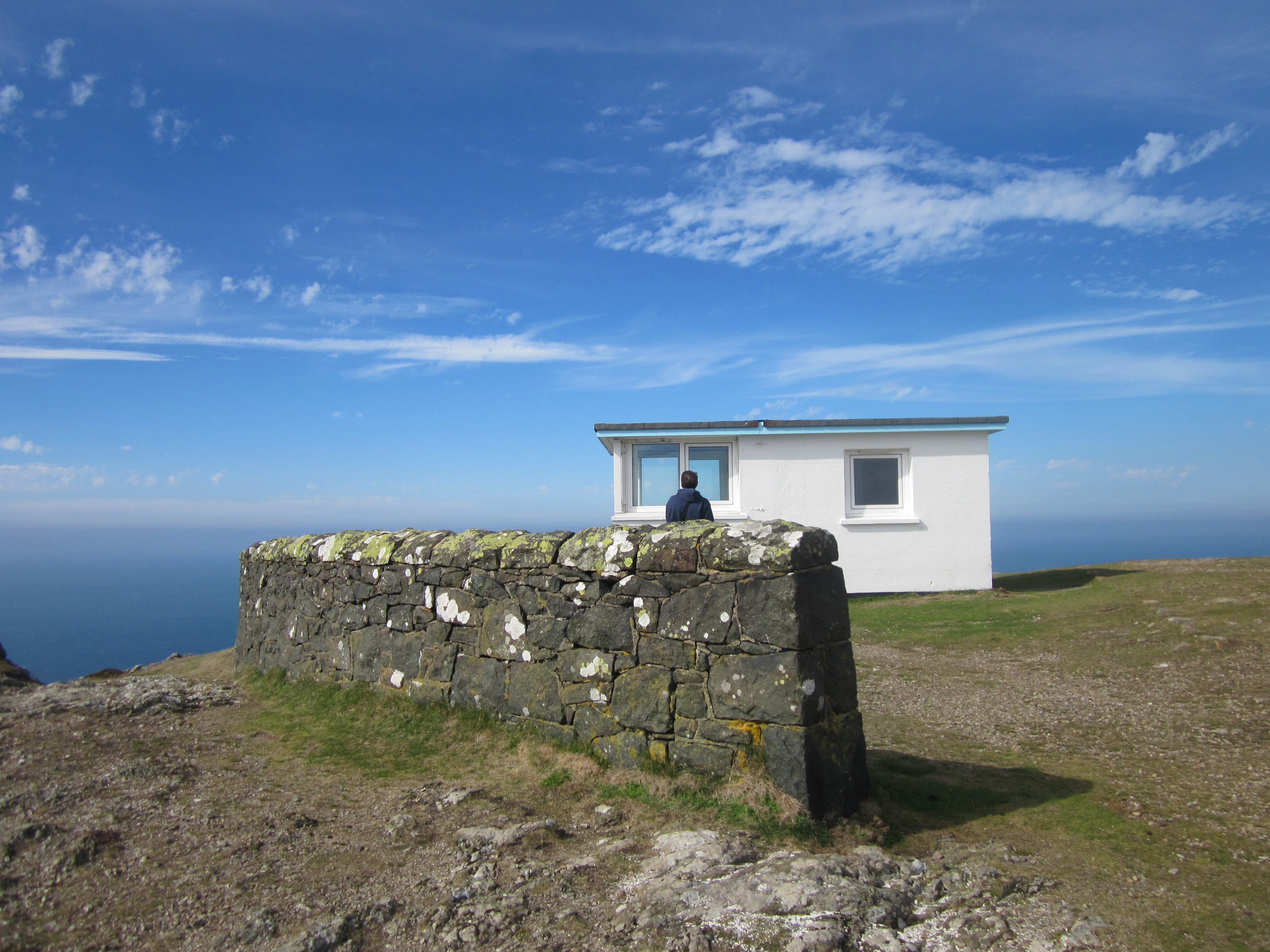
wall former coastguard stationThe old Coastguard buildings stand sharp as Greek chapels against the dazzling sky.

But that’s not what we’re here for – so we inspect them only briefly, then turn and walk slowly down to where the morning mist still lingers.

We stop, transfixed.

Clumps of short yellow gorse and rich purple heather, patched together in a vast blanket, glow in the strengthening sun.

And there. Way below. There it lies, in a deceptively tranquil sea.

Last resting place of those 20,000 saints.

wednesday 013The pilgrim isle. Being what it has been for centuries – a destination, a trial, a hazard, an ordeal.

A journey’s end and a new beginning.

A sanctuary for the holy and the unholy. A place to meet God, for the righteous. A staging post for smugglers, or invaders, with evil on their minds. A hostile environment, ideal for proving souls. On both sides of the moral divide.

A yacht appears in the north-west as the sun’s power becomes fierce, its white sails a splash of coolness on a canvas of hazy heat.

We descend as far as my vertigo will allow and steep ourselves in awe.

There’s something inspiring, exhilarating, enlivening about this place.

A place for losing self. Unimportant, paltry us.

I’m sure a lot of the visitors walking this hill, the day trippers out on the boat that’s churning up the sea as we watch, are as unlike the pilgrims of old as it’s possible to be. But I’d like to think we’re all on a voyage of discovery, that here we’ll all find something inside we’ve never felt. Recognise something beyond ourselves that we’d almost forgotten existed.

So much out there – so little inside.

God, nature, beauty – whatever your preference. It’s just plain humbling.Bardsey Island with sailing boat

* Referring to the John Bunyan hymn, ‘He who would valiant be, gainst all disaster, let him in constancy follow the master, there’s no discouragement shall make him once relent his first avowed intent to be a pilgrim’

Posted in If you only read one ..., Llyn Peninsula | Tagged , , , , , , , , , | 4 Comments

Secrets, dragons and mills

How do you feel about secrets?

I’m ambivalent.

I love the idea of secret gardens. Valleys unlocked by a spell. Mountains where dragons lie hidden.

Places where magic happens. Where the sun beams down on gentle hills from a forget-me-not sky. Where a crescent moon casts a silver light on a gentle sea by night.  Where nightingales sing and the scent of violets perfumes every breeze.

Enchantments for a prosaic world.

But I hate being told secrets. Knowing things I’m not supposed to know.

A confidence from one friend meaning I can’t console another. Secrets I’ve sworn myself to keep – because confessing would hurt a loved one more than keeping it hidden forever.

Secrets like that are burdens.

I’m good with that kind of secret, even if it pains me. I find it  hard, though, not to tell the world about places that – be honest – I don’t really want them to go. But the other day, at one of my favourite places, I had some help from an unexpected quarter.

…We’re driving west along the north Wales coast. Ahead, forbidding grey shapes stand stern, gateposts to a hidden world, locked by a spell.

The open-sesame’s simple – ignore the sinister mountains, their ‘abandon hope all ye’ intimidation. Persist. The sharp grey shards will turn into hills of green and gold as you draw near, welcoming you in.

Before you know it the Llyn peninsula has opened up before you. A secret world. Sort of. And beautiful as can be.

I’ll share a picture, to prove it.thursday 043

We settle in at our seaside cottage. Wake early. Decide to visit a woollen mill.

I can’t resist old mills – anywhere things are made. So this is a treat.

But the mill doesn’t want to be found.

It’s named after a place that’s marked on the map – but that’s not where it is. That would be too easy.

The signs on the road – embellished as they are with red dragons – have been placed for maximum obscurity.

And Anthro-man’s innate – and normally accurate – personal navigation system has been scrambled. By wizards, we reckon.

But somehow, after many wrong turns, we make it. And we step inside, the only work-shy tourists here, to the sound of clacking machinery.

Around the corner I spy through a window that the mill wheel’s working. Never seen that before. I take a little video – just a few seconds – capture a bit of its life.

Everything’s photogenic. Old looms waiting to be brought to life, rusting wheels hanging from roofs, yarns stacked on shelves, boots and clocks and bells. Pictures worth a thousand words – well, maybe five hundred.

Then I see the sign.

‘Sorry, no photography.’

Oops.

We clamber two flights of very steep steps to the shop.

It’s quiet. Closed at weekends –  and on bank holidays, like the mill.

No tea room. No lavatories. No honey or fudge for sale.

Just fabric.

Blankets and cushions. Ties and scarves. Throws. And socks. Thick, fibrous socks.

We’re in the market for a pair, size 11 (not mine) and a bedspread woven from undyed wool.

A woman appears, like a character from a Bronte novel. Silent. Hands together, one on the other, in front of her midriff.

‘I’m sorry,’ I say, ‘I only just saw the sign about photography.’

‘It’s private property,’ she says, jaw trembling with anger – or fear, ‘we can’t allow that, we don’t know what you’ll do with it.’

Fool that I am I think she’ll understand.

‘I’ve been coming since I was a child, I love this place, I was going to blog about it.’

More trembling.

‘No, we don’t want that, not the internet.’

‘Is it for health and safety reasons?’ I persist.

‘We don’t know what people will write. It’s private property.’

No point telling her I only want to write kind things.

That it’s good publicity.

She vanishes.

A man we recognise from previous visits emerges and we try to put some enthusiasm back into our shopping. Leave with our bedspread and size 11 socks.

Subdued.

Loath to let it spoil the day I talk myself through it.

Think about the many discussions we’ve had these past few years.

About companies making bigger and bigger profits.  People taking grosser and grosser bonuses.

When is enough enough?

Is it all the fault of shareholders, as some in the media say?

Or is it simple greed?

Greed of bosses. Greed of shareholders. Greed of people who’ll buy any rubbish dipped in chocolate now Cadbury’s been globalised beyond all recognition.

Sorry, wrong rant.

I think about that anxious woman who runs an old, gem of a mill. A mill that uses only Welsh wool, despite temptation from New Zealand. A mill that’s set in a location that possibly doesn’t exist, protected by spells. That makes no concessions to this mercenary world.

And although I’m a little peeved about the pictures, I respect the way she feels. Enough – is enough.

I hope.

Enough that the mill will carry on for a good long time to come.

I’m not going to tell you its name. But I will tell you it’s not Trefriw. That’s the other working woollen mill in northern Wales.

Trefriw has a tea room. Sells fudge and honey. Has lavatories – his’n’hers.

I love Trefriw too. It’s just – different. Not secret.

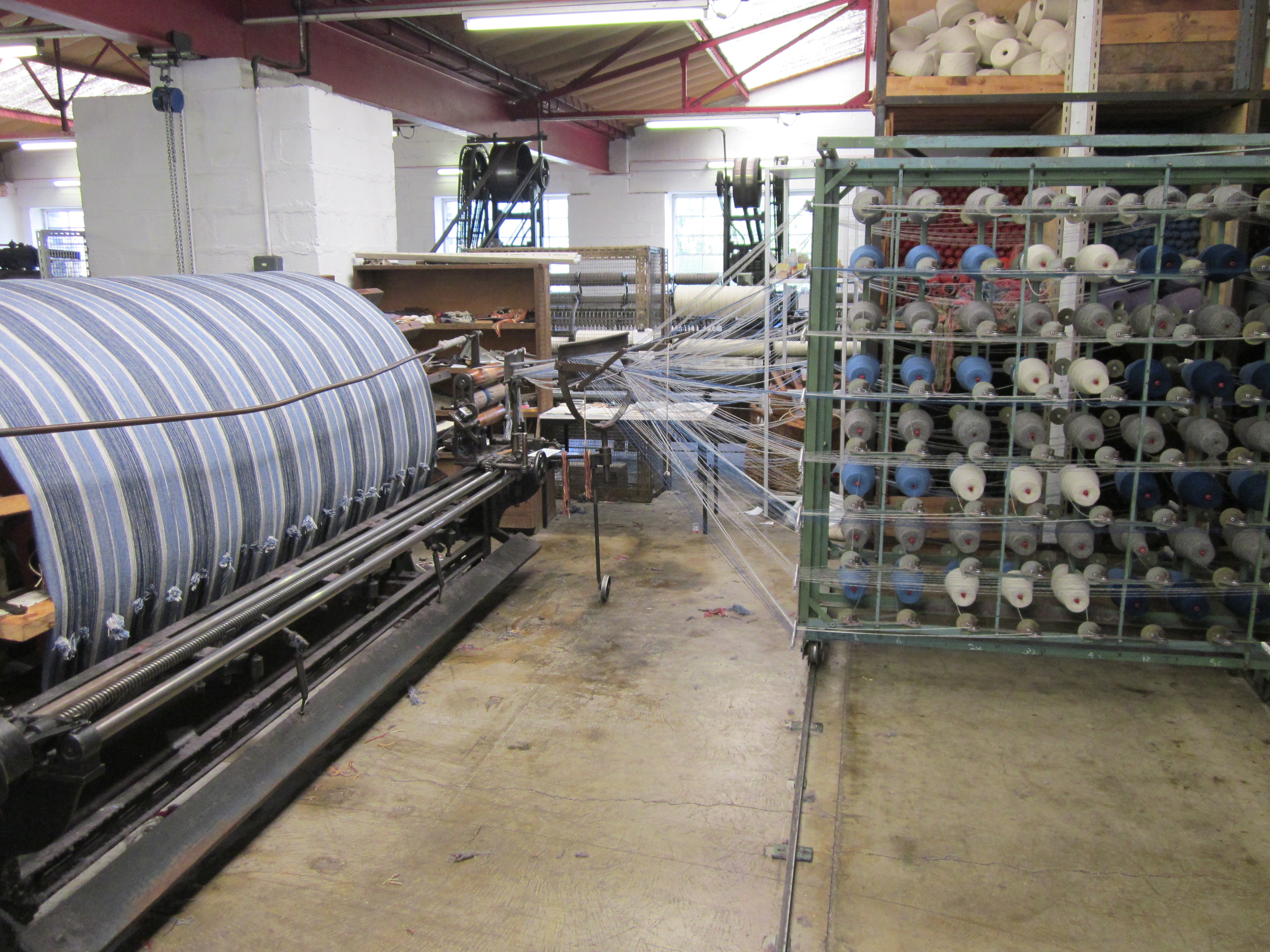
Findable without an abracadabra. To prove it, I have pictures.Trefriw Three of them.

But promise me, once you’ve finished reading this, you’ll forget all about the Llyn Peninsula. Or I’m afraid I’ll have to loose a plague of boils on you. Or toads. Or both.

Trefriw woolTrefriw working machinery

Posted in Llyn Peninsula, Thinking, or ranting, or both | Tagged , , , , , , , | 6 Comments

That road – dejà viewed. Part 4: the journey’s end.

The man who’s driving this long and just-beginning-to-be-winding road has a very soothing manner.

On another day I might – just might – find Fegan’s manner too soothing.

As in irritatingly slow.

Tonight, his aura of calm is perfect.

I sink into the rear seat of a comfortable, far-too-clean-and-smart-for-us Land Cruiser – and I feel grateful. For everything.

Fires burn in the hills, punctuating the blackness like scatters of glowing embers. From the charred ground sunlight will tug up vivid green shoots, heralding spring. But for now there’s fire, there’s darkness – and there’s smoke.

I’m trying to relax, trying not to worry about the road, but it’s a fool’s game. I lean forward and stare through the front windscreen into what I can see of the road ahead. And what I can see is strange.

First it looks like a milky haze, wisps of smoke, vanishing as we pass, like cobwebs on a ghost train. But then the smoke grows denser. The headlights create of it an opaque, chalky tunnel, in the middle of the road.

I stop looking. But then I can’t help myself and return my gaze to the road.

It’s more than just winter fires. We’re driving through a charcoal burning area. The way many rural people earn a living. Making bricks to build ovens. Chopping down wood. Filling hefty sacks with the precious black lumps, for sale by the roadside.

Fegan is careful, but he’s straining to see through this veil of smoke – and he, too, has had a long, tiring day. Up before dawn, driving before the first flight flew into Lusaka – then despatched to rescue us.

He weaves across the road – and quickly recovers.

‘Are you OK?’ asks Archaeo-man.

‘For now, I am,’ the reply. Concise – and honest.

I feel the tension ratcheting up again. I think about the sinuous roads, the precipices, the carcases of cars and lorries, in the mountains beyond Luangwa Bridge.

Leaning forward, I whisper into Archaeo-man’s ear.

‘Shall we try Bridge Camp?’

We should be there in an hour. They have accommodation. But it’s Saturday night – and day-trip distance from Lusaka.

Archaeo-man airs the thought.

‘I think this is a good idea,’ responds an audibly relieved Fegan.

I just hope there will be room. To be honest, I start praying.

We reach the bridge and even in the faint light of the stars – and my stunned state – I’m awed by the vast river and its beauty.

The guard who stops us on the other side brings me down to earth.

‘Do you have a lighter for me?’ he asks.

‘Ah, no, sorry,’ says Fegan.

‘Or matches?’

No matches.

He asks for nothing more – and lets us go.

I wonder how long it is since he was paid – and feel sad we can’t fulfil his rather small request.

Two kilometres down a dirt road, hugging the course of the river, we find the entrance. The forbidding barrier has a military-looking guard who raises it with not even a hint of a welcoming smile.

The car scrunches up the steep slope – and we stop, confused.

There’s not a single sign. Not a single light.

‘Have they gone out of business?’ Archaeo-man voices my thoughts.

I’m already onto plan B – a nap in the car for us all – when he jumps down to investigate, vanishes round the side of a dark building, is gone what seems like an age.

But then he reappears. With a light. With the owner. With a man who helps with our bags.

Our little chalet feels like heaven. It’s small, the screens have seen much better days, but it has two beds, clean sheets, mosquito nets – and plumbing.

I wash my hands. Sit on the edge of the bed, listening to the silence – well, what passes for silence in this land that’s never truly quiet.

I think about the last time we stayed here. That was an emergency, too.

We’d been lost in a hunting concession by night. Nearly 11 pm, we snagged the last available beds. Down by the campsite.

We shared a bathroom with 50-odd men.

Bikers, riding from Cape to Cairo.

They snored and grunted the night away.

Revved up en masse at 5 am.

And they all used the bathroom before us.

So, tonight, I luxuriate in plumbing. Private plumbing. No bikers.

I put on cotton pjs, slide into bed and feel like a princess. No pea under the mattress, as far as I can feel.

At 7 am we find a relaxed, beaming Fegan, checking the vehicle, ready for the last leg of our journey.

luangwa bridge camp 1Nothing happens quickly in Zambia – except maybe the sunset. So we sit over a leisurely breakfast, taking in the view that I find more than a little melancholy.

Because here the river bends on its way to meet the Zambezi. And from that confluence slaves were carried off – to misery.

IMG_0364An anchor from a slave ship hangs from the roof – lest we forget.

Breakfast over, bill paid, we leave, our rested spirits buoyant in the sunshine. Glad to be alive.

The hills hold no fear for me now.  Fegan drives so well I cease to look ahead. Instead I look around.  At the world.

Three hours later and we’re back in the sanctuary of Pioneer Camp, its trees, its birds, its diligent staff – and its character of a barman, Alfred. His cellphone was busy for us, yesterday.

We sit, dazed, in the sunshine, staring at – what? I don’t know.

Then we notice something missing.

Yes, back there, in that place between Nyimba and Petauke, the place that is somewhere, but whose name we never learned, two heads are shaded by new hats. Well, one is new – and brown and rather smart, as these things go. The other is tatty, green and frayed around the edges. That one’s mine.

Was mine.

‘It take a bit of the shine off, doesn’t it?’ says a rueful Archaeo-man.

I don’t think so, not really. In fact, the more I think of it, the more reassured I am by the thought that the only thing we lost, yesterday, was possession of our sun hats.

A minor loss for a major rescue.

And, you know, the thought of those hatted heads, out there, somewhere – it makes me smile.

[that was the last part of this little journey]

Posted in If you only read one ..., Zambia | Tagged , , , , , , , , , , , | 4 Comments

It’s somewhere, not nowhere – and we’ve been there. [Part 3 of that road journey]

The darkness I feared is falling, but we’re no longer straddling that hot, narrow, frightening stretch of road. We’ve driven a few hundred metres. The distance from peril to safety. We hope.

Hordes of children gather. Women appear, suspicious, but inquisitive.

We drag our bags from the 4×4 and stow them in the silver saloon. Lock-up the crippled vehicle but leave the windows open. Because, of course, they won’t shut.

And we keep the keys.

Night tightens its grip and Cosmos is anxious to start for Nyimba.

We clamber into the back of our silver chariot. A young man’s in the passenger seat.

‘My escort,’ explains Cosmos.

I hear, but don’t begin to wonder who – or why. My only concern is reaching Nyimba.

Our rescuer’s a cautious driver, with an ear for cheery music – it’s strong and reviving, like a cup of Malawi tea.

Soon I’ve recovered enough to want to know who’s singing. So I can buy it, to brighten dreary UK days.

It’s Cosmos. The sunny music blaring out is his. He travelled to a studio in Malawi. Recorded a full album. Drinking tea between takes, perhaps.

In less than half an hour we’re in Nyimba.

Night is not kind to the town.

No street lights, this world is dark in a way ours never is. Well, rarely.

The dingy petrol station is lit – but far from bright. It makes the rest of the town look grim.

Red light leaks from the open door of a small bar, not far from the pumps. Loud music pulses out. They have electricity. For now.

We hand the key for the 4×4 to a ‘Miss Grey,’ near an address texted to us by the car hire firm. The place we must leave the vehicle. The one we left at Cosmos’s place.

Miss Grey lives behind the petrol station.

From weary wells of experience I dredge up yet more anxiety. This is where we said we’d meet the driver. It doesn’t look like somewhere I’d really want to hang around at night. With luggage.

Cosmos is there before me.

‘Ah! It is not safe for you to wait here. Can you ring this driver? We can drive towards him, meet on the road.’

Alas, this driver’s phone is switched off.

‘Do you think,’ I pray, out loud, ‘Miss Grey would let us wait with her?’

Our hero enquires. The prayer is answered.

Cosmos leads us down a dark alley to a courtyard. Busy with people and dogs and chickens. Lit by a flickering fire.

We take our leave, hand over a sum of money that I know will go towards a music video. His face relaxes, his eyes smile with genuine happiness – then he’s gone.

The Grey house is a single storey concrete box. The sitting room leads off the yard. To European eyes it looks – well, I don’t know what to say. Perhaps because I’m so grateful for the sanctuary.

It’s a large room. Sparsely furnished. Clean. A worn mat lies on the polished concrete floor.

Maroon settees lean their backs to the walls.

We perch on a two-seater some distance from the woman across the room. Her name is Harriet. She seems to be in charge.

Another woman joins us. Sits on another settee. Across the room.

No-one speaks.

No-one makes eye contact.

Harriet opens a large, square wooden shutter and looks out into the courtyard. A light breeze enters the stuffy room, carrying night sounds.

More women walk past us into short, dimly lit corridors, then vanish.

Silent. Like nuns on their way to prayer.

I feel as if I’m trapped in a play by Tennessee Williams.

Archaeo-man breaks the spell.

‘Is there somewhere we could we wash our hands?’ he asks.

‘Ah, yes, of course. We have water in the mornings, so we fill the bath,’ says Harriet. ‘And you may rest if you like,’ she says as we pass through a very well-ordered room, containing several neatly made-up beds, ‘though I’m not sure it is tidy.’

Women all over the world, are we all the same?

In the bathroom, on a rougher concrete floor, sits an ancient, deep, enamelled bath, filled to the brim with clean water. Underneath is a hole for drainage.

And there’s a lavatory. Moving aside the lacy cover concealing the old cistern we find the handle – and it works, it flushes.

A jug and a basin full of water sit on the floor.  We take turns pouring cold water over our hot, filthy hands onto the floor. The soapy water drains away beneath the bath.

My apprehension vanishes with the dirt. This place has a charm that I, in my condescending western way, find touching. And it’s so, so clean.

A hint of appetite returns and we pull out clumps of bread, cheese and tomato – clumps that once were sandwiches – from a plastic bag still hot from the day. It would have been hard to eat with all those hungry eyes upon us.

Plates appear. Tea is offered and accepted.

Then we notice the jug. And unnamed woman notices us notice it.

‘It’s a traditional drink. Cream of Tartar. Would you like to try it?’

It’s made from the fruit of the mysterious, majestic baobab. Thick, like guava juice. A little sharp, a little sweet. Off-white, opaque. And tasty.

We cancel the tea. A kettle’s been taken outside to the fire in the courtyard. We’re being a nuisance.

And that’s when the cellphone rings. Fegan, the driver, is here. At last. Nearly nine hours since …

Oh, God, such blessed relief.

My new friend fills my empty water bottle with Cream of Tartar and gives me a precious, fuzzy baobab fruit to take away.

The women gather outside to wave us off, like family bidding a fond farewell.

I relax into the plush back seat of the Land Cruiser as we drive into the night.

But the road has a little more fun in store for us.

[To be continued – the final part of this particular journey]

Posted in If you only read one ..., Zambia | Tagged , , , , , , , , | 4 Comments